
GHK-Cu (glycyl-L-histidyl-L-lysine:copper(II)) is a naturally occurring tripeptide-copper complex whose research focuses on gene-expression modulation, regenerative signaling, and pleiotropic anti-inflammatory effects. Before ordering or running assays, every lab needs three things confirmed: a Certificate of Analysis (COA), third-party high-performance liquid chromatography (HPLC) verification, and mass spectrometry (MS) identity confirmation, with reported purity at ≥98%. GHK-Cu is sold for research use and is not approved for human or veterinary use.
Key pre-order checkpoints:
- COA with batch number and lot stability data — no COA means no order
- Third-party HPLC chromatogram confirming ≥98% purity and impurity profile
- MS (M+H) or exact mass confirming peptide identity
- MSDS documentation required by most institutional biosafety offices
- Research-use-only status confirmed; institutional approvals (IACUC for animal work) obtained before receipt
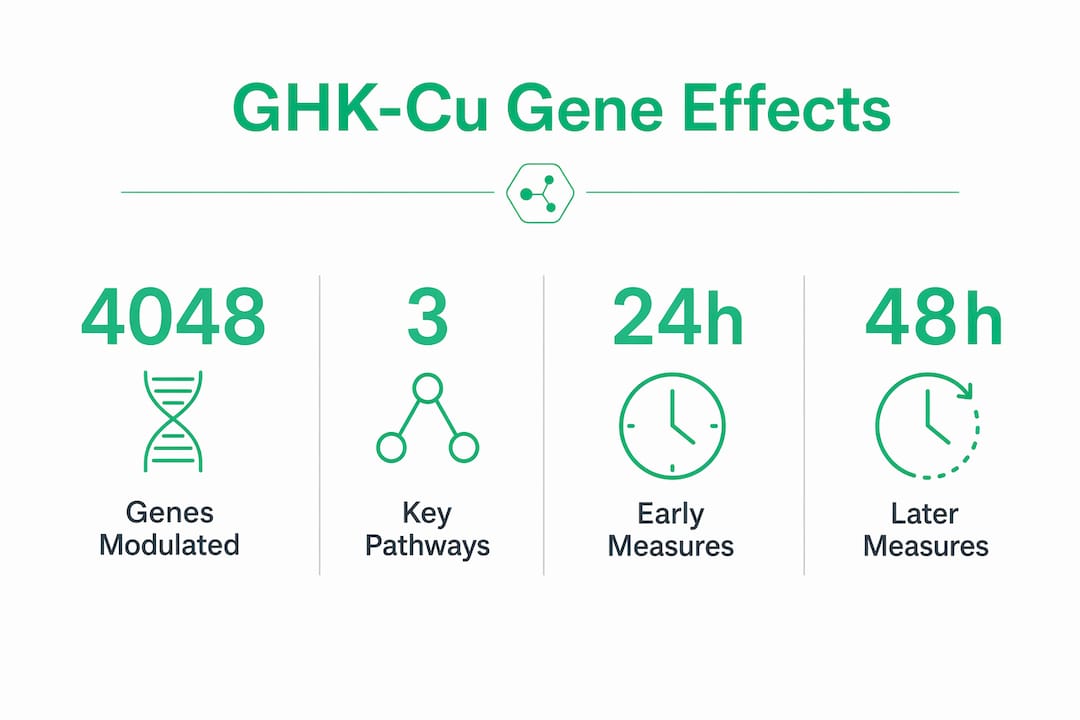
The Broad Institute Connectivity Map (cMap) analysis identified GHK modulation of 4,048 human genes, making transcriptional endpoint selection a critical design decision. Neolabpeptides supplies research-grade GHK-Cu with third-party HPLC and MS verification and COAs documenting ≥98% purity.
Table of Contents
- How does GHK-Cu modulate gene expression?
- What does the preclinical evidence actually show?
- What analytical standards define research-grade GHK-Cu?
- How should you store and reconstitute GHK-Cu in the lab?
- Which assays best measure GHK-Cu activity?
- How do you procure research-grade GHK-Cu in the US?
- Neolabpeptides GHK-Cu: verified purity for your lab
- Key Takeaways
- A practical perspective on GHK-Cu procurement and QC
- Primary sources and recommended reading
How does GHK-Cu modulate gene expression?
GHK-Cu acts pleiotropically: both copper(II) coordination chemistry and direct gene-expression shifts contribute to its biological effects. The cMap transcriptional profiling data are the strongest mechanistic evidence available, linking GHK to reversal of pathological gene signatures across tissues, including COPD-related lung gene expression patterns.
“GHK modulates expression of a very large number of human genes, with significant effects on genes involved in tissue remodeling, antioxidant defense, and anti-inflammatory pathways — a gene expression profile of comparable breadth to no other cosmetic peptide or small molecule.” — Pickart et al., Connectivity Map analysis
The affected pathways include TGF-β signaling, NFκB-driven inflammation, p38 MAPK stress responses, antioxidant gene networks (SOD, glutathione system), DNA repair, and ubiquitin-proteasome function. Copper(II) coordination silences redox activity while delivering non-toxic copper intracellularly, which activates cuproenzymes central to connective tissue formation and antioxidant defense. These two mechanisms are not mutually exclusive; current evidence supports both operating simultaneously.
For experiment design, prioritize NFκB, TGF-β, and antioxidant gene panels as primary readouts. Transcriptional endpoints are more sensitive than single-protein assays when the hypothesis involves pleiotropic effects.
Pro Tip: Run a short RT-qPCR panel (TGF-β1, IL-6, SOD2, COL1A1) at 24 and 48 hours post-treatment before committing to full RNA-seq. This confirms a functional transcriptional response in your specific cell model without the cost of whole-transcriptome profiling.
What does the preclinical evidence actually show?
Multiple in vitro and animal models consistently support wound healing, anti-inflammatory, and antioxidant actions for GHK-Cu, though most evidence remains preclinical.
Key evidence lines:
-
Wound healing (multi-species animal models): GHK-Cu accelerates wound closure, stimulates collagen and glycosaminoglycan synthesis, and improves angiogenesis in rats, mice, rabbits, and pigs. In one ischemic rat wound model, wound size decreased 64.5% in the GHK-Cu group versus 28.2% in untreated controls.
-
cMap gene profiling: Reversal of COPD-related gene signatures in silico, supporting functional restoration hypotheses beyond skin tissue.
-
DSS colitis model (murine, 2025): GHK-Cu reduced TNF-α, IL-6, and IL-1β, improved mucosal healing via SIRT1/STAT3 regulation, and upregulated tight junction proteins ZO-1 and Occludin.
-
Antioxidant in vitro assays: GHK-Cu blocks Cu(2+)-dependent LDL oxidation and quenches reactive carbonyl species including acrolein and 4-hydroxynonenal, outperforming SOD in some assay formats.
“The DSS colitis study represents the first preclinical evidence of GHK-Cu’s therapeutic potential in inflammatory bowel disease, with SIRT1 identified as a molecular target via network pharmacology and molecular docking.” — Frontiers in Pharmacology, 2025
Limitations: Dose ranges vary widely across models, most animal work uses acute rather than chronic exposure, and no controlled human clinical trials exist for injectable or systemic GHK-Cu. Translation from rodent wound models to human tissue remains unvalidated.
What analytical standards define research-grade GHK-Cu?
Research-grade means documented purity and identity via COA with third-party HPLC and MS verification, with a purity target of ≥98%. A 2026 review positions GHK-Cu as a model system for coordination chemistry requiring structural profiling and impurity testing — reinforcing why third-party verification is now a baseline expectation, not a premium add-on.
| COA Field | Passing Value | Flag If |
|---|---|---|
| Reported purity (HPLC) | ≥98% | <98% or no chromatogram attached |
| MS (M+H) or exact mass | Matches theoretical MW | Deviation >1 Da or absent |
| Peptide sequence | Gly-His-Lys confirmed | Sequence not stated |
| Residual solvents | Within ICH Q3C limits | Not reported |
| Water content (Karl Fischer) | Typically <10% for lyophilized | Not reported |
| Counterion | Acetate or TFA stated | Unlisted (affects dosing calculations) |
| Lot/batch number | Present | Absent |
| Expiration/stability | Stated | Absent |
Understanding how to read a COA is the single fastest way to filter out low-quality suppliers before you spend budget on a batch.
Pro Tip: When impurity peaks appear in the HPLC chromatogram, request LC-MS/MS peptide mapping to identify whether they are related-sequence fragments or process-related impurities. Fragment impurities can confound biological assays, particularly at low nanomolar concentrations.
How should you store and reconstitute GHK-Cu in the lab?
Store lyophilized GHK-Cu at −20°C with desiccant; for long-term archival, −80°C is preferred. Reconstitute immediately before use and validate concentration spectroscopically or by mass spec when precision dosing is required.
Reconstitution protocol:
- Equilibrate the vial to room temperature before opening to prevent condensation.
- Add sterile water (preferred) or sterile water with 0.1% acetic acid if solubility is limited. Consult acetic acid reconstitution guidance for concentration-specific notes.
- Add solvent slowly along the vial wall; do not vortex. Gently swirl until fully dissolved.
- Filter-sterilize through a 0.22 µm membrane for cell culture work.
- Aliquot into single-use volumes and store at −20°C. Avoid repeated freeze-thaw cycles.
- Confirm concentration by UV absorbance or analytical HPLC before use.
Working concentration ranges (in vitro):
| Application | Reported Range | Notes |
|---|---|---|
| Fibroblast collagen assays | 0.01–10 nM | Biphasic dose-response common |
| Anti-inflammatory cell models | 0.1–10 µM | Titrate; cytotoxicity check at upper range |
| Antioxidant assays | 1–100 µM | Model-dependent; confirm with pilot |
| Small animal wound models | Per published protocol | IACUC-approved dosing required |
Avoid high-pH buffers (PBS at pH >7.4 can accelerate peptide degradation). Copper chelation by EDTA-containing media will strip the metal and alter activity; use metal-free buffers where possible.
Pro Tip: Run a parallel copper-only control (CuCl₂ at equimolar concentration) in every cell assay. This separates GHK-Cu-specific effects from free copper ion effects, which is a common confound in the literature.
Which assays best measure GHK-Cu activity?
Pair targeted biochemical and cellular assays with transcriptional readouts to capture both immediate and downstream effects. The choice of assay should map directly to the mechanistic hypothesis being tested.
Recommended assay panel:
- Collagen deposition: Sirius Red staining or hydroxyproline quantification in fibroblast or 3D skin models
- Fibroblast migration/wound closure: Scratch assay with time-lapse imaging; 24-hour endpoint standard
- Anti-inflammatory cytokines: ELISA for IL-6, TNF-α, and IL-1β; match to the SIRT1/STAT3 pathway endpoints if using colitis models
- Antioxidant activity: SOD activity assay, glutathione quantification, LDL oxidation inhibition assay
- Gene expression: RT-qPCR panels for TGF-β1, COL1A1, NFκB, SOD2, and IL-6; escalate to RNA-seq for pleiotropic profiling
“Broad transcriptional effects identified via cMap explain GHK-Cu’s pleiotropic regenerative and anti-inflammatory outcomes; labs should pair short functional assays with gene panels to validate activity.” — PMC, Regenerative and Protective Actions of GHK-Cu
Controls: Always include vehicle control, equimolar CuCl₂ control, and a scrambled tripeptide control. For potency verification after receipt, a 24-hour fibroblast migration assay is the fastest functional check.
A lack of effect may reflect incomplete metalation (free GHK rather than GHK-Cu), copper chelation by media components, or peptide degradation from improper storage, not necessarily biological inactivity.
How do you procure research-grade GHK-Cu in the US?
Order lyophilized, COA-backed GHK-Cu from a supplier with documented third-party HPLC and MS verification. Expect standard lead times of 3–7 business days for in-stock material; custom quantities or additional stability testing can extend this to 2–3 weeks.
Procurement checklist:
- COA with third-party HPLC chromatogram and MS data attached
- Reported purity ≥98% and impurity profile documented
- MSDS available before shipment (required by most institutional safety offices)
- Vendor confirms research-use-only status in writing
- IACUC approval obtained before ordering for animal work
- Institutional biosafety review completed if required by your facility
- Shipping temperature confirmed (cold-chain or ambient with desiccant, per vendor spec)
- Billing and purchase order details ready to reduce processing delays
Typical pricing for research-grade GHK-Cu in the US ranges from moderate to premium depending on quantity, purity tier, and whether third-party testing is included in the base price or charged separately. If a COA field is missing or the HPLC chromatogram shows unexplained peaks, request the raw data file and the instrument report before accepting the batch. Suppliers who cannot provide raw chromatograms on request are a procurement risk.
Neolabpeptides GHK-Cu: verified purity for your lab
Neolabpeptides supplies research-grade GHK-Cu in lyophilized form with third-party HPLC and MS verification, COAs documenting ≥98% purity, and MSDS documentation included with every order. Every batch ships with the analytical documentation the procurement checklist above requires: sequence confirmation, batch number, purity percentage, HPLC chromatogram, and MS identity data.

Orders are processed through the Neolabpeptides webshop with fast US shipping. Institutional buyers can contact the team directly for purchase order processing, technical QC questions, or lot-specific documentation requests. The COA provided with each GHK-Cu order satisfies the analytical checkpoints described throughout this guide, from HPLC purity to MS identity confirmation.
Place your order or request lot documentation at neolabpeptides.com.
Key Takeaways
GHK-Cu research requires third-party-verified purity (≥98%), COA documentation, and assay design aligned to the peptide’s pleiotropic gene-modulatory mechanism.
| Point | Details |
|---|---|
| Gene-scale mechanism | GHK-Cu modulates a large number of human genes via cMap profiling; design assays around NFκB, TGF-β, and antioxidant pathways. |
| Analytical minimum | Demand COA with third-party HPLC (≥98% purity) and MS identity confirmation before accepting any batch. |
| Storage and reconstitution | Store lyophilized at −20°C with desiccant; reconstitute in sterile water or 0.1% acetic acid immediately before use. |
| Research-use-only status | GHK-Cu is not approved for human or veterinary use; IACUC and institutional biosafety approvals are required for animal work. |
| Neolabpeptides | Supplies lyophilized GHK-Cu with third-party HPLC/MS verification and COAs documenting ≥98% purity, with fast US shipping. |
A practical perspective on GHK-Cu procurement and QC
The single most common source of failed GHK-Cu experiments is not biology — it is batch quality. Researchers spend weeks troubleshooting dose-response curves that simply reflect a peptide that was never properly metalated or that degraded during shipping.
The fix is straightforward: request the raw HPLC chromatogram file and the MS spectrum for your specific lot before you run a single assay. A PDF summary is not enough. If the copper coordination is incomplete, you are dosing free GHK, which has a different activity profile. Run a small fibroblast migration pilot within 48 hours of receipt. If the assay shows no response at concentrations where the literature reports activity, the problem is almost always the material, not your model.
On the logistics side: provide institutional billing details and any required purchase order numbers at the time of order, not after. This single step removes the most common delay between order placement and shipment. Coordinate shipping windows to avoid weekend arrivals for cold-chain material.
Primary sources and recommended reading
The sources below support the mechanistic, preclinical, and analytical claims in this guide. For experiment design, start with the PMC reviews; for transcriptional endpoint selection, the cMap analysis is the essential reference.
- Mechanism and gene profiling: GHK Peptide as a Natural Modulator of Multiple Cellular Pathways in Skin Regeneration — primary source for the 4,048-gene modulation finding and in vitro concentration ranges
- Pleiotropic actions and cMap: Regenerative and Protective Actions of the GHK-Cu Peptide — best single reference for mechanism, cMap COPD reversal data, and assay design rationale
- Wound healing (animal models): Regenerative and Protective Actions — MDPI — multi-species wound healing data and collagen synthesis endpoints
- Colitis model (SIRT1/STAT3): Frontiers in Pharmacology, 2025 — first preclinical IBD evidence; useful for inflammatory pathway assay design
- Antioxidant endpoints: GHK-Cu and Antioxidant Gene Regulation — MDPI Cosmetics — LDL oxidation and reactive carbonyl assay data
- Analytical standards: GHK-Cu as a Coordination Chemistry Model System — 2026 commentary on structural profiling and impurity testing requirements
- Broad Institute Connectivity Map: Use the cMap database as a next step for labs wanting to profile transcriptional responses against existing GHK gene signatures
- Supplier QA and third-party testing: Peptide third-party testing guide — practical walkthrough of HPLC and MS workflows for research peptide verification
Recommended
This article summarizes published research for informational purposes. Products sold by Neo Lab Peptides are for laboratory research use only and are not intended for human or animal use.