Catch Substituted Batches: Peptide Documentation Control for Labs
September 5, 2026 · STEPHAN ZOHAR

Accept a research peptide only when it arrives with a batch-specific Certificate of Analysis showing an HPLC chromatogram, matching method details, and a mass spectrometry identity result tied to the exact lot on the vial. Confirm the lot number on the label matches the lot on the paperwork, then file the record before the vial goes into the freezer. A COA proves purity and identity under the stated method; it does not prove sterility, human-use suitability, or stability after your shipment sat in transit.
TL;DR:
- Always verify that the lot number on the vial matches the lot number on the COA before accepting a peptide batch.
- Ensure the COA includes a clear chromatogram and mass spectrum, with detailed test method parameters listed for accurate validation.
- Retain a physical sample from each batch and document key data such as retention time, mass, and assay content to enable independent re-testing.
- Avoid relying solely on a purity percentage; instead, cross-check the chromatogram, MS identity, and test date to confirm authenticity.
- Establish a repeatable workflow that links COAs, purchase orders, and physical vials to maintain chain of custody and documentation integrity.
Table of Contents
- What a Peptide COA Should Actually Show You
- How Do You Verify a COA Before Trusting It?
- Building a Documentation Control Workflow for Your Lab
- Chain of Custody: Proving the COA Matches Your Vial
- Your Acceptance Checklist and SOP Language
- Why Single-Number COAs Undersell Reproducibility Risk
- How Neo Lab Peptides Handles Documentation for You
- Sources
What a Peptide COA Should Actually Show You
A Certificate of Analysis is only as useful as what it discloses. A COA that meets minimum documentation standards identifies the peptide name, the batch or lot number, the test date, the testing laboratory, the analytical method, and the results with proper units, backed by a chromatogram or spectrum you can actually inspect.
Each field carries weight for a specific reason:
- Lot/batch ID: ties the paper to the physical vial you received, not a different production run.
- Test date: tells you whether the analysis happened before or after the batch existed (a COA dated before manufacture is a fabrication, not an oversight).
- Testing lab name: anonymous “third-party lab” language with no identifiable name is not verification.
- Method (HPLC/LC-MS/HRMS): without this, the numbers are unfalsifiable.
- Chromatogram/spectrum image: the visual evidence behind the stated purity percentage.
- Assay or net peptide content: distinct from HPLC area-percent, and often lower once salts and residual water are factored in.
- Salt form and residual water/solvent data: TFA counterion content and moisture materially reduce usable peptide mass even when area-percent purity reads high.
HPLC area-percent and mass spectrometry answer different questions entirely. HPLC estimates how much of the sample elutes as the main peak under a given method. It says nothing about what that peak actually is. MS confirms molecular mass and identity, which is why a defensible COA pairs both rather than leaning on one. Method transparency matters too: column type, gradient, detection wavelength (commonly 214 nm), and run time all change what “purity” means, and omitting those parameters makes the area-percent figure difficult to interpret.
How Do You Verify a COA Before Trusting It?
Verification is a sequence, not a single glance at the percentage on page one. Run it in this order every time a shipment arrives:
- Check the lot number on the vial label against the lot number on the COA. Any mismatch stops the process immediately.
- Confirm the COA date falls after the batch’s manufacturing date, and note the testing lab’s name and contact information.
- Look for the chromatogram and, separately, a mass spectrum. A COA with a purity number but no supporting image is a claim, not evidence.
- Run an in-house RP-HPLC check at 214 nm if your lab has the capability, comparing retention time and peak shape against the vendor’s chromatogram.
- Verify mass with your own MS access when available, matching the observed mass against the expected molecular weight.
- Escalate to outside testing when stakes are higher: amino acid analysis (AAA) for absolute quantitation when dosing is stoichiometric, HR-MS/MS when sequence confirmation matters, or endotoxin and sterility testing for anything approaching sterile-use protocols. Pairing RP-HPLC with ESI-MS intact mass confirmation is the reasonable minimum analytical package for most research use, with AAA added when stoichiometry is critical.
Pro Tip: Keep a running log of retention times and peak shapes by peptide and supplier. A sudden shift on an otherwise “identical” COA is often the fastest way to catch a substituted batch before it enters an experiment.
Certain patterns should trigger quarantine on sight. Missing lot numbers, absent chromatograms or spectra, suspiciously round purity numbers (exactly 99% on every batch), identical COAs reused across different lots, and unnamed testing labs all count as documentation failures, not minor gaps. A COA dated before the batch existed is the clearest sign of a copy-paste job rather than a genuine analysis.
Building a Documentation Control Workflow for Your Lab
Verification only protects you if it becomes a repeatable procedure rather than a one-time judgment call. Structure the workflow around intake, quarantine, acceptance, and retention.
On receipt, log the COA against the purchase order and vial lot inside your ELN or LIMS, then label the physical vial with lot number and receipt date before it touches a shelf. Set a quarantine hold as the default state until acceptance criteria are met: matching lot number, chromatogram present, MS identity confirmed, and (when dosing precision matters) assay content documented. Someone with defined authority, typically the lab manager or QC lead, signs off on release rather than leaving acceptance to whoever opens the box.
A minimal metadata schema worth storing per lot includes:
- Peptide name and lot number
- Vendor and COA date
- HPLC method parameters and result
- MS result and observed mass
- Assay/net peptide content, if provided
- Acceptance signature and date
- Storage location and retained-sample reference
Retain the COA, the raw chromatogram file, any independent test results, and version history for as long as the associated data might need defending, which for most research programs means the life of the project plus several years. Restrict write access to COA files so records cannot be silently edited after acceptance, and hold back a small retained sample from each lot in case a re-test becomes necessary later. Linking the COA to the purchase order and vial lot inside your ELN or LIMS closes the loop between paperwork and the physical material sitting in your freezer.
Chain of Custody: Proving the COA Matches Your Vial
A COA is only trustworthy if you can trace an unbroken line from the analytical result to the specific vial on your shelf. That chain runs through four checkpoints: the lot number printed on both the vial and the COA, the invoice referencing that same lot, the shipment record showing when it arrived, and a retained physical sample you could send out for independent re-testing if a result is ever questioned.
Practical habits make this traceable rather than theoretical:
- Scan every COA to PDF immediately and store it with a checksum or hash so the file can’t be altered without detection.
- Name files consistently (peptide, lot, date) so retrieval doesn’t depend on memory.
- Keep retained samples in a separate, labeled quarantine freezer zone, not mixed with active inventory.
- Cross-reference the vendor’s stated testing lab against the lab named on the chromatogram itself.
Batch documentation only earns trust when the testing behind it is independently verifiable. The research peptides are verified through third-party HPLC and mass spectrometry testing at over 98% purity, with a Certificate of Analysis included with every product.
That standard reflects what this article has argued throughout: a purity number without the underlying method, lab identity, and lot match is not documentation, it’s a claim. Retaining a sample and re-testing critical lots independently reduces downstream experimental uncertainty far more than trusting any single COA at face value, no matter how clean the percentage looks.
Your Acceptance Checklist and SOP Language
Paste this directly into your intake procedure or ELN template.
Acceptance checklist:
- Lot number on vial matches lot number on COA
- HPLC chromatogram present, with method parameters listed (column, gradient, wavelength)
- MS identity result present and mass matches expected value
- Assay/net peptide content stated, or documented as not applicable
- Testing lab name and contact information listed
- COA date postdates the batch manufacturing date
SOP snippet: On intake, place the vial in quarantine and log the COA against the PO in the LIMS. Do not release for experimental use until the acceptance checklist is complete and signed by the QC lead. Escalate any failed item to procurement before the material is used.
Email template, missing details: “We received lot [X] but the COA does not include [method parameters/MS result]. Please send the complete chromatogram and MS report for this specific lot before we proceed.”
Email template, suspected reuse: “The COA for lot [X] appears identical to a previous submission for lot [Y]. Please confirm this is a lot-specific analysis or provide a corrected report.”
Why Single-Number COAs Undersell Reproducibility Risk
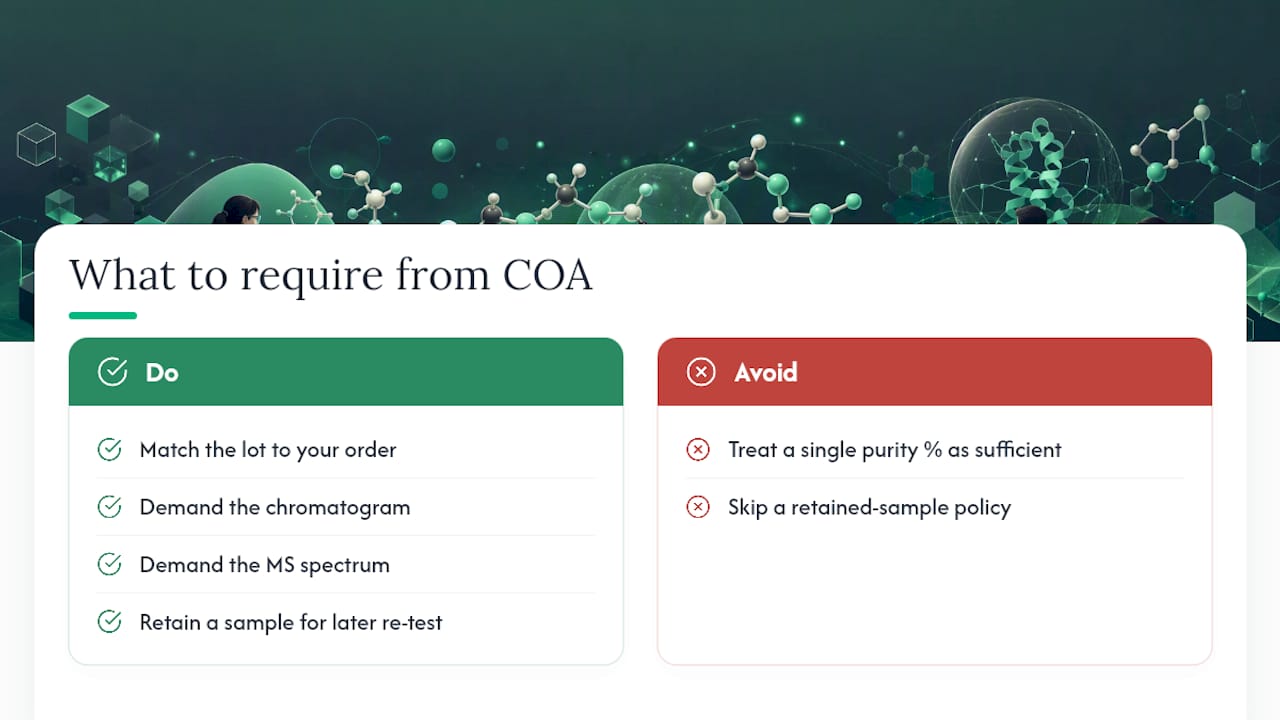
The habit that worries me most in procurement is treating a purity percentage as the whole story.
The fix isn’t complicated. Match the lot, demand the chromatogram and the MS spectrum, and retain a sample so you can re-test when a result looks strange six months later. Our internal guide on reading a peptide Certificate of Analysis walks through this in more depth, and the lot traceability guide covers the retained-sample policy worth adopting before your next high-stakes experiment, not after.
— Stephan
How Neo Lab Peptides Handles Documentation for You
Batch-specific COAs are supplied as standard, not as an upsell.

If a document arrives incomplete or you need an independent confirmation before release, our third-party testing guide outlines how to request additional verification for a specific lot. Browse the current catalog and check documentation availability for any peptide before you order at Neo Lab Peptides, where every listing links back to its batch-specific COA.
Sources
The verification steps in this article draw on established COA-interpretation guidance, including the peptide COA reading guide from PeptideStat, the HPLC versus mass spectrometry breakdown from Compound Review, the complete COA red-flags guide, and the independent verification workflow from Best Peptides For You.
For lab-specific SOP language, three internal resources extend this framework further: the lot traceability and chain-of-custody guide, the breakdown of GMP versus research-grade compliance expectations, and the top quality criteria checklist for GMP-certified peptides, useful when your documentation standards need to scale beyond a single research protocol.
Recommended
This article summarizes published research for informational purposes. Products sold by Neo Lab Peptides are for laboratory research use only and are not intended for human or animal use.