Require 98% Purity and COA: Research Peptides vs SARMs for Labs
September 6, 2026 · STEPHAN ZOHAR

Research peptides are high-purity, lyophilized amino acid sequences supplied with a Certificate of Analysis for studying receptor biology and signaling pathways. SARMs are nonsteroidal androgen receptor ligands used where AR-mediated anabolic response is the experimental variable. Choose peptides when your endpoints track peptide receptor activation; choose SARMs when the pathway under study runs through the androgen receptor. Both classes are strictly research-use-only, not for human or veterinary use.
TL;DR:
- Peptides are ideal for receptor activation studies, while SARMs are suited for androgen receptor-specific anabolic research, with their respective strengths and limitations.
- SARM binding affinities vary widely, but even strong receptor binding does not reliably predict in vivo functional selectivity or clinical efficacy.
- Proper experimental design requires matching compound class to biological endpoints, conducting pilot dose-escalation studies, and aligning sampling timepoints with pharmacokinetics.
- High-purity (98% or above) research-grade peptides and verified documentation are essential to ensure accurate pharmacology and safety in preclinical work.
- Reliable sourcing from suppliers that provide third-party verified Certificates of Analysis reduces variability, improves reproducibility, and is crucial for scientific integrity.
Table of Contents
- Research Peptides vs SARMs: The Molecular and Pharmacologic Divide
- Which Class Fits Your Study Design?
- What Purity and Documentation Should You Demand From a Supplier?
- How Should You Handle and Document These Compounds in the Lab?
- A Researcher’s Decision Checklist for Choosing Between Classes
- Where to Source Verified Research-Grade Peptides
- Sources
Research Peptides vs SARMs: The Molecular and Pharmacologic Divide
The two classes drive downstream biology through entirely different receptor systems, and that distinction shapes every assay decision that follows. Research peptides act on specific peptide receptors (GHRH receptor, growth hormone secretagogue receptor, or tissue-repair pathways depending on the sequence), triggering signaling cascades similar to endogenous ligands. SARMs work by binding the androgen receptor itself, intended to produce tissue-selective anabolic activity in muscle and bone with comparatively less androgenic signaling elsewhere in the body, although selectivity is relative and these effects vary.
Affinity data matters here. Preclinical SARM compounds show androgen receptor binding affinities, expressed as Ki values, ranging from roughly 4 to 37 nanomolar depending on the specific molecule and assay conditions. That range tells you something practical: a low Ki number signals strong receptor binding in vitro, but it doesn’t guarantee the same functional selectivity in a living organism. Coregulator recruitment and pharmacokinetic handling both influence how that binding translates to a whole-animal readout, and selectivity between compounds is relative rather than absolute.
Administration route and pharmacokinetics diverge sharply between the two classes:
- Research peptides are typically administered parenterally in bench and rodent studies, since most sequences degrade rapidly in the gastrointestinal tract; dosing schedules follow the peptide’s biological half-life, often requiring multiple daily doses or continuous infusion protocols.
- SARMs are commonly dosed orally in preclinical work, and several compounds show half-lives in the 12 to 36 hour range, supporting once-daily dosing in early-phase studies.
- Interpretation caveat: functional endpoints (lean mass, organ weight) don’t always track cleanly with receptor-binding data, so pair binding assays with a phenotypic readout before drawing conclusions.
None of the SARM compounds referenced in the literature carries FDA approval for human use, and clinical translation remains incomplete, with early trials reporting modest lean mass gains but limited functional endpoints. That gap between binding data and clinical outcome is exactly why preclinical design has to be rigorous on both fronts.
Which Class Fits Your Study Design?
Matching reagent class to research aim starts with the biological question, not the catalog page. Research peptides suit receptor pharmacology studies, signaling pathway mapping, dose-response curves, and both in vitro and in vivo peptide biology work. SARMs fit AR-specific anabolic models: bone density studies, muscle-wasting and cachexia models, and select oncology models where androgen receptor modulation is the variable under investigation.
A practical framework for structuring the study:
- Define the primary endpoint first — receptor occupancy, downstream phosphorylation, lean mass change, or organ weight — before selecting a compound class.
- Select controls that match the mechanism. Peptide studies need receptor antagonist controls and vehicle-only arms; SARM studies benefit from castrated-rodent models measuring prostate and levator ani muscle weight, a method used to characterize anabolic and androgenic activity in early SARM pharmacodynamics work.
- Run a pilot dose-escalation arm. Peptide degradation kinetics and SARM half-life both argue for a short pilot before committing to a full timepoint schedule.
- Align timepoints to PK/PD, not convenience. A peptide with a short half-life demands earlier sampling than a SARM dosed once daily.
- Build in safety monitoring from day one, particularly for SARM protocols (more on this below).
Pro Tip: Solubility testing before your first dosing day saves weeks. Many lyophilized peptides reconstitute cleanly in bacteriostatic water, but sequence-specific solubility issues (particularly with hydrophobic peptides) can derail a pilot cohort if you discover them mid-study instead of at the bench.
What Purity and Documentation Should You Demand From a Supplier?
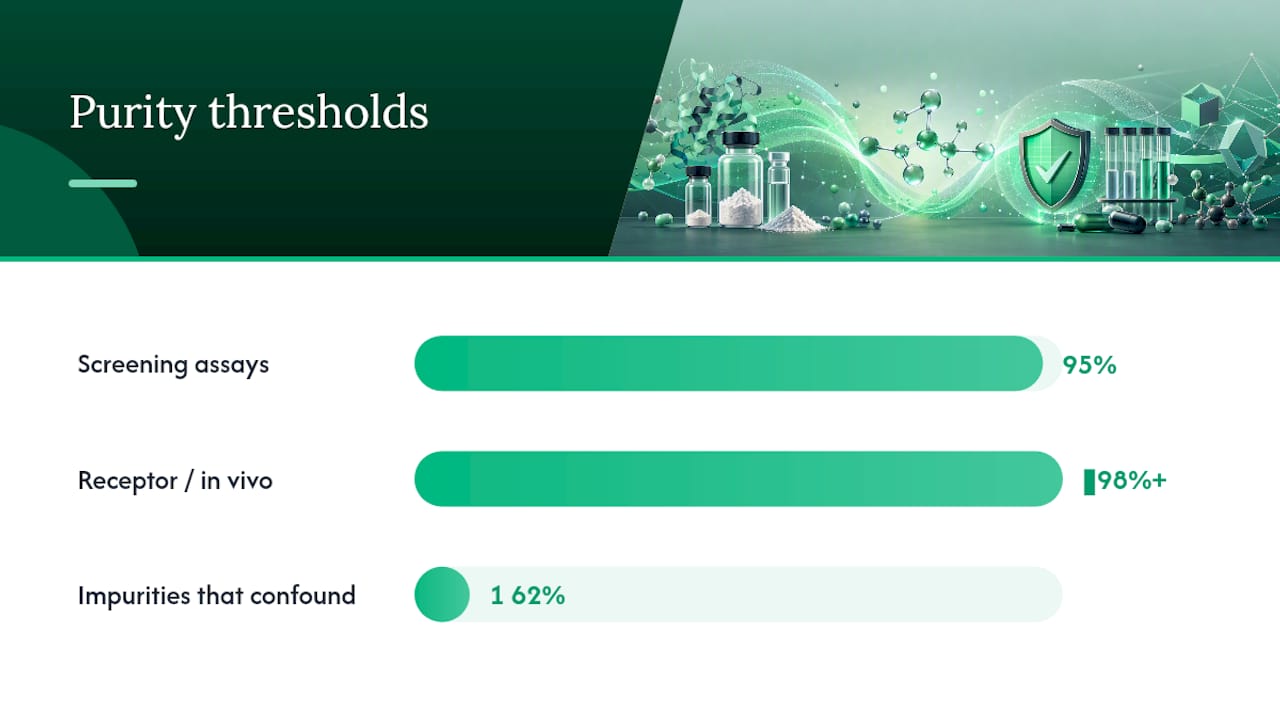
Screening assays can tolerate 95% purity, but receptor pharmacology and in vivo rodent dosing studies warrant 98% or higher, since impurities at even 1 to 2% can confound binding and potency data in critical PK/PD or toxicity work.
Reading a Certificate of Analysis correctly means checking four things every time:
- HPLC purity chromatogram showing a single dominant peak with quantified area percentage.
- Mass spectrometry identity confirmation matching the expected molecular weight.
- Lot number that traces to the specific vial in hand, not a generic product-line reference.
- Storage recommendations and expiration date, since lyophilized peptides degrade differently than solubilized stock.
Third-party verification catches what a supplier’s own internal QC sometimes misses. If a COA is missing spectra, shows an ambiguous lot trace, or lists inconsistent lot numbers across a shipment, treat it as a red flag rather than a paperwork oversight.
That pairing of third-party testing and documentation is what distinguishes research-grade material from consumer-grade product, which typically isn’t manufactured to any comparable audit standard. For a deeper walkthrough of chromatogram interpretation, Neolabpeptides’ guide to reading a peptide COA and its peptide purity guide both cover the mechanics in more depth than a product label ever will.
How Should You Handle and Document These Compounds in the Lab?
Lyophilized peptides need careful reconstitution: use bacteriostatic or sterile water depending on the intended assay, work under sterile technique to avoid contamination, and store reconstituted stock at the manufacturer’s recommended temperature rather than assuming standard refrigeration is sufficient. Unreconstituted lyophilized product typically holds stability far longer than reconstituted solution, so reconstitute only the volume a given experiment needs.
Documentation discipline matters just as much as bench technique:
- Keep MSDS records on file and accessible for every compound in active use; Neolabpeptides outlines where to source and file an MSDS correctly for institutional audits.
- Log lot numbers, COA copies, and receiving dates against every institutional review or animal protocol reference.
- Maintain a disposal record consistent with your institution’s chemical waste policy.
Every compound sold under an RUO label carries the same regulatory boundary: not for human or veterinary use, and not manufactured to clinical GMP standards. That labeling exists specifically so institutional review boards and animal protocol committees know exactly what tier of material they’re authorizing. For SARM protocols specifically, build in liver enzyme monitoring; ALT elevations have been reported at higher SARM doses in preclinical and early clinical dosing work, and histopathology endpoints belong in any systemic dosing design.
A Researcher’s Decision Checklist for Choosing Between Classes
Six steps cut through most of the indecision researchers face when a new protocol lands on the bench:
- Define the biological objective — receptor pathway or AR-mediated outcome.
- Choose the compound class that matches that pathway, not the one that’s cheaper or faster to source.
- Verify purity and COA before the material reaches the bench, not after results come back inconsistent.
- Confirm formulation and delivery route match your PK assumptions.
- Run a pilot cohort and monitor safety signals, especially liver enzymes in SARM work.
- Archive the COA and MSDS against every lot used in a published or reportable result.
I’d add one point the checklist doesn’t capture well: provenance is a research variable, not paperwork. A study is only as reproducible as the material behind it, and a supplier that can’t produce a clean COA on request is a supplier you can’t cite with confidence. Partnering with a verified source shortens procurement cycles and removes a whole category of variability from your QA process before it ever touches a pipette.
— Stephan
Where to Source Verified Research-Grade Peptides

Unlike suppliers who publish purity claims without third-party backing, some suppliers provide documented COAs for each lot that can be checked against bench standards before opening the vial. Some suppliers handle bulk orders and custom synthesis inquiries directly for compounds outside the standard catalog. For background reading before you order, the peptide third-party testing guide and the research-grade peptide guide to Tesamorelin, MGF, and Ipamorelin both walk through application-specific selection in more detail. All products are sold strictly for laboratory research and are not approved for human or veterinary use. Visit Neolabpeptides to request a COA for a specific lot or start a bulk order for your next study.
Sources
- Selective androgen receptor modulators in preclinical and clinical development
- Selective Androgen Receptor Modulators - LiverTox - NCBI Bookshelf
- Pharmacodynamics of Selective Androgen Receptor Modulators
- Frequently Asked Questions About Research Peptides
Recommended
This article summarizes published research for informational purposes. Products sold by Neo Lab Peptides are for laboratory research use only and are not intended for human or animal use.