Choose PES Over 0.2 vs 0.22 Obsession: Sterile Filtration for Peptide Labs
September 4, 2026 · STEPHAN ZOHAR

A 0.22 µm sterile filter is the standard lab method for removing bacteria from heat-sensitive aqueous solutions such as cell culture media, buffers, and reconstituted peptides. It’s classified as sterilizing-grade because it retains Brevundimonas diminuta under a defined challenge test, not simply because of its pore size. It will not reliably remove most viruses, endotoxin, or every mycoplasma species, so solutions with those specific risks need a tighter membrane or a different technology altogether.
TL;DR:
- A 0.22 µm filter is classified as sterilizing-grade only after passing a bacterial challenge test with Brevundimonas diminuta; pore size alone does not guarantee complete removal of all microbes.
- Manufacturer validation of bacterial retention is more critical than the exact pore size rating, and membrane material choice significantly affects filtration performance and chemical compatibility.
- The primary limitation of 0.22 µm filtration is its inability to remove viruses and endotoxin, requiring additional purification steps for endotoxin-sensitive or virus-contaminated samples.
- Proper technique, including gentle pressure and pre-wetting of the membrane, is essential to avoid filter rupture and ensure sterility, especially with viscous or particulate-laden solutions.
- Post-filtration handling, such as immediate transfer into sterile vials and proper storage, is vital to maintain sample sterility and stability over time.
Table of Contents
- What Does “Sterile Filtration 0.22 Micron” Actually Mean?
- When Should You Use 0.22 Micron Filtration, and Where Does It Fall Short?
- How Do You Use a 0.22 Micron Syringe Filter Correctly?
- How Is Sterilizing-Grade Filtration Performance Validated?
- Choosing and Troubleshooting Your 0.22 Micron Filter
- How a peptide supplier supports sterile filtration workflows
- Post-Filtration Handling: Keeping Your Sample Sterile After the Filter
- How Long Do Filtered Solutions Stay Stable?
- Common Contaminants That Compromise Filtration Efficacy
- What Regulatory Standards Govern Sterile Filtration?
- An Honest Take on What Actually Matters Here
- Sources
What Does “Sterile Filtration 0.22 Micron” Actually Mean?
The number on the box is a functional rating, not a literal hole size. Membranes carry a distribution of pore diameters, and a filter earns its “sterilizing-grade” label only after passing a microbial challenge test using Brevundimonas diminuta, a bacterium chosen specifically because it’s small and stubborn enough to expose weak membranes. The industry standard for this challenge requires demonstrated bacterial retention, which is why two filters rated “0.22 µm” from different manufacturers can still perform slightly differently depending on membrane chemistry and construction.
You’ll also see filters marketed as 0.2 µm. In practice, these labels are often used interchangeably because pore size ratings reflect microbial retention performance rather than one fixed diameter. Don’t assume a 0.2 µm product is automatically finer than a 0.22 µm one from the same category. What matters is whether the manufacturer backs the rating with actual bacterial challenge data.
Membrane material is where the real differences show up:
- PES (polyethersulfone): Low protein-binding and the default recommendation for peptide and protein solutions, since it minimizes sample loss during filtration.
- PTFE: Best suited for organic solvents and aggressive chemicals that would degrade other membranes.
- PVDF: A middle ground, tolerant of many solvents while still offering moderate low-binding performance.
- Nylon: Common for aqueous samples but generally higher protein binding than PES, which makes it a weaker choice for dilute peptide solutions.
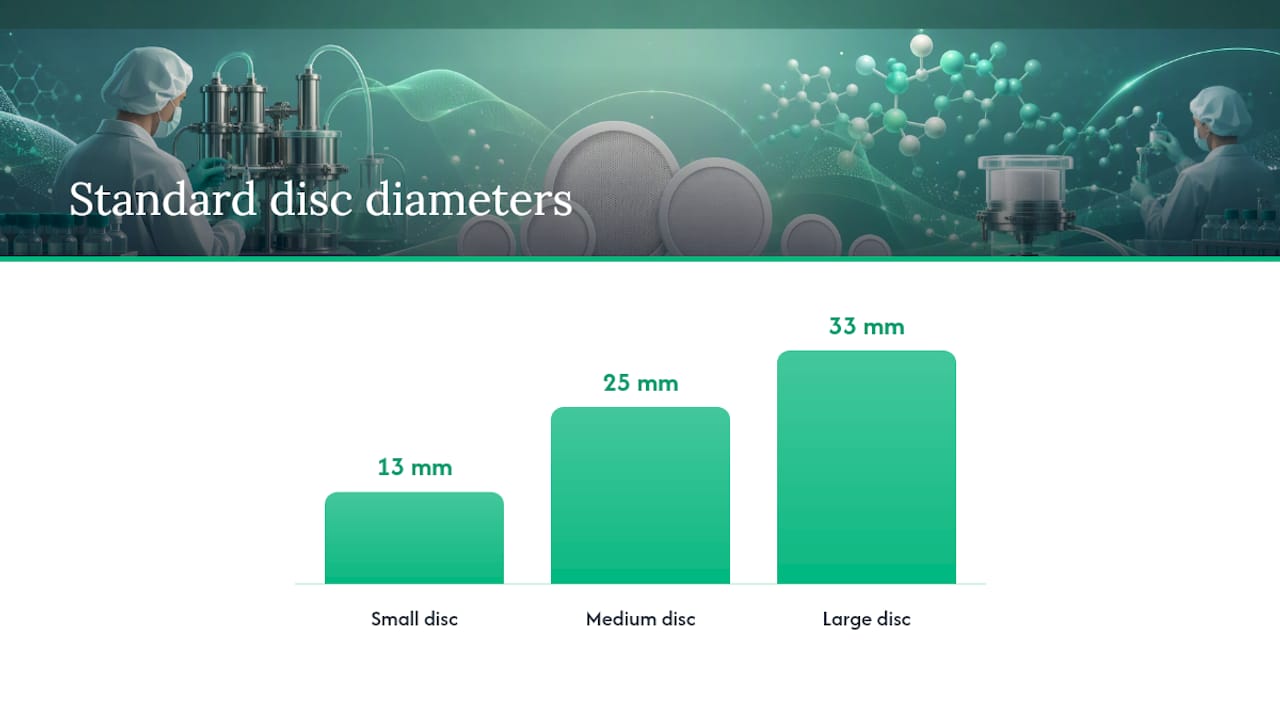
Standard disc diameters run 13 mm, 25 mm, and 33 mm, with luer lock or luer slip connections depending on your syringe. Smaller diameters suit low-volume peptide reconstitution; larger discs handle bigger buffer or media batches with less clogging. Most units ship individually packaged and sterilized for single use, with hold-up volume (the small residual liquid trapped in the housing) worth checking if you’re working with precious microgram-scale peptide quantities.
When Should You Use 0.22 Micron Filtration, and Where Does It Fall Short?
Sterile filtration earns its place in the workflow specifically because heat destroys what you’re trying to prepare. Autoclaving works fine for glassware and buffers that can tolerate 121°C, but cell culture media, sera, and peptide solutions denature or degrade under that kind of thermal stress. Filtration sterilizes without heat, which is why it’s the default step for:
- Cell culture media and supplements
- Reconstituted peptide solutions
- Protein and buffer solutions sensitive to temperature
- Fetal bovine serum and other biological sera
- Small-volume parenteral formulations prepared in research settings
The limitation researchers most often overlook: a 0.22 µm membrane retains bacteria, but most viruses and endotoxin pass straight through it. Endotoxin molecules are far smaller than the pore rating, and many viral particles are too. If your application specifically requires virus clearance or endotoxin removal, you need nanofiltration, ultrafiltration, or affinity-based removal steps layered on top, not a finer syringe filter.
Particulate load is the other practical constraint. Solutions with visible haze, precipitate, or particulates from lyophilized cake residue will clog a 0.22 µm membrane fast. A quick pre-filtration step through a coarser membrane (0.45 µm or a glass fiber prefilter) before the sterilizing step saves both filters and frustration.
How Do You Use a 0.22 Micron Syringe Filter Correctly?
Technique matters as much as the filter itself. Sloppy handling introduces the exact contamination you’re trying to eliminate, and heavy-handed pressure can rupture the membrane outright.
What you need before you start:
- A sterile disposable syringe, sized appropriately for your solution volume
- A sterile receiving vial, ideally pre-labeled to avoid mix-ups
- A 0.22 µm PES syringe filter (single-use, individually packaged)
- A clean, disinfected work surface, or a biosafety cabinet if your protocol calls for it
The procedure:
- Open the filter’s sterile packaging only when you’re ready to use it. Don’t pre-stage it on an open bench.
- Draw your peptide solution or buffer into the sterile syringe, avoiding contact between the needle and any non-sterile surface.
- Attach the syringe filter to the syringe tip using a firm luer connection.
- If the manufacturer recommends priming, push a small amount of solution through first to wet the membrane before collecting your actual sample.
- Depress the plunger with steady, gentle pressure. Don’t force it. Excessive force is the leading cause of membrane rupture and pressure spikes, which can compromise sterility instantly.
- Collect the filtrate directly into your sterile receiving vial, keeping the outlet tip away from any surface.
- Discard the filter after a single use. Reusing a syringe filter reintroduces contamination risk and degrades membrane performance on the second pass.
Never touch the membrane face or the outlet nozzle with your fingers, and stop immediately if you feel resistance building rather than pushing harder.
Pro Tip: For low-volume peptide solutions, pre-wetting the PES membrane with a small volume of buffer before filtering your actual sample reduces nonspecific binding losses and improves flow, since a dry membrane tends to adsorb more peptide on first contact than one that’s already saturated.
How Is Sterilizing-Grade Filtration Performance Validated?
Manufacturers don’t get to call a filter “sterilizing-grade” on pore size alone. The benchmark is a microbial challenge test using Brevundimonas diminuta, and reputable manufacturers validate their sterilizing-grade claims against a bacterial retention challenge at a standardized organism concentration. This is the detail worth checking before you trust a vendor’s claim on a datasheet, not just the printed pore size.
Beyond the challenge test, a proper specification sheet should list:
- Maximum operating pressure and differential pressure limits, since exceeding these is a common cause of membrane failure
- Extractables data, particularly relevant if you’re filtering into a formulation destined for sensitive downstream assays
- Recommended solvent compatibility, which tells you whether PES, PTFE, or PVDF is the right call for your specific solution
- Bacterial retention/challenge test data, ideally with the organism and log reduction value stated explicitly
In larger-scale peptide processing runs, continuous monitoring of flow rate and pressure through inline sensors reduces the risk of undetected membrane damage and improves batch consistency. For syringe-scale bench work this level of instrumentation isn’t necessary, but the underlying principle holds: pressure control is a quality control step, not just a convenience.
Keep the Certificate of Analysis and filter datasheet on file with your batch records. If a vendor can’t produce bacterial challenge data on request, treat that as a red flag rather than an oversight.
Choosing and Troubleshooting Your 0.22 Micron Filter
Selecting the right filter starts with your sample, not the catalog page. Match membrane chemistry to solution composition first: aqueous peptide and protein solutions call for PES, solvent-based samples call for PTFE or PVDF, and anything with visible particulate needs a prefilter step regardless of final membrane choice.
| Sample condition | Recommended action |
|---|---|
| Aqueous peptide/protein solution | PES membrane, low protein-binding |
| Organic solvent present | PTFE or PVDF for chemical compatibility |
| Visible particulate or haze | Prefilter (0.45 µm or glass fiber) before sterilizing filtration |
| High-viscosity peptide concentration | Dilute, or apply shear-reduction step before filtering |
Low flow and pressure spikes are usually the same underlying problem: the membrane is clogging faster than the solution can pass through, and pushing harder just accelerates rupture risk. Reducing applied force at the first sign of resistance prevents most membrane failures before they happen. If you’re consistently fighting resistance on a particular sample type, switch to a larger disc diameter or add a prefilter rather than forcing the same 13 mm unit.
Viscous peptide solutions at higher working concentrations present a specific problem: they may resist syringe filtration entirely at standard pressure. Pre-shear treatment or dilution followed by re-filtration can make a viscous formulation passable without bursting the membrane, and this is worth building into your protocol upfront if you routinely work with concentrated stocks.
Pro Tip: A slightly larger disc diameter costs marginally more per unit but often pays for itself in reduced clogging and fewer failed filtration attempts, especially with samples that carry any particulate load.
How a peptide supplier supports sterile filtration workflows
Every peptide Neolabpeptides ships arrives lyophilized with a Certificate of Analysis backed by third-party HPLC and mass spectrometry verification, giving you a documented purity baseline before you ever reach for a filter. That baseline matters: filtration removes microbial contamination, but it doesn’t compensate for a peptide that wasn’t verified at 98%+ purity to begin with.
Our reconstitution and vial handling guide walks through aseptic technique for the reconstitution step that typically precedes filtration, and our peptide purity reference covers how purity metrics interact with downstream sample integrity. Between verified starting material and disciplined filtration technique, researchers get a sterile, reliable solution ready for the bench.
Post-Filtration Handling: Keeping Your Sample Sterile After the Filter
The filter’s job ends the moment your filtrate hits the collection vial. From there, sterility is entirely a function of your handling discipline.
Collect filtrate directly into a pre-sterilized vial and cap it immediately. Don’t leave a filtered sample sitting open on the bench “for a minute” while you grab something else. Every second of open-air exposure is a chance for airborne contamination to undo the work the filter just did. If you’re transferring the filtrate to a secondary container, do it inside a biosafety cabinet or laminar flow hood, not on an open countertop.
Label the vial immediately with filtration date, solution identity, and concentration. This sounds obvious, but mislabeled or unlabeled sterile stock is one of the most common sources of downstream confusion in shared lab freezers.
Avoid repeated freeze-thaw cycles on filtered stock. Each cycle introduces both a physical stress on the peptide structure and a fresh opportunity for contamination every time the vial is opened.
If you’re aliquoting a single filtered batch into multiple smaller vials, do the entire aliquoting session in one aseptic sitting rather than reopening the master vial repeatedly over days or weeks. Every additional open-and-close cycle on a “sterile” stock vial chips away at the sterility you just achieved.
How Long Do Filtered Solutions Stay Stable?
Sterile filtration removes microbial risk, but it doesn’t stop chemical degradation. A peptide solution can be perfectly sterile and still lose potency over time from hydrolysis, oxidation, or aggregation, none of which a 0.22 µm membrane has any bearing on.
Stability depends heavily on the specific peptide, the buffer system, concentration, and storage temperature. As a general pattern, reconstituted peptide solutions held at 2 to 8°C tend to remain usable for days to a couple of weeks, while frozen storage at -20°C or below extends usable life considerably longer for most research peptides. Some peptides are notably less stable in solution than others regardless of storage conditions, so always default to the manufacturer’s specific stability guidance rather than a generic rule of thumb.
Watch for signs a filtered solution has degraded beyond usability: visible turbidity or precipitate forming in a solution that was clear after filtration, unexpected color change, or a pH drift from your original reading. Any of these suggest chemical breakdown or contamination, even if the solution was filtered correctly at the outset.
Document your reconstitution and filtration date on every vial. Retrospectively figuring out how old a “mystery vial” is defeats the entire purpose of maintaining a sterile, traceable research workflow. A reconstitution guide with clear volume and concentration tracking makes this bookkeeping far less error-prone than tracking it by memory.
Common Contaminants That Compromise Filtration Efficacy
Not every contamination risk originates outside the vial. Even visually clear, high-purity solutions can carry microscopic contaminants shed from stoppers, vial walls, or packaging materials, which is exactly why sterile filtration functions as a final safety layer rather than a redundant step for “clean-looking” solutions.
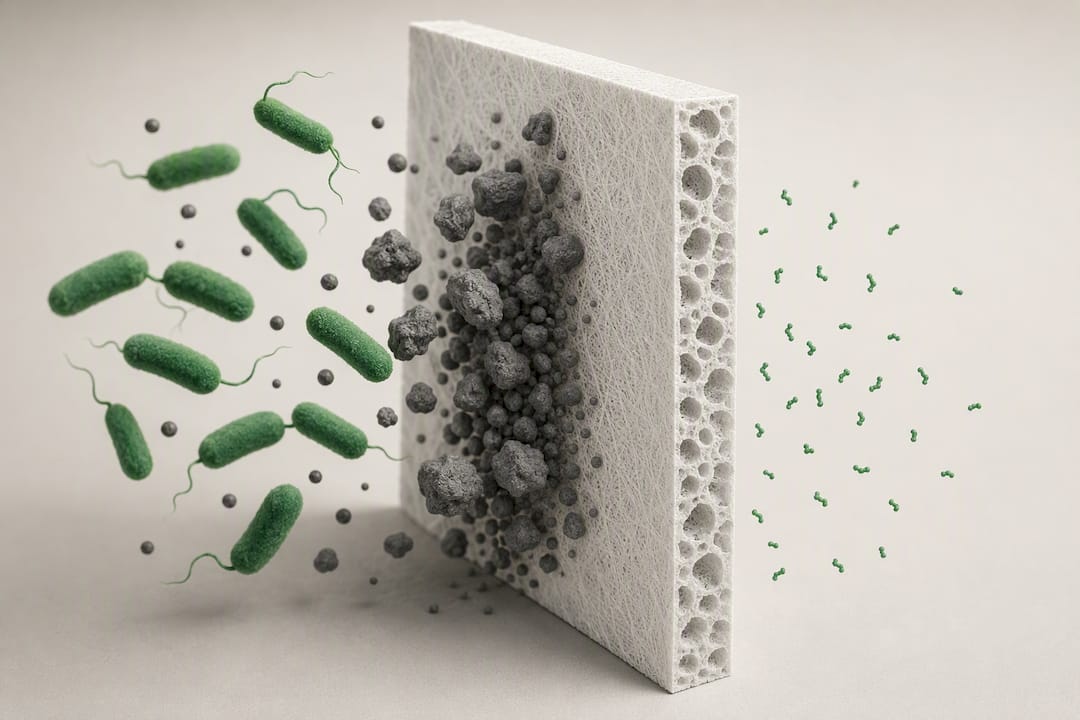
Bacterial contamination is the primary target of 0.22 µm filtration, and it’s also the contaminant most likely to originate from poor aseptic technique during reconstitution rather than from the source peptide itself. A contaminated needle tip, an improperly disinfected stopper, or an open vial exposed to room air for too long can all introduce bacterial load that filtration then has to catch.
Particulate matter is the most common cause of reduced filtration efficacy, not because it slips through the membrane, but because it clogs it. Lyophilized peptide cake that hasn’t fully dissolved, glass or rubber particulate shed from stoppers, or precipitated buffer salts can all build up on the membrane surface and reduce effective flow well before the rated volume capacity is reached.
Endotoxin deserves particular attention because it’s invisible to standard filtration and invisible to the eye. It originates from gram-negative bacterial cell walls and persists even after the bacteria themselves are filtered out, since 0.22 µm membranes are not designed or validated to remove endotoxin. If your application is endotoxin-sensitive, that requires a dedicated depyrogenation step, not a filtration workaround.
What Regulatory Standards Govern Sterile Filtration?
Sterile filtration in research and pharmaceutical settings operates against a backdrop of established guidance, even when individual research labs aren’t formally regulated the same way manufacturing facilities are.
The FDA’s guidance for sterile drug products produced by aseptic processing treats filtration validation, including bacterial challenge testing, as a core expectation for any process claiming sterility. The United States Pharmacopeia maintains chapters addressing sterilization and filtration validation that inform how manufacturers substantiate sterilizing-grade claims on their datasheets. The European Medicines Agency applies parallel expectations under its own guidance on manufacturing sterile medicinal products, with similar emphasis on validated bacterial retention rather than pore size alone.
For research-only laboratory use, these frameworks aren’t directly enforced the way they would be in pharmaceutical manufacturing. But they set the technical baseline that reputable filter manufacturers design against, and they’re the reason a bacterial challenge test using Brevundimonas diminuta remains the universal benchmark referenced on legitimate product datasheets. When evaluating a supplier’s sterile filtration claims, checking whether their validation language mirrors this established framework is one of the fastest ways to separate a well-documented product from a vague marketing claim.
An Honest Take on What Actually Matters Here
Most of the discussion around 0.22 µm filtration fixates on pore size precision, as if the difference between 0.2 and 0.22 were the make-or-break variable. It isn’t. The bacterial challenge validation behind the rating matters far more than the second decimal point, and researchers who obsess over 0.2 versus 0.22 while ignoring membrane chemistry are optimizing the wrong variable.
The bigger, less-discussed risk sits in technique, not spec sheets. A properly rated PES filter used with excessive plunger force will fail the same way a cheaper membrane would. Sterility assurance is a system: verified starting material, the right membrane for the solution, gentle and steady technique, and disciplined post-filtration handling. Skip any one link and the others don’t compensate.
If you take one thing from this beyond the procedure itself, prioritize membrane material over brand loyalty. PES exists specifically because peptide and protein researchers kept losing sample to protein-binding membranes that were never designed for their solutions. That single choice, made correctly at the start, prevents more downstream headaches than any amount of pressure fine-tuning during the filtration step itself.
— Stephan
Sources
- Sterilization by liquid filtration: How it works and when to use it — Tuttnauer
- Defining a pore size and sterile filtering: 0.2 microns vs 0.22 microns — Sterlitech
- Peptide bioprocessing: Proteins and peptides (application note) — PendoTech
Recommended
This article summarizes published research for informational purposes. Products sold by Neo Lab Peptides are for laboratory research use only and are not intended for human or animal use.