
Peptide vials are specialized glass containers designed to store lyophilized peptides securely for laboratory research, preserving molecular integrity from production through experimental use. Standard vials use USP Type I borosilicate glass, sealed with a rubber stopper and aluminum crimp cap, to protect the freeze-dried contents from moisture, oxygen, and contamination. Researchers working in drug development, diagnostics, and mass spectrometry depend on vial integrity as the first line of defense against peptide degradation. Neolabpeptides supplies lyophilized research peptides, including IPAMORELIN, BPC-157, and CJC-1295, in sealed vials verified by HPLC and mass spectrometry, each accompanied by a Certificate of Analysis.
What are the standard peptide vial sizes?
Common peptide vial sizes are 2 mL and 3 mL, with 5 mL and 10 mL formats used for larger payload experiments. The 3 mL borosilicate glass vial is the most widely used format in research labs because it fits standard autosampler racks and minimizes headspace, reducing oxygen exposure to the lyophilized powder. Vial selection depends on peptide quantity, expected reconstitution volume, and whether the vial will be used as a single-dose or multi-dose container.
The table below summarizes the most common formats and their typical research applications.
| Vial size | Typical peptide payload | Common use case |
|---|---|---|
| 2 mL | 1–5 mg | Single-dose research compounds |
| 3 mL | 2–10 mg | Standard multi-dose research vials |
| 5 mL | 5–20 mg | Higher-volume peptide experiments |
| 10 mL | 10–50 mg | Bulk or long-term study protocols |
Borosilicate glass resists chemical interaction with peptide compounds, making it the material of choice over soda-lime glass. The rubber stopper allows needle penetration without full vial opening, preserving sterility across multiple withdrawals. Aluminum crimp caps lock the stopper in place and provide a tamper-evident seal that confirms the vial has not been compromised before use.
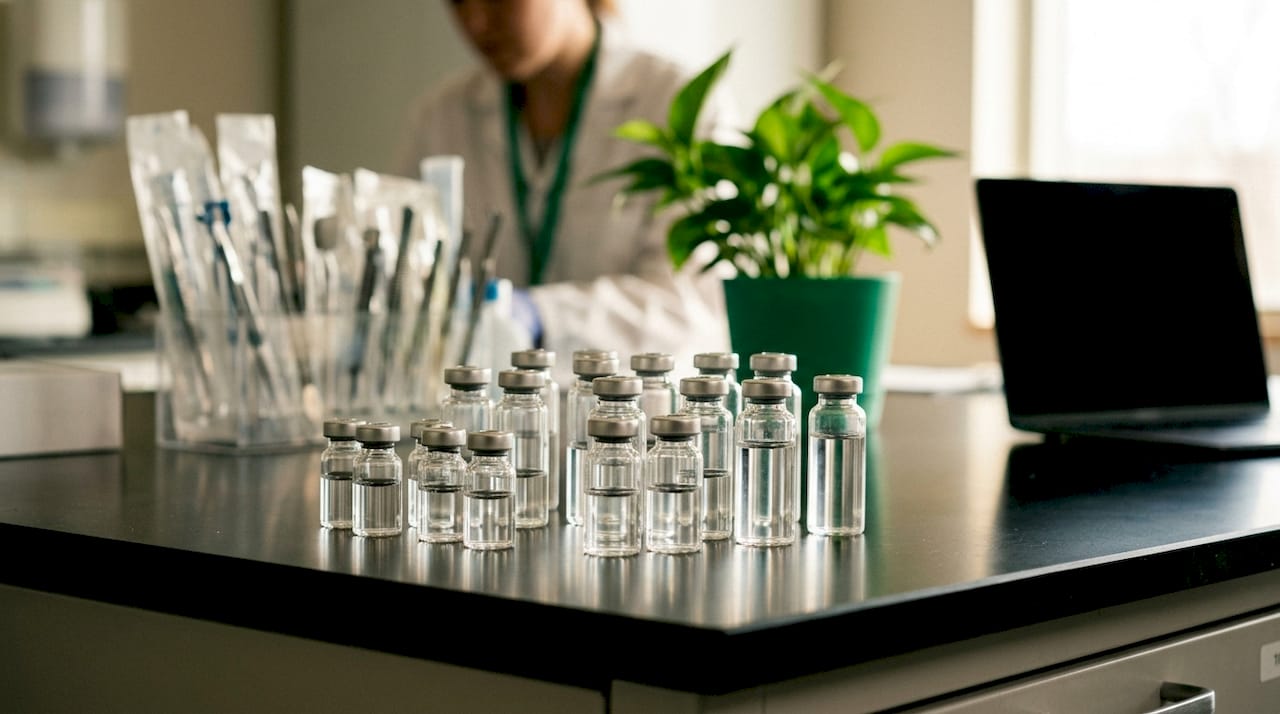
Pro Tip: When selecting a vial size, choose the smallest format that accommodates your full reconstituted volume. Excess headspace increases oxygen contact and accelerates oxidative degradation of sensitive peptide sequences.
What is inside a peptide vial?
Lyophilized peptide powder is the primary contents of a research vial. Lyophilization, or freeze-drying, removes water from the peptide solution under vacuum, leaving a dry, stable powder that resists microbial growth and chemical breakdown far longer than a liquid formulation.
Powder appearance does not reliably indicate peptide mass because manufacturers add bulking agents like mannitol during freeze-drying to maintain the structural integrity of the dried cake. A vial containing 5 mg of active peptide may look identical to one containing 2 mg. This means visual estimation of dosage is unreliable and researchers must rely on labeled quantities and third-party documentation.
Verifying vial contents before use requires reviewing the Certificate of Analysis (COA). A valid COA reports purity by HPLC, confirms molecular identity by mass spectrometry, and lists the exact peptide quantity per vial. Neolabpeptides includes a COA with every product. Researchers unfamiliar with interpreting these documents can consult the guide on reading a peptide COA to confirm purity values and batch-specific data before beginning an experiment.
Key indicators of vial integrity before reconstitution:
- Crimp cap is fully seated with no visible gaps or deformation
- Rubber stopper shows no discoloration, cracking, or prior puncture marks
- Lyophilized cake is intact, not collapsed or discolored
- Label matches COA batch number and peptide name
- Vial has been stored at the temperature specified on the label
How do you reconstitute a peptide vial?
Reconstitution is the process of adding a liquid diluent to lyophilized peptide powder to produce a solution ready for experimental use. The diluent choice and addition technique directly determine whether the peptide retains its biological activity.
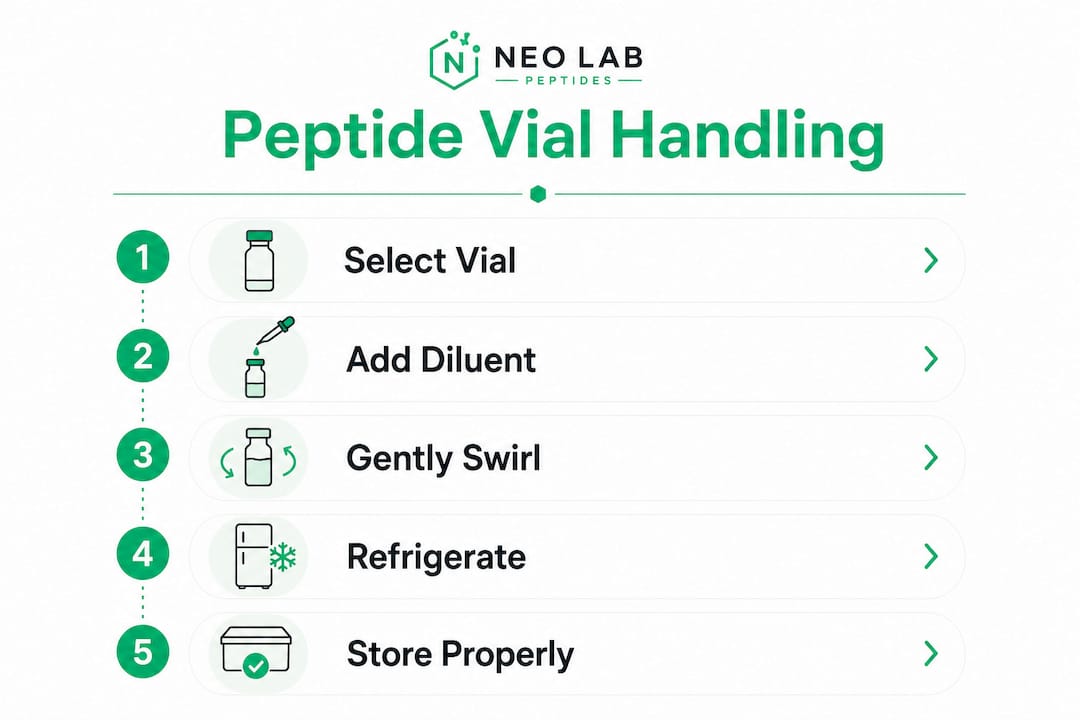
Bacteriostatic water is the preferred diluent for multi-dose vials because it contains 0.9% benzyl alcohol, which inhibits bacterial growth and extends the usable life of the reconstituted solution. Sterile water is acceptable for single-use vials but offers no antimicrobial protection once the stopper is punctured. Neolabpeptides offers USP-grade bacteriostatic water specifically formulated for peptide reconstitution.
The reconstitution process, step by step:
- Remove the vial from cold storage and allow it to reach room temperature. This prevents condensation from forming inside the vial when the cold glass contacts warmer diluent.
- Wipe the rubber stopper with a 70% isopropyl alcohol swab and allow it to dry completely before needle insertion.
- Draw the calculated volume of bacteriostatic water into an 18–23 gauge needle syringe for reconstitution.
- Insert the needle at a slight angle through the stopper and position the tip so it points toward the inner vial wall, not directly at the powder.
- Add diluent slowly down the vial wall, not directly onto the powder cake. Rapid injection denatures peptide compounds by mechanical disruption.
- Withdraw the needle and gently swirl the vial in a circular motion. Do not shake. Shaking introduces air bubbles and can fragment peptide chains.
- Inspect the solution for clarity. A properly reconstituted peptide solution is clear and colorless or faintly yellow. Cloudiness indicates incomplete dissolution or contamination.
- Switch to a 29–31 gauge insulin syringe for withdrawing the reconstituted solution for experimental use.
Pro Tip: If the powder does not dissolve fully after gentle swirling, place the vial in a refrigerator for 15 minutes and swirl again. Temperature-assisted dissolution works better than prolonged agitation at room temperature.
Concentration calculation follows a straightforward formula. Divide the total peptide mass in micrograms by the total diluent volume in milliliters to get micrograms per milliliter. For example, 5 mg (5,000 mcg) dissolved in 2 mL produces a concentration of 2,500 mcg/mL. Each 0.1 mL withdrawal then delivers 250 mcg.
What are the best storage conditions for peptide vials?
Storage conditions determine how long a peptide vial remains viable for research. Lyophilized peptides are not indefinitely stable. Temperature fluctuations are the primary cause of molecular degradation even in freeze-dried form. Consistent temperature is more protective than simply achieving a cold target.
| Storage state | Temperature | Expected stability |
|---|---|---|
| Lyophilized, unopened | -20°C to -80°C | Years (manufacturer-specified) |
| Lyophilized, opened | 2°C to 8°C | Weeks (use promptly) |
| Reconstituted, refrigerated | 2°C to 8°C | 4–5 weeks |
| Reconstituted, frozen | -20°C | Months (avoid repeated freeze-thaw) |
Reconstituted peptides stored under refrigeration have a typical shelf life of 4–5 weeks. This window assumes consistent temperature, minimal light exposure, and proper sterile technique at each withdrawal. Exceeding this window risks both potency loss and microbial growth.
Multi-dose vials have a beyond-use date of 28 days after the first puncture, regardless of remaining volume. Write the puncture date directly on the vial label with a permanent marker at the time of first use. Discard the vial on day 28 even if solution remains.
Repeated freeze-thaw cycles degrade peptide samples faster than continuous refrigeration. Aliquoting the reconstituted solution into smaller volumes before freezing minimizes potency loss. Each aliquot is thawed once and discarded after use, protecting the remaining stock.
What are the most common peptide vial handling errors?
Contamination is the primary risk in non-clinical peptide handling. Proper sterile technique requires cleaning vial stoppers with alcohol wipes before every needle insertion and maintaining hand hygiene throughout the process. Skipping either step introduces microbial contamination that compromises experimental results.
Stopper coring is a less-discussed but significant problem. It occurs when a needle cuts a small plug of rubber from the stopper during insertion, depositing particulate matter into the vial contents. Using 18–23 gauge needles for reconstitution and inserting at a slight bevel-up angle reduces coring risk substantially.
Do’s and don’ts for peptide vial handling:
- Do verify the COA before use, confirming HPLC purity and mass spectrometry identity
- Do use bacteriostatic water for any vial that will be accessed more than once
- Do label every vial with the reconstitution date, concentration, and discard date
- Do store vials away from light sources, including UV-emitting lab fixtures
- Don’t shake a reconstituted vial. Swirl gently instead
- Don’t mix incompatible solvents such as acetic acid with peptides that require neutral pH buffers
- Don’t use a vial if the solution appears cloudy, particulate, or discolored
- Don’t re-freeze a thawed aliquot. Discard it after the experiment
Cloudy solutions after reconstitution indicate one of three problems: incomplete dissolution, peptide aggregation from rapid diluent addition, or contamination. Incomplete dissolution resolves with refrigeration and gentle swirling. Aggregation and contamination require discarding the vial and starting fresh.
Key Takeaways
Proper peptide vial handling requires correct diluent selection, slow reconstitution technique, consistent cold storage, and strict sterile practice at every step.
| Point | Details |
|---|---|
| Vial size selection | Choose the smallest vial that fits your full reconstituted volume to limit oxygen exposure. |
| Diluent choice | Use bacteriostatic water for multi-dose vials; it contains 0.9% benzyl alcohol to prevent bacterial growth. |
| Reconstitution technique | Add diluent slowly down the vial wall and swirl gently. Never inject directly onto the powder or shake the vial. |
| Storage and discard dates | Reconstituted peptides last 4–5 weeks refrigerated; multi-dose vials must be discarded 28 days after first puncture. |
| Quality verification | Always review the COA for HPLC purity and mass spectrometry confirmation before beginning any experiment. |
What I’ve learned from years of watching researchers handle peptide vials
The most consistent mistake I see is not in reconstitution technique or storage temperature. It is in sourcing. Researchers spend considerable effort on protocol precision, then undermine it by using peptides from suppliers who provide no third-party verification. A vial labeled “5 mg” from an unverified source may contain 3 mg of active compound, 1 mg of degraded peptide, and 1 mg of unidentified impurity. No reconstitution protocol corrects for that.
The second most common error is treating lyophilized peptides as indefinitely stable. Researchers pull vials from a -20°C freezer that have been there for two years with no documentation of storage conditions, no record of freeze-thaw events, and no COA review. The powder looks fine. It may not be fine. Stability is a function of time, temperature consistency, and initial purity, not appearance.
I also see researchers underestimate how much reconstitution technique affects results. Injecting diluent directly onto the powder cake at speed is the single fastest way to produce a partially denatured solution that looks fully dissolved. The vial passes a visual check and fails the experiment. Slow addition down the vial wall takes an extra 30 seconds. That 30 seconds is worth protecting months of experimental design.
My recommendation is to build a simple checklist for every vial interaction: source verification, COA review, stopper inspection, diluent selection, reconstitution technique, labeling, and storage confirmation. Reproducibility in peptide research depends on consistency at each of these steps, not just the ones that feel important.
— Stephan
Research-grade peptide vials from Neolabpeptides
Neolabpeptides provides lyophilized research peptides verified at over 98% purity through third-party HPLC and mass spectrometry testing. Every order ships with a Certificate of Analysis, giving researchers the documentation they need to confirm compound identity and purity before any experiment begins.

The catalog includes peptides like BPC-157 10mg, Ipamorelin 10mg, and Sermorelin 5mg, all supplied in sealed vials with fast US shipping. Researchers who need a reliable, documented source for research-grade compounds can review the full catalog at Neolabpeptides. All products are for laboratory research purposes only and are not approved for human or veterinary use.
FAQ
What type of glass is used in research peptide vials?
USP Type I borosilicate glass is the standard material for research peptide vials. It resists chemical interaction with peptide compounds and withstands temperature changes without cracking.
How long do reconstituted peptides last in a vial?
Reconstituted peptides stored at 2°C to 8°C have a typical shelf life of 4–5 weeks. Multi-dose vials must be discarded 28 days after the first puncture regardless of remaining volume.
Why is bacteriostatic water better than sterile water for peptide vials?
Bacteriostatic water contains 0.9% benzyl alcohol, which inhibits bacterial growth in multi-dose vials. Sterile water offers no antimicrobial protection after the stopper is first punctured.
How do I know if a peptide vial has been compromised?
Inspect the crimp cap for gaps, the stopper for prior puncture marks, and the reconstituted solution for cloudiness or particulate matter. Always cross-reference the vial label against the COA batch number before use.
What causes peptide degradation in storage?
Temperature fluctuations are the primary cause of peptide molecular degradation, even in lyophilized form. Repeated freeze-thaw cycles, light exposure, and moisture also accelerate breakdown.
Recommended
This article summarizes published research for informational purposes. Products sold by Neo Lab Peptides are for laboratory research use only and are not intended for human or animal use.