Reconstituting Peptides Calculator: A Lab Guide for 2026
July 11, 2026 · STEPHAN ZOHAR

A reconstituting peptides calculator is a mathematical tool that converts lyophilized peptide mass and solvent volume into exact concentrations, dose volumes, and syringe units for laboratory use. Researchers working with peptides like BPC-157, IPAMORELIN, or GLP-1 analogs depend on this type of tool to eliminate manual calculation errors that compromise experimental reproducibility. The standard industry term is “peptide reconstitution calculator,” though “reconstituting peptides calculator” describes the same function. Precision here is not optional. A miscalculated concentration propagates through every downstream dose, invalidating data across an entire experimental run.
How does a reconstituting peptides calculator work?
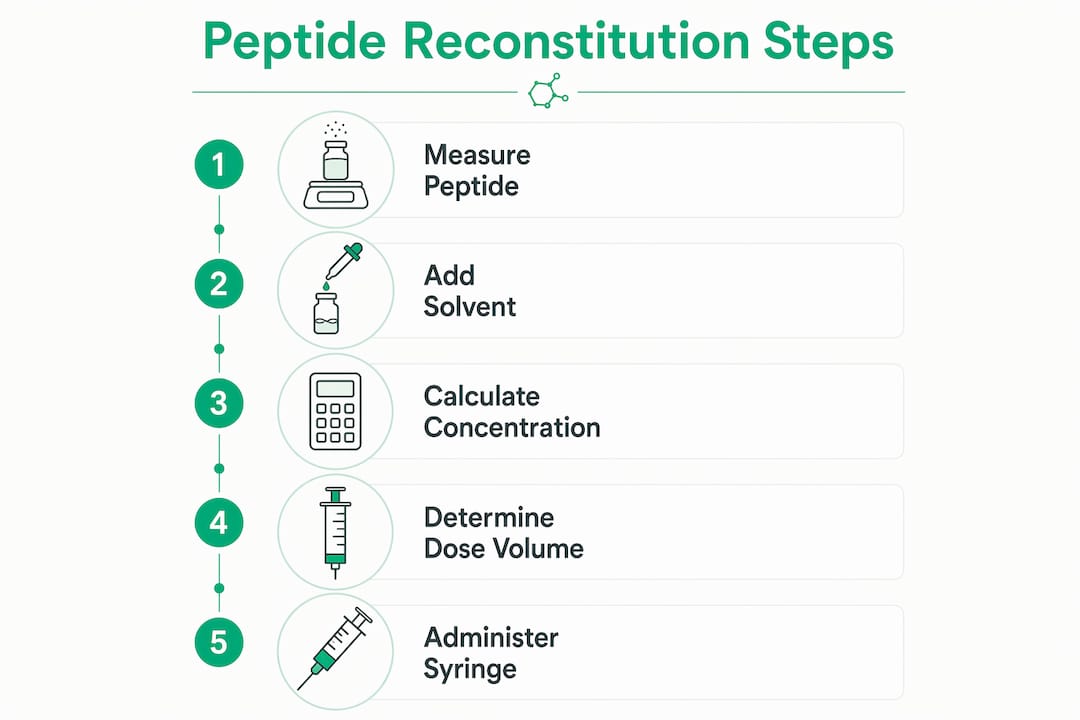
The core formula is straightforward: concentration equals peptide mass divided by solvent volume. If you reconstitute a 5 mg vial with 2 mL of bacteriostatic water, the resulting concentration is 2.5 mg/mL. Every downstream dose calculation depends on this single number being correct.
From there, the calculator converts your target dose into a syringe draw volume. The standard syringe formula is: Syringe Units = (Target Dose ÷ Concentration) × 100, assuming a U-100 insulin syringe where 1.0 mL equals 100 units. A 250 mcg dose from a 2.5 mg/mL solution equals 10 units on the syringe scale. That is a draw of just 0.10 mL, a volume that requires precise syringe selection to measure accurately.
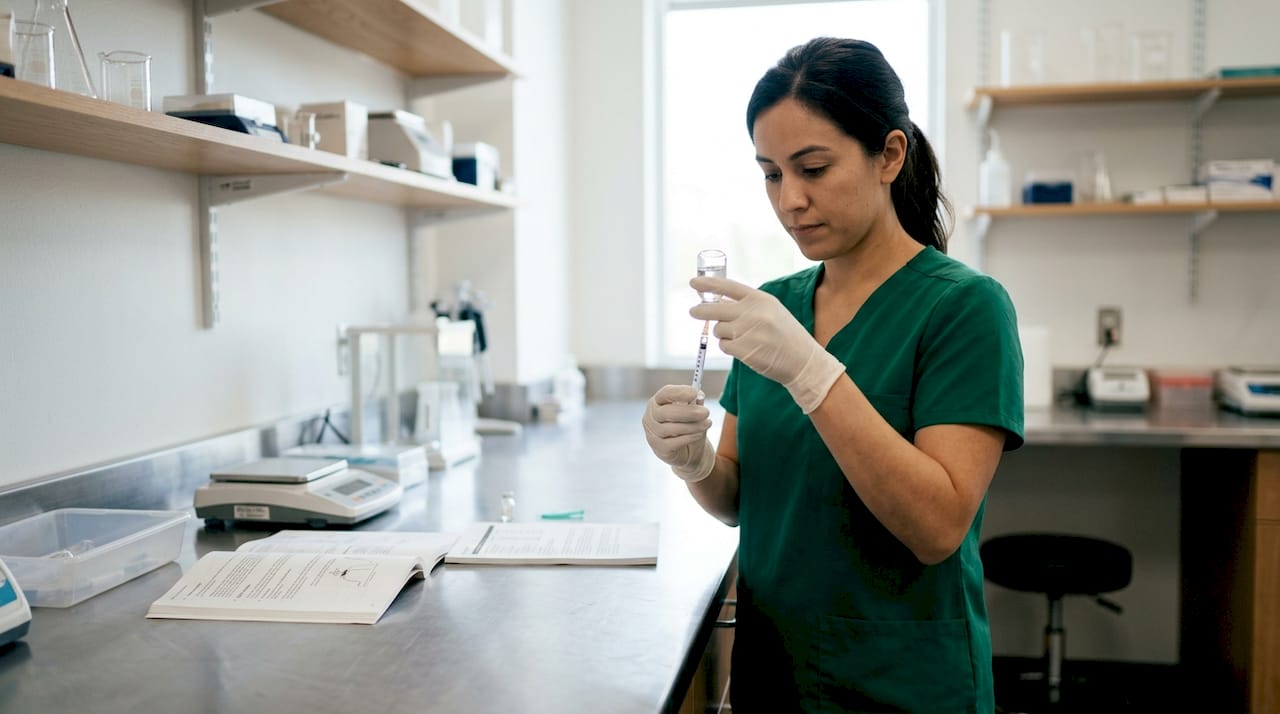
The calculator also handles unit conversions automatically. Peptide mass is typically listed in milligrams (mg) on the vial, while target doses are often expressed in micrograms (mcg). One mg equals 1,000 mcg. A dosage calculator for peptides must account for this conversion before outputting a syringe reading, or the result will be off by a factor of 1,000.
The table below shows how solvent volume affects concentration and the resulting syringe draw for a fixed 250 mcg dose from a 5 mg vial.
| Solvent volume | Concentration | 250 mcg dose (syringe units) |
|---|---|---|
| 1 mL | 5.0 mg/mL | 5 units |
| 2 mL | 2.5 mg/mL | 10 units |
| 5 mL | 1.0 mg/mL | 25 units |
| 10 mL | 0.5 mg/mL | 50 units |
Lower solvent volumes produce higher concentrations and smaller draw volumes. Higher solvent volumes spread the dose across more syringe units, which can improve measurement resolution for small doses.
Pro Tip: When using a peptide concentration calculator, always enter mass in the same unit throughout. Convert everything to mcg before calculating, then verify the output against the syringe scale you are actually using.
Why is precise peptide reconstitution critical in experimental research?
Concentration stability is the single most important quality parameter in peptide reconstitution. A stable, repeatable concentration is the cornerstone of dosing accuracy and experimental integrity in 2026 lab protocols. Without it, dose-response relationships become unreliable and cross-experiment comparisons lose validity.
Errors in reconstitution do not stay contained. If you add 1.8 mL of solvent instead of 2.0 mL, your concentration rises from 2.5 mg/mL to 2.78 mg/mL. Every subsequent dose drawn at “10 units” now delivers 11% more peptide than intended. Over a multi-week study, that systematic error distorts every data point.
“Accurate peptide reconstitution is critical because errors in concentration propagate to dosing, affecting experimental reproducibility and data validity. 2026 protocols emphasize stable, repeatable concentration as a critical quantitative step.”
A peptide dosing chart calculator helps researchers plan full experimental runs before opening a single vial. For example, a 5 mg vial with a 0.5 mg dose yields exactly 10 experimental doses. Knowing this upfront prevents mid-study shortfalls that force researchers to reconstitute a second vial at a potentially different concentration.
Common mistakes that compromise reconstitution accuracy include:
- Adding solvent too quickly, which can cause foaming and peptide degradation
- Failing to let the lyophilized cake fully dissolve before drawing a dose
- Using non-sterile or non-bacteriostatic water, which introduces contamination risk
- Measuring solvent volume with a graduated cylinder instead of a calibrated syringe
- Skipping vortex or gentle swirl steps, leaving concentration gradients in the solution
- Not recording the reconstitution date, leading to use of degraded solutions
Each of these errors introduces variability that no calculator can correct after the fact.
How do syringe size and solvent volume affect dosing precision?
Syringe selection directly determines how accurately you can execute a calculator’s output. U-100 insulin syringes come in three sizes: 0.3 mL (30 units), 0.5 mL (50 units), and 1.0 mL (100 units). Smaller syringes provide finer graduation marks and reduce relative measurement error for small draw volumes.
The trade-off is practical. A 0.3 mL syringe is ideal for draws under 15 units but cannot accommodate larger doses. A 1.0 mL syringe covers the full range but introduces more measurement uncertainty at low volumes because each graduation represents a larger absolute volume.
Choosing solvent volume involves a direct trade-off: higher volume improves syringe draw resolution but increases total solution volume, which may not suit all experimental designs. A researcher working with a 5 mg vial and a 100 mcg dose should use 5 mL of bacteriostatic water to produce a 1.0 mg/mL concentration, yielding a 10-unit draw on a 0.3 mL syringe. That draw is easy to read accurately.
| Syringe size | Total units | Best for | Minimum readable draw |
|---|---|---|---|
| 0.3 mL | 30 units | Doses under 15 units | ~1 unit |
| 0.5 mL | 50 units | Doses 10–40 units | ~1–2 units |
| 1.0 mL | 100 units | Doses 20–80 units | ~2–3 units |
The 0.3 mL syringe is the most precise option for small-volume peptide research. Researchers using GLP-1 analogs or other compounds requiring sub-milligram doses should default to this size whenever the draw volume permits.
Pro Tip: Reconstitute with a volume that places your target dose between 10 and 30 units on the syringe. This range gives you enough graduation marks to read accurately without requiring a larger syringe.
What are the best practices for verifying calculator results in the lab?
Calculator outputs are mathematical estimates. Lab notebook verification remains essential despite calculator convenience, and researchers must independently verify dosing for sensitive protocols. The calculator tells you what to draw. Your physical technique determines what you actually deliver.
Start by reviewing the Certificate of Analysis (COA) for every peptide vial before reconstitution. The COA confirms the actual peptide content, which may differ slightly from the labeled amount. Neolabpeptides includes HPLC and mass spectrometry verified COAs with all products, giving researchers a verified starting mass for their calculations. Reading the COA correctly before entering values into a dosage calculator for peptides prevents errors from the very first step.
Syringe dead space and transfer losses are frequently overlooked. Best practice is calculating a slight excess to compensate for minor losses during transfer. A standard approach is to prepare 5–10% more volume than the experiment requires, accounting for dead space in the needle hub and any residual solution left in the vial.
Recommended verification steps for every reconstitution:
- Weigh the vial before and after adding solvent to confirm the volume added
- Cross-reference the calculator output with a manual calculation using the concentration formula
- Record the reconstitution date, solvent volume, and resulting concentration in a lab notebook
- Draw a test volume and check it against the syringe scale under good lighting before the first dose
- Store reconstituted peptide at the temperature specified in the COA and note the expiration window
Physical verification and documentation complement calculator use and reflect best practices in laboratory reliability. No digital tool replaces the discipline of a well-kept lab record.
Key Takeaways
A peptide reconstitution calculator produces accurate results only when researchers input verified peptide mass, use calibrated solvent volumes, and select the correct syringe size for the target draw volume.
| Point | Details |
|---|---|
| Core formula | Concentration equals peptide mass divided by solvent volume; all downstream doses depend on this value. |
| Syringe unit conversion | Use the U-100 formula: Syringe Units = (Target Dose ÷ Concentration) × 100 for accurate draws. |
| Syringe size selection | Match syringe size to draw volume; 0.3 mL syringes give the highest precision for small doses. |
| COA verification | Always confirm actual peptide content from the COA before entering values into any calculator. |
| Dead space accounting | Prepare 5–10% excess volume to compensate for syringe dead space and transfer losses. |
Why I trust the calculator but never skip the manual check
Researchers who use a peptide reconstitution calculator for the first time often make the same mistake: they treat the output as the final answer. I have seen this lead to systematic dosing errors that only surface when results fail to replicate across cohorts. The calculator is correct when the inputs are correct. That is the entire constraint.
The most underappreciated variable is solvent volume accuracy. Researchers who add bacteriostatic water by eye, or who use a large-bore syringe with poor graduation resolution, introduce errors before the calculator even runs. A 10% volume error at reconstitution becomes a 10% concentration error, which becomes a 10% dose error on every single draw. That compounds across a study.
What actually changed my practice was starting to weigh vials before and after solvent addition. A calibrated analytical balance catches volume errors that a visual check misses entirely. Paired with a COA review and a manual concentration check, this takes under three minutes and eliminates the most common source of downstream variability.
The other thing worth stating plainly: syringe selection is not a minor detail. Researchers who draw 5 units on a 1.0 mL syringe are reading a mark that represents 0.05 mL. On a 0.3 mL syringe, that same mark is far easier to read with confidence. The best peptide calculator workflow ends with the right syringe in your hand, not just the right number on a screen.
— Stephan
Neolabpeptides: research-grade peptides built for accurate reconstitution
Accurate calculator results depend on knowing the exact peptide mass in your vial. Neolabpeptides supplies research-grade lyophilized peptides verified at over 98% purity via HPLC and mass spectrometry, with a COA included for every product. That verified mass is the number your dosing calculator needs to produce reliable outputs.

Neolabpeptides also stocks USP grade bacteriostatic water in 10 mL vials, the standard solvent for peptide reconstitution in US research labs. For researchers working with BPC-157 or other high-demand research peptides, the full catalog is available at Neolabpeptides, with fast US shipping and third-party verified documentation on every order.
FAQ
What is a peptide reconstitution calculator?
A peptide reconstitution calculator is a tool that converts lyophilized peptide mass and solvent volume into concentration, dose volume, and syringe units. It applies the formula: concentration = mass ÷ volume, then outputs the corresponding U-100 syringe draw.
How many units do I draw for a 250 mcg dose?
The draw depends on your concentration. A 5 mg vial reconstituted with 2 mL of bacteriostatic water gives 2.5 mg/mL; a 250 mcg dose equals 10 units on a U-100 syringe.
Which syringe size gives the best dosing accuracy?
The 0.3 mL U-100 syringe provides the highest resolution for small draw volumes, making it the best choice for doses under 15 units.
Does the calculator replace lab verification?
No. Online peptide calculators provide mathematical estimates but do not replace physical verification; researchers must confirm inputs via COA review and manual cross-checks.
Why does solvent volume matter so much?
Solvent volume sets the concentration, which determines every syringe draw in the experiment. A volume error at reconstitution creates a proportional dosing error across all subsequent doses.
Recommended
This article summarizes published research for informational purposes. Products sold by Neo Lab Peptides are for laboratory research use only and are not intended for human or animal use.