
A peptide testing kit is a specialized analytical tool used to quantify or verify peptides and peptide-tagged proteins in biomedical and biochemical research workflows. These kits apply assay formats including colorimetric, fluorometric, and lateral flow technologies to deliver fast, reproducible results without requiring complex instrumentation. For researchers working with synthetic peptides, recombinant proteins, or proteomics samples, selecting the right peptide analysis kit directly affects data quality and experimental reproducibility. Neolabpeptides supplies research-grade peptides verified by HPLC and mass spectrometry, making reliable testing methods a natural part of any rigorous lab workflow.
What assay types are used in peptide testing kits?
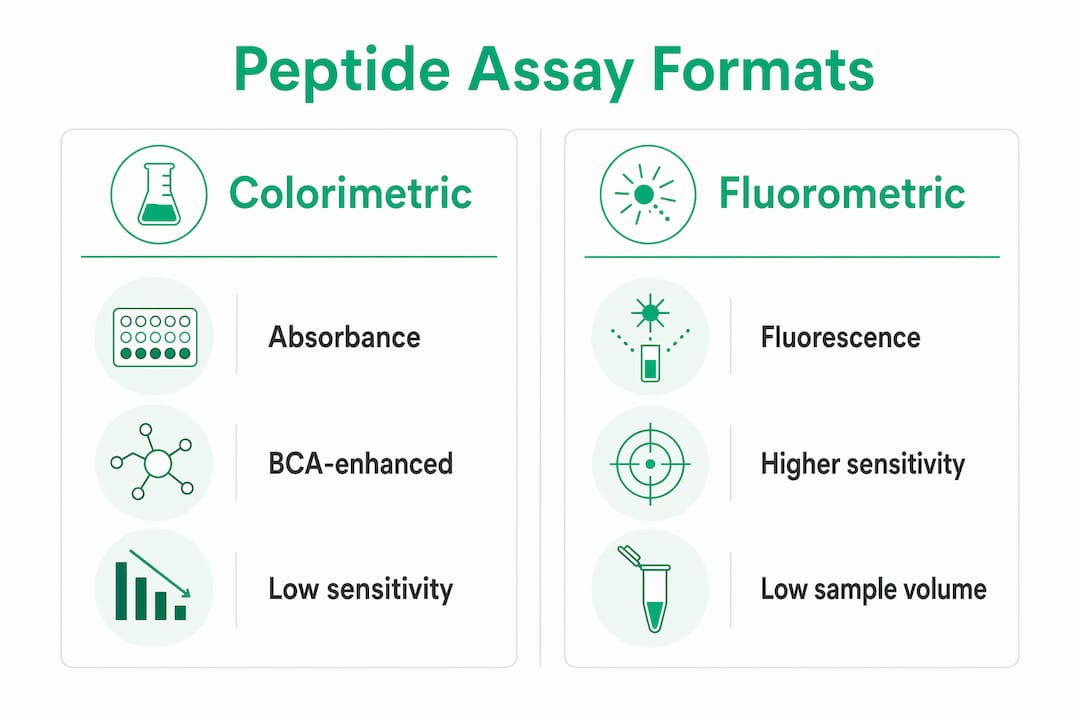
Three core assay formats define the peptide testing kit market: colorimetric, fluorometric, and lateral flow. Each format suits different experimental priorities, from high-throughput quantification to rapid qualitative screening.
Colorimetric assays
Colorimetric assays use enhanced BCA-based chemistry to detect peptides through absorbance measurements. Enhanced BCA-based kits deliver 3–4 fold higher absorbance signals than standard BCA protocols, with sensitivity down to 25 μg/mL in 15 minutes. That sensitivity level makes colorimetric formats well suited for complex peptide digests and pre-LC-MS quantification. These kits require only 20 µL of sample, which matters when working with limited biological material.
Fluorometric assays
Fluorometric assays detect peptides at lower concentrations than colorimetric methods. Fluorometric peptide kits achieve a linear detection range of 5–1,000 μg/mL, with signals stabilizing within 5 minutes and remaining stable for hours. That stability window gives researchers flexibility in reading plates without time pressure. Fluorometric formats also show broad compatibility with mass spectrometry sample prep buffers, which reduces the need for buffer exchange steps before analysis.
Lateral flow test strips
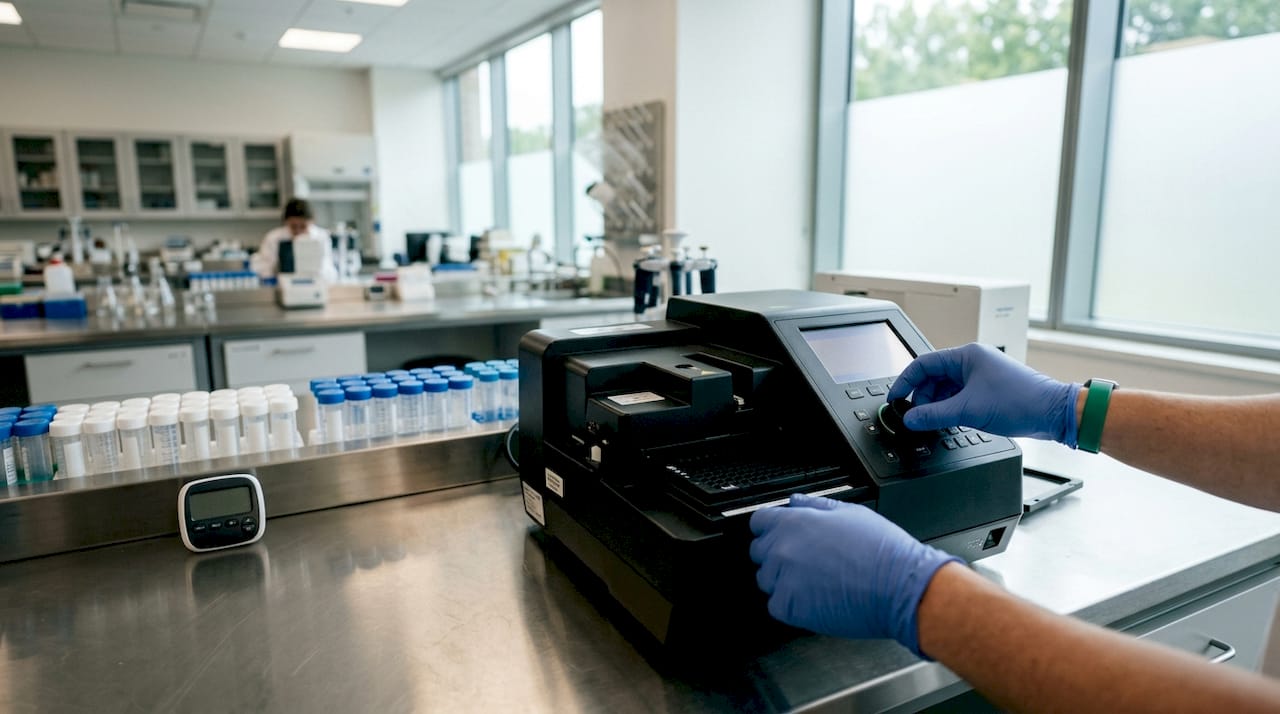
Lateral flow peptide test strips provide qualitative or semiquantitative results in under 3 minutes without any instrumentation. Rapid lateral flow strips detect epitope-tagged proteins such as myc, HA, and His tags at detection limits around 0.2 µM for 50 kDa proteins. These strips work directly with crude cell lysates, clarified lysates, and culture supernatants, eliminating complex sample preparation. They are the fastest option for confirming protein expression during purification workflows.
| Assay type | Detection limit | Time to result | Best use case |
|---|---|---|---|
| Colorimetric (BCA-enhanced) | 25 μg/mL | 15 minutes | Pre-LC-MS quantification, complex digests |
| Fluorometric | 5 μg/mL | 5–10 minutes | High-throughput quantitation, MS prep |
| Lateral flow strips | ~0.2 µM (50 kDa) | Under 3 minutes | Rapid tag verification, expression screening |
Pro Tip: Choose fluorometric over colorimetric when your sample volume is limited and your detection range spans multiple orders of magnitude. Choose lateral flow when you need a pass/fail answer in under 5 minutes.
How to select the best peptide testing kit for your needs
Kit selection depends on matching assay performance characteristics to your specific experimental requirements. The wrong format wastes reagents and introduces variability that undermines downstream analysis.
Key selection criteria include:
- Sensitivity and detection range. Fluorometric kits cover 5–1,000 μg/mL. Colorimetric kits start at 25 μg/mL. If your samples fall below 25 μg/mL, colorimetric formats will not give reliable readings.
- Sample volume requirements. Colorimetric BCA-enhanced kits require as little as 20 µL per reaction. Low-volume formats protect scarce biological samples.
- Buffer and matrix compatibility. Many peptide quantification kits tolerate common buffers including PBS, Tris, acetonitrile, and formic acid without additional processing. Confirm compatibility before committing to a kit format.
- Assay duration. Lateral flow strips deliver results in under 3 minutes. Colorimetric assays complete in 15 minutes. Fluorometric assays stabilize within 5 minutes. Match assay duration to your workflow pace.
- Quantitative vs. qualitative output. Lateral flow strips confirm presence or absence. Colorimetric and fluorometric formats generate concentration values. Choose based on whether your experiment requires a number or a decision.
- Reproducibility in high-throughput settings. Kits with defined internal standards and calibration curves perform more consistently across plates and operators. This matters most in differential proteomics and biomarker discovery studies.
Understanding how to read a certificate of analysis for your peptide standards also helps you verify that starting material quality matches kit specifications before you begin.
Pro Tip: Always run a matrix-matched standard curve using your actual sample buffer. A standard curve prepared in water will produce inaccurate concentration readings when your samples contain acetonitrile or detergents.
How do peptide testing kits integrate into research workflows?
Peptide testing kits fit into multiple stages of a research workflow, from initial expression confirmation through final proteomics sample preparation. The following applications represent the most common and highest-value integration points.
-
Pre-LC-MS quantification. Accurate peptide quantification before LC-MS analysis improves reproducibility and reduces variability in proteomics sample preparation. Normalizing injection volumes by peptide concentration rather than total protein concentration produces more comparable data across samples. This step is critical for differential proteomics and biomarker discovery.
-
Rapid expression screening with lateral flow strips. During recombinant protein purification, lateral flow tag test strips confirm expression in under 3 minutes using crude lysates. Researchers can screen multiple fractions simultaneously without running a gel. Serial dilution of samples also provides semiquantitative estimates of tag concentration.
-
Quality control in peptide synthesis. After solid-phase peptide synthesis and purification, colorimetric or fluorometric assays confirm final peptide concentration before storage or use. This step catches concentration errors that would otherwise propagate through every downstream experiment.
-
Monitoring digestion efficiency in proteomics. Tryptic digestion efficiency varies with enzyme-to-substrate ratio, incubation time, and buffer conditions. Running a fluorometric assay on digested versus undigested aliquots quantifies digestion completeness. Incomplete digestion produces misleading peptide identification rates in LC-MS/MS.
-
Troubleshooting failed experiments. When an assay produces unexpected results, a rapid peptide quantification step rules out concentration error as the cause. Confirming that your peptide is present at the expected concentration narrows the diagnostic space considerably.
Proper peptide vial handling before testing also prevents concentration artifacts caused by improper storage or freeze-thaw cycling.
What advanced factors affect peptide testing kit performance?
Standard kit protocols assume ideal conditions. Real samples introduce variables that affect assay accuracy in ways that are not always obvious.
- Peptide sequence effects. Colorimetric BCA-based assays detect peptide bonds and aromatic residues. Peptides rich in tyrosine, tryptophan, or cysteine produce higher absorbance signals than sequence-matched controls. This creates systematic bias when comparing peptides of different composition. Fluorometric assays that target free amines show similar sequence-dependent variation.
- Post-translational modifications. Phosphorylation, glycosylation, and acetylation alter the chemical groups available for detection. A phosphopeptide may read lower than its unmodified counterpart in amine-reactive assays. Always use a modification-matched standard when quantifying modified peptides.
- Instrumental variability in MRM-MS workflows. Paired labeled and unlabeled peptide standards in testing kits account for instrumental variability and enable interference-free MRM-MS proteomics measurements. This approach is recommended by proteomics specialists for any quantitative workflow where run-to-run signal drift is a concern.
- Sample matrix interference. High concentrations of detergents, reducing agents, or lipids suppress or enhance assay signals. Diluting samples into a compatible buffer reduces matrix effects. Some kits include detergent-compatible formulations that tolerate SDS at low concentrations.
- Regulatory classification. Peptide testing kits for research use are classified as Research Use Only (RUO) and are not intended for patient diagnostics. All testing must follow laboratory research guidelines and standard operating procedures.
Emerging technologies including microfluidic peptide chips and AI-assisted spectral deconvolution are beginning to appear in research settings. These formats promise higher throughput and lower sample volumes, but validated commercial kits remain the standard for most labs in 2026.
Key Takeaways
Selecting the right peptide testing format is the single most consequential decision in any peptide quantification workflow, because assay format determines sensitivity, throughput, and data comparability across experiments.
| Point | Details |
|---|---|
| Match assay format to need | Use fluorometric for quantitation, colorimetric for digests, lateral flow for rapid tag screening. |
| Verify buffer compatibility | Confirm kit tolerance for your specific buffers before running samples to avoid signal interference. |
| Use matched standards | Sequence-matched or modification-matched standards prevent systematic concentration errors. |
| Quantify before LC-MS | Normalizing peptide concentration before injection improves proteomics reproducibility across samples. |
| Respect RUO classification | All research-grade peptide testing kits are for laboratory use only, not clinical diagnostics. |
Why I think most researchers underuse their peptide testing kits
After working closely with peptide research workflows for years, the pattern I see most often is this: researchers invest in a good peptide analysis kit, run it once for initial quantification, and then treat that single data point as ground truth for every subsequent experiment. That approach fails quietly.
Peptide concentration changes after freeze-thaw cycles, during long-term storage, and after reconstitution in different solvents. A kit reading from three months ago does not reflect what is in the vial today. The researchers who get the most consistent data re-quantify at each experimental session, not just at the start of a project.
The second mistake I see is skipping the internal standard. Paired labeled standards exist precisely because instruments drift between runs. Skipping them to save reagent cost introduces variability that no amount of statistical correction will fix cleanly.
My recommendation: treat your peptide testing supplies as a routine quality checkpoint, not a one-time validation step. Combine at least two assay formats when your experiment depends on absolute quantification. Use lateral flow strips for rapid go/no-go decisions and a fluorometric or colorimetric kit for the actual concentration value. That combination catches errors that either method alone would miss.
— Stephan
Research-grade peptide standards from Neolabpeptides
Reliable peptide testing starts with reliable starting material. Neolabpeptides supplies research-grade peptides including IPAMORELIN, CJC-1295, BPC-157, TB500, and GLP-1 analogs, all verified at over 98% purity by third-party HPLC and mass spectrometry. Every product ships with a Certificate of Analysis, giving you the documentation your testing workflow requires.

Researchers building out their peptide testing supplies can find lyophilized peptide standards, bacteriostatic water for reconstitution, and curated research peptide stacks at Neolabpeptides. Fast US shipping and third-party verified purity make it a practical source for labs that cannot afford to wait or guess on material quality. All products are for research purposes only and are not approved for human or veterinary use.
FAQ
What is a peptide testing kit used for?
A peptide testing kit quantifies or verifies peptides and peptide-tagged proteins in research samples using colorimetric, fluorometric, or lateral flow assay formats. These kits support applications including pre-LC-MS sample normalization, expression screening, and quality control in peptide synthesis.
What is the detection limit of fluorometric peptide assays?
Fluorometric peptide assays detect concentrations as low as 5 μg/mL, with a linear range extending to 1,000 μg/mL and signal stability within 5 minutes of mixing.
Can lateral flow peptide test strips give quantitative results?
Lateral flow strips are primarily qualitative but provide semiquantitative estimates through serial dilution. They deliver results in under 3 minutes from crude lysates without instrumentation.
Are peptide testing kits approved for clinical diagnostics?
No. Research-grade peptide testing kits are classified as Research Use Only (RUO) and must be used according to laboratory research guidelines. They are not approved for patient diagnostic applications.
How do I avoid matrix interference in peptide assays?
Dilute samples into a kit-compatible buffer and run a matrix-matched standard curve using your actual sample matrix. Many kits tolerate PBS, Tris, acetonitrile, and formic acid without additional processing steps.
Recommended
This article summarizes published research for informational purposes. Products sold by Neo Lab Peptides are for laboratory research use only and are not intended for human or animal use.