Peptide Synthesis Reagents: A Researcher's 2026 Guide
July 24, 2026 · STEPHAN ZOHAR

What are the main classes of peptide synthesis reagents?
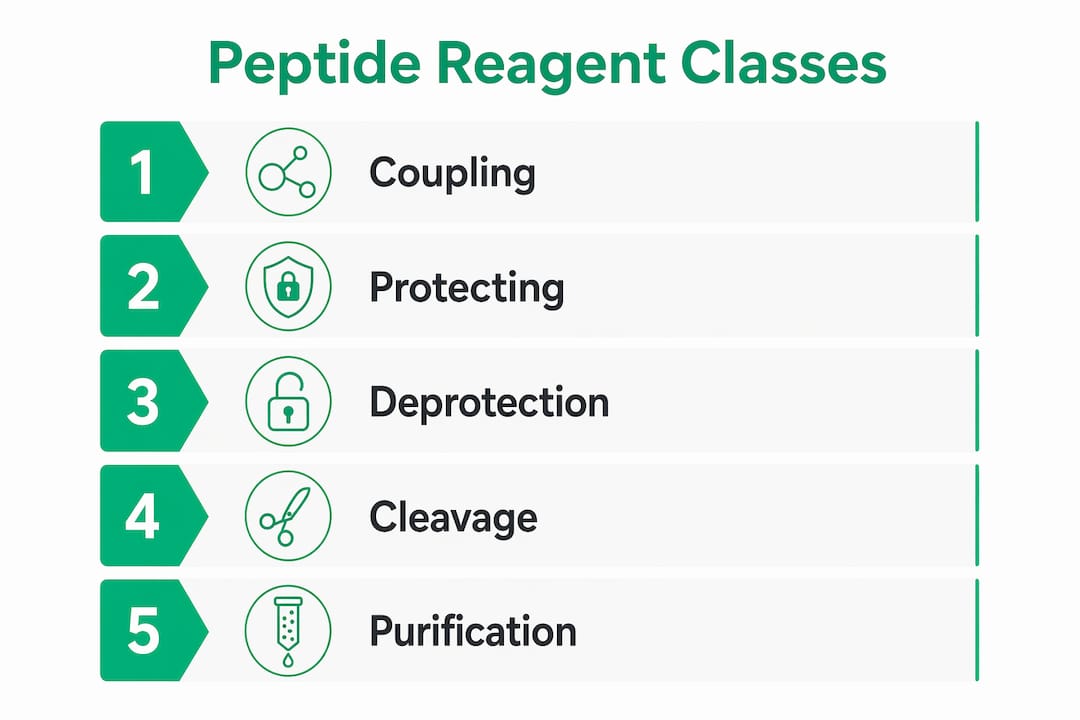
Peptide synthesis reagents are the chemical workhorses behind every peptide bond formed in the lab. Their selection directly determines yield, purity, and whether a difficult sequence succeeds or fails.
Coupling reagents fall into four primary classes:
- Carbodiimides (DCC, DIC, EDC): widely used activators, often paired with additives like HOBt or Oxyma Pure to suppress racemization and N-acyl urea formation
- Phosphonium salts (BOP, PyBOP, PyAOP): high coupling efficiency, low racemization risk, and no guanylation activity toward free amines
- Uronium/aminium salts (HBTU, TBTU, HATU, COMU): fast, clean reactions; require a tertiary base and must be added after pre-forming the carboxylate to avoid N-terminal capping
- Triazole-based reagents (T3P): high efficiency with low toxicity and reduced racemization, well suited for sterically hindered or sensitive substrates
Protecting groups are equally critical. Fmoc (removed by piperidine in DMF), Boc (cleaved by TFA), and Cbz (hydrogenolysis) each define the deprotection chemistry for the entire synthesis route. In solid-phase peptide synthesis (SPPS), Fmoc/tBu is now the dominant strategy because it allows milder final cleavage conditions than Boc chemistry.
Additives such as HOBt, HOAt, and Oxyma Pure enhance reactivity and reduce side products during coupling. Their choice is not cosmetic. HOAt, for instance, provides anchimeric assistance through its pyridine nitrogen, making HATU and PyAOP the most efficient reagents in the OBt series.
Table of Contents
- Safety considerations and the shift toward safer coupling reagents
- How to troubleshoot sequence aggregation and racemization
- Best practices for selecting and handling reagents in the lab
- Expert recommendations for 2026: what the field is prioritizing
- Neolabpeptides: research-grade peptides verified for your lab
- Key Takeaways
Safety considerations and the shift toward safer coupling reagents
Traditional reagents built around HOBt and HOAt carry real hazards. Both compounds are classified as potentially explosive, and their use in quantity requires strict handling protocols. The industry is actively moving away from them.
Key safety concerns and current guidance:
- HOBt and HOAt: explosive risk under dry or shock conditions; require storage with moisture and careful inventory management
- BOP: produces carcinogenic HMPA as a by-product, limiting its use in modern labs despite excellent coupling performance
- TFA cleavage cocktails: concentrated trifluoroacetic acid requires fume hood use, chemical-resistant gloves, and safety glasses at all times
- Oxyma Pure-based reagents (COMU, PyOxim): not based on triazole chemistry, so they carry no explosive classification. Industry guidance now recommends these as the forward-looking replacements for HOBt-containing reagents like HBTU, TBTU, and PyBOP
Disposal of coupling reagent by-products, particularly urea derivatives from carbodiimides, requires compliance with institutional chemical waste protocols. DMF and NMP, the most common synthesis solvents, are reproductive toxins and must be handled and disposed of accordingly.
Pro Tip: When selecting between Oxyma Pure-based reagents, note that COMU solutions in DMF have lower stability than uronium-based solutions. Prepare COMU solutions fresh and use within the same session to avoid degraded performance.
How to troubleshoot sequence aggregation and racemization
Sequence aggregation is the leading cause of peptide synthesis failure in SPPS. As the growing chain folds on itself or interacts with adjacent chains on the resin, coupling efficiency drops sharply and deletion sequences accumulate.
Strategies and reagent choices that address common synthesis problems:
- Depsipeptide and pseudoproline units: incorporating these into difficult sequences disrupts beta-sheet formation and restores coupling efficiency for sequences that fail standard protocols
- Racemization control: substituting sym.-collidine for DIPEA or NMM as the base significantly reduces epimerization when activating racemization-prone residues such as His, Cys, and peptide fragments
- Fragment and cyclization reactions: phosphonium reagents are preferred here because they can be used in excess to drive slow reactions to completion without causing guanidinylation side reactions that uronium salts produce
- N-methyl amino acids: HATU with HOAt is the coupling combination of choice, as standard OBt-based reagents often fail with these sterically demanding residues
- Aspartimide formation: common with Asp(OtBu) in DMF; switching to a backbone amide linker or using alternative solvents reduces this side reaction
Checking the linear peptide by analytical HPLC and mass spectrometry before final cleavage catches most of these issues before they become irreversible losses.
Best practices for selecting and handling reagents in the lab
Reagent quality and handling discipline directly affect reproducibility. A synthesis that works once and fails the next is almost always a reagent or solvent issue.
- Solvent selection: DMF and NMP dissolve the widest range of reagents and support peptide bond formation through high polarity; DCM is preferred for resin swelling in SPPS
- Inert atmosphere: argon is preferred over nitrogen for sensitive couplings because its higher density provides better blanketing of the reaction mixture, reducing oxygen and moisture ingress
- Uronium reagent stability: solutions of HBTU and TBTU in DMF are exceptionally stable, making them practical for automated synthesizers that use pre-made reagent solutions
- Phosphonium reagent solutions: moderate stability in DMF; keep in sealed vials and use within 48 hours
- Resin compatibility: for automated SPPS, confirm that resin mesh size matches the synthesizer’s reaction vessel specifications. Incorrect mesh leads to clogging and failed runs
- Storage: store moisture-sensitive reagents under inert gas, in sealed containers, at the temperature specified by the supplier. Degraded reagents are the most common source of unexplained yield drops
- Purity verification: review the certificate of analysis for every reagent lot before use; HPLC purity and water content are the two figures that matter most
For peptide vial handling and reconstitution after synthesis, consistent solvent choice and technique prevent aggregation in the final product.
Expert recommendations for 2026: what the field is prioritizing
The clearest trend in peptide synthesis reagent selection is the move toward safety without sacrificing efficiency.
- Prioritize Oxyma Pure-based reagents (COMU, PyOxim) as the default for routine SPPS, replacing HOBt-containing reagents
- Use HATU with HOAt for difficult sequences, N-methyl amino acids, and fragment couplings where maximum efficiency is required
- Apply sym.-collidine as the base when racemization risk is elevated, particularly with His, Cys, and peptide fragment activations
- Maintain rigorous lot-to-lot quality control; verify purity by HPLC before committing a reagent to a long synthesis run
- Follow institutional and EPA guidelines for DMF, NMP, and TFA disposal; these solvents carry regulatory obligations in most US research facilities
Neolabpeptides: research-grade peptides verified for your lab
Synthesizing peptides from scratch demands reliable reagents and verified starting materials. Neolabpeptides offers a direct alternative: research-grade peptides including BPC-157, CJC-1295, TB500, IPAMORELIN, and GLP-1 analogs, all verified at 98%+ purity by third-party HPLC and mass spectrometry, with a Certificate of Analysis included with every order.

For labs that need characterized, lyophilized peptides ready for biomedical or biochemical research without the synthesis overhead, Neolabpeptides ships across the United States with fast turnaround and full documentation. Browse the catalog at neolabpeptides.com and request your COA before you order.
Key Takeaways
Oxyma Pure-based reagents are now the safety-compliant default for SPPS, replacing HOBt-containing reagents without sacrificing coupling efficiency.
| Point | Details |
|---|---|
| Reagent class selection | Match carbodiimides, phosphonium, or uronium salts to synthesis complexity and sequence sensitivity. |
| Safety shift to Oxyma Pure | COMU and PyOxim replace HOBt-based reagents, eliminating explosive risk in routine SPPS. |
| Aggregation and racemization | Use pseudoproline units for difficult sequences; substitute sym.-collidine for DIPEA to reduce epimerization. |
| Solvent and storage discipline | DMF and NMP maximize reagent solubility; store moisture-sensitive reagents under inert gas and verify purity by COA. |
| Neolabpeptides | Supplies 98%+ purity research peptides with third-party COA, verified by HPLC and mass spectrometry, shipped across the US. |
Recommended
This article summarizes published research for informational purposes. Products sold by Neo Lab Peptides are for laboratory research use only and are not intended for human or animal use.