Acetic Acid for Peptides: Lab Protocols and US Suppliers
July 18, 2026 · STEPHAN ZOHAR

A dilute acetic acid solution is commonly used as the reconstitution solvent for peptides that aggregate or fail to dissolve at neutral pH. It works by protonating key amino acid residues, particularly histidine and glutamate, which adds positive charge to the peptide and prevents intermolecular clumping. GLP-1 analogs (Semaglutide, Tirzepatide, Retatrutide), growth hormone fragments such as GH 176-191, and certain antimicrobial peptides are the most common candidates. USP Chapter 〈503〉 formally designates acetic acid as a counter-ion in commercial peptide preparations, establishing the regulatory baseline for concentration and quality in US labs.
Acetic acid is a specialty reagent, not a default solvent. Use it only when product documentation or a Certificate of Analysis explicitly calls for acidic reconstitution.
Key facts for researchers:
- Standard concentration: dilute acetic acid solution with mildly acidic pH
- Mechanism: protonation of histidine, glutamate, and related residues prevents aggregation
- Use only when the product documentation or Certificate of Analysis specifies acidic reconstitution
- Never apply glacial (concentrated) acetic acid directly to a peptide
- Verify USP compliance for all solvents used in US biotech and pharma labs
Best practices for reconstituting peptides with acetic acid
Following a consistent protocol protects peptide integrity and keeps results reproducible across experiments.
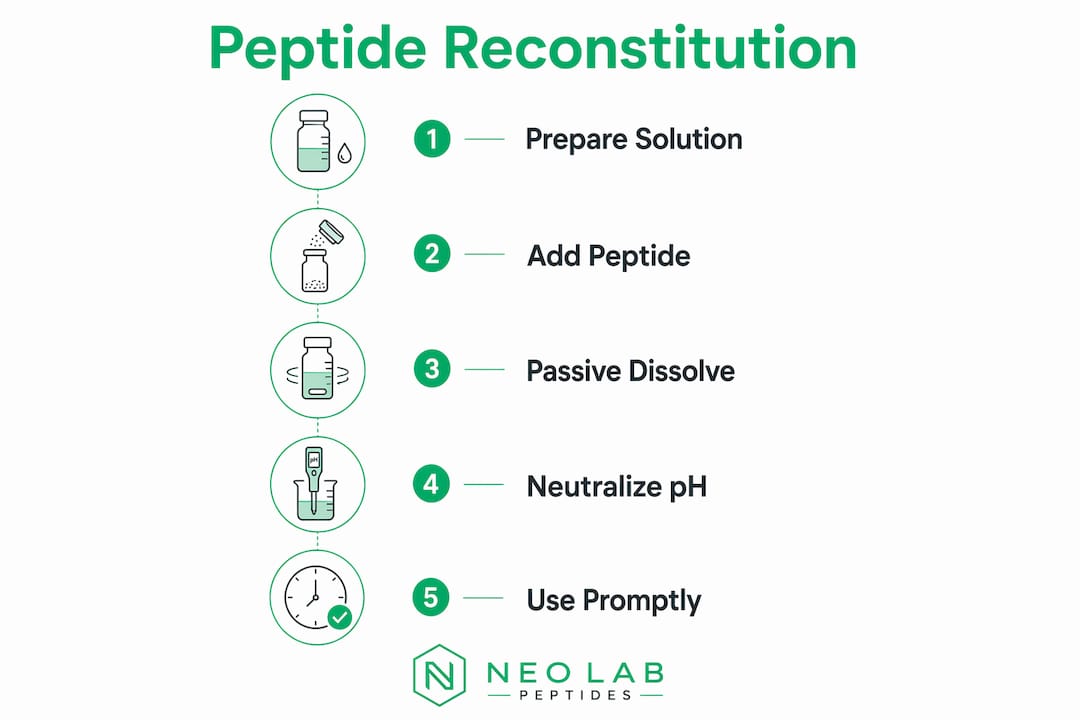
- Confirm the solvent requirement. Check the COA or product documentation before opening the vial. If the document specifies bacteriostatic water, use that. Switching solvents without confirmation risks degradation.
- Add acetic acid slowly. Inject 1–2 mL of 0.6% acetic acid into the lyophilized vial using a sterile syringe. Add it along the vial wall rather than directly onto the powder.
- Dissolve passively at 4°C. Allow the peptide to dissolve without agitation. Aggressive mixing can cause irreversible denaturation; passive dissolution at low temperature preserves secondary structure.
- Roll, never shake. If the peptide needs encouragement, gently roll the vial between your palms for 2–3 minutes. Shaking introduces shear forces that damage sensitive peptide bonds.
- Dilute to working concentration. Once fully dissolved, dilute with bacteriostatic water or PBS to bring the final pH closer to physiological range. This two-step protocol is standard for GLP-1 class peptides.
- Never use glacial acetic acid directly. Concentrated acetic acid is caustic and will irreversibly denature or degrade the peptide. Always use a pre-prepared 0.6% solution.
- Maintain sterile technique throughout. Use sterile syringes and needles for every withdrawal. Reconstituted peptide vials used for multi-dose research have a 28-day use window when handled correctly.
- Store reconstituted peptides at 4°C. Avoid freeze-thaw cycles after reconstitution. Lyophilized stock should remain frozen until the moment of use.
Pro Tip: Acetic acid reconstitution often takes longer than bacteriostatic water. Allow up to 5–10 minutes of passive dissolution with occasional gentle rolling before concluding the peptide has not dissolved. Patience here prevents unnecessary solvent switching.
Excessive acid beyond what the peptide requires can affect downstream applications if not properly neutralized. Always dilute to working concentration before use in analytical or pharmacological assays.
Comparing top US suppliers of research-grade peptides and acetic acid solutions
Supplier selection directly affects peptide purity, documentation quality, and protocol reliability. The five US-accessible suppliers below differ meaningfully in specialization, communication, and geographic reach.

| Supplier | Product Range & Specialization | Communication | Purity & Certifications | Best For | Rating |
|---|---|---|---|---|---|
| PEPTIDES STORE | Metabolic, recovery, GH signaling, longevity | Standard e-commerce | Published COAs, strict purity standards | Advanced lab research, specialty compounds | 3.9★ (7) |
| Peptides Supplies | General peptide supply, Chicago, IL | WhatsApp direct ordering | Not publicly listed | Researchers needing direct supplier chat | 5★ (3) |
| PEPTIDES SUPPLIES MI | Local peptide supply, Michigan | Not publicly listed | Not publicly listed | Michigan-based lab procurement | 5★ (3) |
| Peptide Supply US | Peptide store, Brooklyn, NY, local delivery | Not publicly listed | New York researchers needing local sourcing | 5★ (3) | |
| Blue Ridge Peptides | Wholesale peptides, Warrenton, VA | Not publicly listed | Not publicly listed | Bulk procurement for research labs | 5★ (1) |
PEPTIDES STORE carries the broadest documented catalog among these options, covering metabolic research peptides, recovery compounds, and longevity agents with published pricing. Its COAs and purity standards make it a practical choice for labs that need documentation for institutional compliance.
Peptides Supplies and Peptide Supply US both offer WhatsApp-based ordering, which suits researchers who need to clarify reconstitution solvent requirements or confirm lot-specific documentation before placing an order. Peptide Supply US serves Brooklyn and the surrounding New York area with local delivery.
Blue Ridge Peptides operates as a wholesaler in Warrenton, VA, positioning it for labs that procure peptides in bulk. No pricing is publicly listed. PEPTIDES SUPPLIES MI serves researchers in Michigan with local access; its profile beyond regional availability is not publicly detailed.
Third-party verification via HPLC and mass spectrometry, paired with lot-matched COAs, is the minimum documentation standard for any acetic acid reconstitution solvent or peptide used in US biotech and pharma research.
Safety and environmental regulations for acetic acid in US biotech labs
Acetic acid in US laboratory settings falls under several overlapping regulatory frameworks. OSHA’s Hazard Communication Standard (29 CFR 1910.1200) requires a Safety Data Sheet for acetic acid, including glacial grades, to be accessible at every worksite where it is used. At 0.6% concentration the acute hazard is low, but concentrated stocks require secondary containment and chemical-resistant PPE.
The EPA classifies acetic acid as a non-hazardous waste at dilute concentrations under RCRA, though labs must verify local municipal discharge limits before disposing of acidic waste streams. Many US biotech facilities route acetic acid waste through neutralization before drain disposal, bringing pH to the 6–9 range required by most publicly owned treatment works.
For labs operating under FDA oversight or GMP-adjacent conditions, USP Chapter 〈503〉 provides the quality standard for acetic acid used in peptide preparations. Using USP-grade acetic acid and maintaining lot traceability aligns with both regulatory expectations and internal quality systems. Document solvent lot numbers alongside peptide COAs to create a complete audit trail for each reconstitution batch.
Neolabpeptides offers research-grade peptides with full documentation
If the suppliers compared above don’t align with your lab’s documentation requirements or shipping timeline, Neolabpeptides is a direct alternative worth evaluating.

Neolabpeptides supplies lyophilized research peptides, including GLP-1 analogs and GHK-Cu, with purity verified at 98%+ via HPLC and mass spectrometry. Every order ships with a lot-matched Certificate of Analysis. The catalog includes USP-grade bacteriostatic water alongside peptide compounds, so researchers can source both the peptide and the appropriate reconstitution solvent from a single supplier. Fast US shipping and transparent documentation make Neolabpeptides a practical fit for research institutions and biotech labs that need reliable supply with full traceability. Browse the full catalog at neolabpeptides.com.
Key Takeaways
Acetic acid at 0.6% concentration is a specialty reconstitution solvent for acid-sensitive peptides, not a universal replacement for bacteriostatic water.
| Point | Details |
|---|---|
| Standard concentration | Use 0.6% acetic acid for peptides requiring acidic reconstitution. |
| Dissolution protocol | Add solvent slowly, dissolve passively at 4°C, and roll gently rather than shaking. |
| Glacial acid hazard | Never apply concentrated acetic acid directly; always use a pre-diluted 0.6% solution. |
| Regulatory compliance | USP Chapter 〈503〉 governs acetic acid in peptide preparations for US lab use. |
| Neolabpeptides | Supplies 98%+ purity lyophilized peptides with lot-matched COAs and USP-grade bacteriostatic water for US researchers. |
Recommended
- Top 4 Bacteriostatic Water for Peptides Alternatives 2026 – Neo Lab Peptides
- Peptide Vials: A Researcher’s Guide to Handling Them – Neo Lab Peptides
- How to Read a Peptide Certificate of Analysis (COA) | Neo Labs – Neo Lab Peptides
- Reconstituting Peptides Calculator: A Lab Guide for 2026 – Neo Lab Peptides
This article summarizes published research for informational purposes. Products sold by Neo Lab Peptides are for laboratory research use only and are not intended for human or animal use.