
Research-grade ipamorelin and CJC-1295 are available for purchase in the United States exclusively for in vitro and scientific laboratory use. Both peptides are supplied in lyophilized form with purity verified above 98% through third-party HPLC and mass spectrometry analysis, with Certificates of Analysis included with every shipment. When you buy CJC-1295 ipamorelin online for research, what you’re procuring is a synergistic growth hormone secretagogue combination: CJC-1295 amplifies GH pulse amplitude, while ipamorelin increases pulse frequency through ghrelin receptor agonism. Together, they elevate circulating GH and IGF-1 levels in experimental models.
Key facts for laboratory procurement:
- Both peptides are not approved for human or veterinary use and are restricted to laboratory research contexts
- Purity verification via HPLC and mass spectrometry is the standard for research-grade formulations
- Certificates of Analysis confirm identity, purity, and batch-specific quality
- Researchers should monitor IGF-1 and glucose as primary biomarkers during experimental administration
- Transient insulin resistance is a documented physiological effect requiring experimental controls
Table of Contents
- What do ipamorelin and CJC-1295 do in growth hormone research?
- How do you verify the purity of research-grade peptides?
- How should you store and handle ipamorelin and CJC-1295 in the lab?
- Which biomarkers should you monitor during GH axis peptide research?
- What do US researchers need to know before ordering these peptides?
- How do you prepare dosing solutions for in vitro experiments?
- How do ipamorelin and CJC-1295 interact with other peptides or compounds?
- Neolabpeptides: verified research peptides, shipped across the US
- Key Takeaways
What do ipamorelin and CJC-1295 do in growth hormone research?
CJC-1295 is a synthetic growth hormone-releasing hormone (GHRH) analog. The No DAC variant has an extended half-life compared to native GHRH, which makes it useful for sustaining elevated GH pulse amplitude across experimental timeframes. Ipamorelin is a selective growth hormone secretagogue receptor (GHSR) agonist that increases GH pulse frequency with minimal off-target effects on cortisol or prolactin, a specificity that distinguishes it from earlier-generation GHRPs.
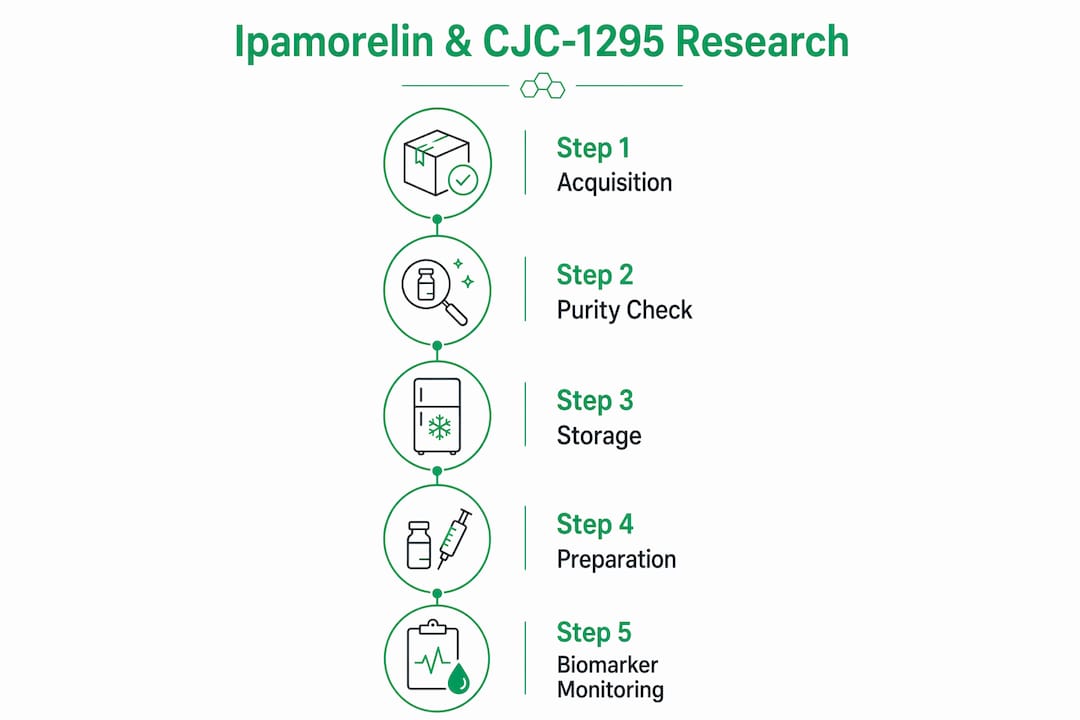
Used together, the two peptides act on complementary receptor pathways. The result is a synergistic elevation of both GH pulse amplitude and frequency, producing higher circulating IGF-1 levels than either compound achieves alone.
Physiological effects relevant to experimental design:
- Increased lean mass and anabolic signaling via IGF-1 upregulation
- Appetite modulation, consistent with ghrelin pathway activation
- Mild fluid retention in some experimental models
- Transient insulin resistance, requiring glucose monitoring in longitudinal studies
- Improved recovery markers in tissue-level assays
These effects inform how you structure controls, select biomarker panels, and interpret downstream data.
How do you verify the purity of research-grade peptides?
Experimental reproducibility depends entirely on the purity and identity of the peptides you use. A single contaminated or degraded batch can invalidate weeks of data. Third-party verification is not optional for serious research.
The two gold-standard analytical methods are:
- HPLC (High-Performance Liquid Chromatography): Separates peptide components to quantify purity percentage and detect impurities or degradation products
- Mass Spectrometry: Confirms molecular identity by matching the peptide’s measured mass to its theoretical molecular weight
Neolabpeptides delivers products with third-party verified purity consistently above 98%, with a Certificate of Analysis accompanying every order. When reviewing a COA, check that the HPLC chromatogram shows a single dominant peak, that the mass spec data matches the expected molecular weight, and that the batch number on the COA corresponds to your shipment.
Purity benchmark: Research-grade peptides should meet a minimum 98% purity threshold by HPLC to be considered suitable for controlled in vitro experimentation.
Red flags that indicate substandard sourcing:
- No COA available, or COA issued by the vendor’s own internal lab rather than an independent third party
- Purity listed without specifying the analytical method used
- No mass spectrometry confirmation of molecular identity
- Vague or missing batch-specific data
How should you store and handle ipamorelin and CJC-1295 in the lab?
Peptide stability is directly tied to storage conditions. Lyophilized peptides are far more stable than reconstituted solutions, but they still require controlled environments to maintain activity over time.
Storage and handling protocols:
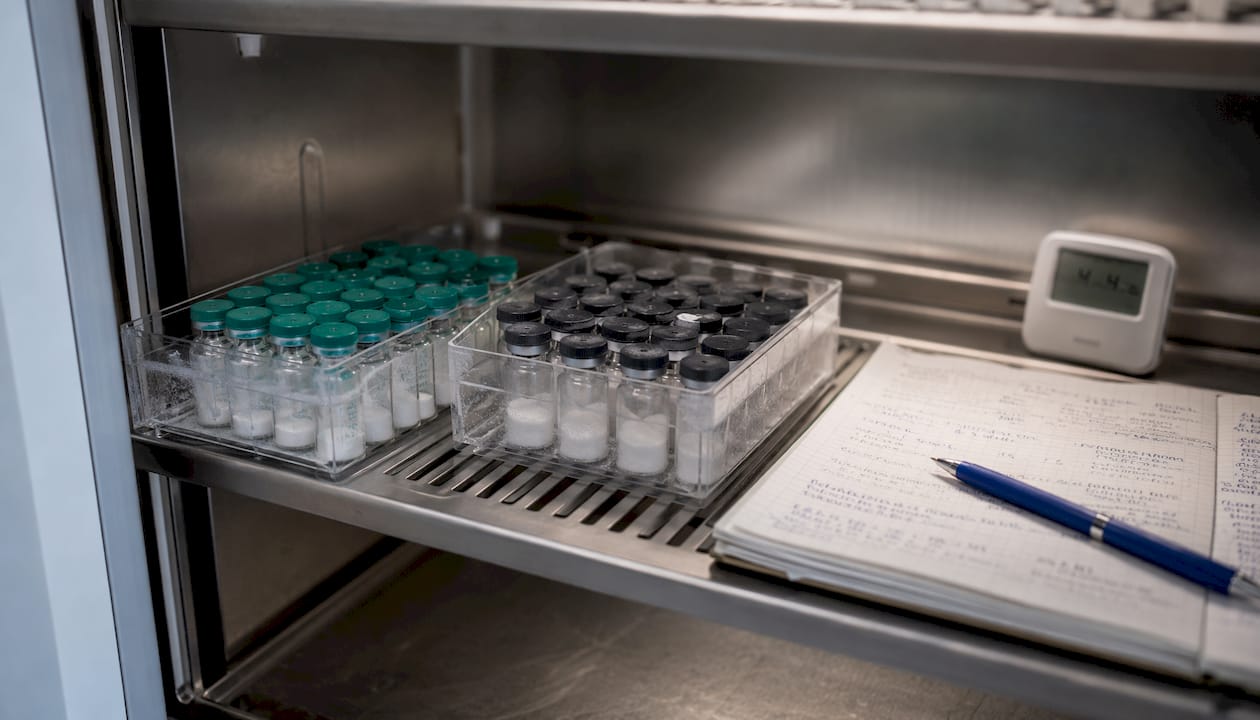
- Lyophilized state: Store at 2–8°C in a desiccated environment; for long-term archiving beyond 6 months, storage at -20°C is preferable
- Reconstituted solutions: Keep at 4°C and use within 2–4 weeks; avoid repeated temperature cycling
- Solvent selection: Bacteriostatic water is the standard reconstitution vehicle; solvent alternatives such as dilute acetic acid may be appropriate depending on peptide solubility
- Sterile technique: Use laminar flow hoods, sterile syringes, and 0.22 µm filters when preparing working solutions
- PPE: Nitrile gloves, lab coat, and eye protection are standard minimums when handling lyophilized or reconstituted peptides
Pro Tip: Aliquot reconstituted peptide into single-use volumes immediately after preparation. This eliminates repeated freeze-thaw cycles, which degrade peptide integrity faster than any other handling error. Label each aliquot with the preparation date and concentration.
Shelf life for lyophilized peptides stored correctly is typically 24 months from the manufacture date. Once reconstituted, stability drops significantly, making aliquoting the single most impactful step you can take to protect your material. For detailed reconstitution calculations, Neolabpeptides maintains a peptide reconstitution guide with volume-to-concentration protocols.
Which biomarkers should you monitor during GH axis peptide research?
Monitoring the right biomarkers is what separates interpretable data from noise. When working with growth hormone secretagogues, two markers are non-negotiable: IGF-1 and fasting glucose. Research on GH axis stimulation confirms that both require longitudinal tracking to account for systemic metabolic shifts during experimental administration.
Core biomarker panel:
- IGF-1: The primary downstream marker of GH activity; elevated levels confirm peptide efficacy and help calibrate dosing schedules
- Fasting glucose: Transient insulin resistance is a documented effect of sustained GH elevation; glucose monitoring is necessary for metabolic controls
- Insulin: Pairing insulin measurements with glucose data clarifies whether observed glucose changes reflect true insulin resistance or altered secretion
Temporal considerations matter. GH pulses from ipamorelin and CJC-1295 are episodic, not tonic, so single-timepoint sampling can miss peak activity. Sampling at consistent intervals relative to peptide administration, rather than at arbitrary clock times, produces more reliable biomarker data.
Design note: Establish baseline IGF-1 and glucose values across at least three pre-treatment timepoints before introducing peptides. This baseline variance determines your statistical threshold for detecting a treatment effect.
What do US researchers need to know before ordering these peptides?
Purchasing ipamorelin and CJC-1295 in the United States requires awareness of the regulatory framework governing research chemicals. These peptides are classified as research-use-only compounds and are not approved by the FDA for human or veterinary administration. Vendors operating within US law restrict sales to research institutions, academic laboratories, and verified scientific professionals.
Practical procurement checklist:
- Confirm the vendor explicitly classifies products as research use only and prohibits human use
- Verify that the supplier complies with FDA and DEA guidelines for research chemical distribution
- Request COAs before or at the time of purchase, not after delivery
- Check that packaging is labeled with peptide name, batch number, quantity, and storage conditions
- Confirm the vendor offers domestic US shipping with appropriate cold-chain handling where required
- Compare pricing transparently: cost per milligram varies across suppliers, and unusually low prices often correlate with lower purity or missing documentation
Neolabpeptides ships domestically within the US with fast turnaround and includes COAs with every order, meeting the documentation standards required for institutional procurement.
How do you prepare dosing solutions for in vitro experiments?
Accurate preparation of peptide working solutions is foundational to reproducible in vitro data. The standard approach for ipamorelin and CJC-1295 in cell-based or tissue assays follows a consistent protocol.
Preparation steps:
- Calculate target concentration based on your assay’s effective concentration range; for GH secretagogue research, working concentrations typically fall in the nanomolar to low micromolar range
- Reconstitute lyophilized peptide using bacteriostatic water or the appropriate solvent; add solvent slowly along the vial wall rather than directly onto the lyophilized cake to minimize foaming
- Verify concentration by measuring absorbance at 280 nm if the peptide contains aromatic residues, or by using a BCA protein assay for confirmation
- Prepare serial dilutions in your assay buffer to reach working concentrations; use low-binding tubes to prevent peptide adsorption to vessel walls
- Filter-sterilize all solutions through a 0.22 µm membrane before use in cell culture systems
For combined ipamorelin/CJC-1295 experiments, prepare each peptide as a separate stock solution and combine at the desired molar ratio immediately before use. This preserves individual peptide stability and gives you flexibility to adjust the ratio across experimental arms.
How do ipamorelin and CJC-1295 interact with other peptides or compounds?
When designing multi-compound experiments, understanding interaction profiles prevents confounded results. Both ipamorelin and CJC-1295 act on the GH axis, so co-administration with other GH-modulating compounds requires careful controls.
Key interaction considerations:
- GHRP-2 or GHRP-6: These earlier-generation secretagogues share the GHSR target with ipamorelin. Co-administration produces additive GH release but also introduces cortisol and prolactin effects absent with ipamorelin alone, complicating interpretation
- Tesamorelin: As another GHRH analog, tesamorelin and CJC-1295 act on the same receptor; combining them does not produce additive amplitude effects and may saturate the receptor pathway
- BPC-157: No direct GH axis interaction, but BPC-157’s anabolic and tissue-repair signaling may overlap with IGF-1-mediated effects, requiring separate biomarker panels to distinguish contributions
- GLP-1 analogs: These compounds influence insulin secretion and glucose metabolism; co-administration with ipamorelin/CJC-1295 in metabolic models requires tightly controlled glucose monitoring given the overlapping effects on insulin sensitivity
- Somatostatin analogs: These directly inhibit GH release and will blunt or abolish the secretagogue effect of both peptides; they are useful as negative controls in GH axis assays
When combining peptides, always run single-compound arms alongside combination arms. This design lets you attribute observed effects to specific compounds rather than the combination as a whole.
Neolabpeptides: verified research peptides, shipped across the US
Researchers who need to purchase CJC-1295 ipamorelin online with documented purity and fast domestic delivery have a direct option in Neolabpeptides. Every product ships with a third-party COA confirming high purity verified by third-party analysis by HPLC and mass spectrometry, which is the documentation standard institutional review and replication studies require.

Neolabpeptides supplies lyophilized ipamorelin and CJC-1295 as a verified research blend, alongside individual peptides and multi-compound stacks for anabolic, recovery, and metabolic pathway studies. The catalog is built for researchers who need reliable material, not for general consumers. Pricing is transparent, shipping is domestic, and every order includes the documentation your lab needs to proceed with confidence. Visit Neolabpeptides to review available formulations and place your order.
Key Takeaways
Ipamorelin and CJC-1295 are research-grade growth hormone secretagogues available in the US with high purity verified by third-party analysis, requiring rigorous biomarker monitoring and sterile handling to generate valid experimental data.
| Point | Details |
|---|---|
| Purity standard | Research-grade peptides must exceed 98% purity, confirmed by third-party HPLC and mass spectrometry with a batch-specific COA. |
| Synergistic mechanism | CJC-1295 amplifies GH pulse amplitude; ipamorelin increases pulse frequency, producing higher IGF-1 elevation together than either does alone. |
| Biomarker monitoring | Track IGF-1 and fasting glucose longitudinally; transient insulin resistance requires dedicated experimental controls. |
| Storage protocol | Store lyophilized peptides at 2–8°C in desiccated conditions; aliquot reconstituted solutions immediately to avoid freeze-thaw degradation. |
| Neolabpeptides | Supplies the ipamorelin/CJC-1295 blend with third-party COAs and fast US shipping, meeting institutional documentation requirements. |
Recommended
This article summarizes published research for informational purposes. Products sold by Neo Lab Peptides are for laboratory research use only and are not intended for human or animal use.