Peptide Sciences Alternatives for US Researchers (2026)
August 3, 2026 · STEPHAN ZOHAR

For U.S. research labs displaced by the Peptide Sciences shutdown, Neolabpeptides is a verified, procurement-ready replacement: third-party HPLC and mass spectrometry testing, batch-specific Certificates of Analysis (COAs) with every product, explicit research-use-only (RUO) labeling, and fast domestic shipping. Your immediate next step is to request a batch-specific COA before placing any order, and to confirm that COA includes independent HPLC and MS data, not an in-house certificate.
Three categories of peptide sciences alternatives are worth evaluating alongside Neolabpeptides:
- COA-first suppliers: Vendors whose primary differentiator is public, batch-specific third-party documentation. These are the safest starting point for institutional procurement.
- Broad-catalog distributors: Suppliers offering wide peptide coverage across GLP-1 analogs, research peptides, and ancillary reagents. Useful when you need to consolidate SKUs from a single source.
- Specialty small-batch labs: Suppliers focused on custom synthesis or niche sequences. Appropriate for non-standard research needs, but require more rigorous documentation verification.
Pro Tip: Before placing any order with a new vendor, request the batch-specific COA for the exact lot you will receive, not a generic or representative certificate. If the vendor cannot supply it within 24 hours, treat that as a disqualifying red flag.
Table of Contents
- How do top peptide sciences alternatives compare on what labs actually care about?
- What must procurement verify before switching peptide vendors?
- What happened to Peptide Sciences and what does it mean for your lab?
- Why Neolabpeptides is a verified replacement for US research labs
- How to transition your lab from Peptide Sciences to a new supplier
- Shortlist of reliable Peptide Sciences alternatives (named vendors)
- Key Takeaways
- The documentation gap most labs overlook when switching suppliers
- Neolabpeptides supports US labs with verified peptides and full documentation
- Authoritative resources for peptide vendor verification
How do top peptide sciences alternatives compare on what labs actually care about?
Documentation quality, not price, is the clearest signal of a supplier’s operational maturity. Vendors that publish batch-specific COAs are consistently rated more trustworthy than those that provide COAs only on request or issue in-house certificates. The table below maps the four supplier categories across the dimensions procurement teams use most.

| Supplier Category | Verified Purity & COA (HPLC/MS) | US Manufacturing / Shipping | Catalog Coverage | Pricing & MOQ | Documentation & Support |
|---|---|---|---|---|---|
| Neolabpeptides | 98%+ purity; third-party HPLC & MS; batch-specific COA with every order | US-focused fulfillment; fast domestic shipping | IPAMORELIN, CJC-1295, TB500, BPC-157, GLP-1 analogs, NAD+, GHK-CU, blends | Competitive; bulk pricing available; price tool available | COAs published; RUO-labeled; responsive procurement contact |
| COA-first US vendors | Third-party testing standard; batch-specific COAs common; QR-code or searchable library access | Typically US-warehoused; 3–7 day delivery | Core research peptides; coverage varies by vendor | Moderate to premium; MOQs vary | Strong documentation; COA access usually public |
| Catalog-focused distributors | Testing practices vary; some publish COAs, others require requests | Mixed; some domestic, some international with US warehouses | Broad; often many peptides plus reagents | Volume discounts common; MOQs often higher | Support quality inconsistent; COA retrieval can be slow |
| Specialty/small-batch labs | Custom synthesis with COA per batch; MS confirmation standard | Often domestic; lead times 2–4 weeks for custom work | Narrow; custom sequences and niche peptides | Higher per-unit cost; low MOQ for custom | Detailed documentation per synthesis; slower turnaround |
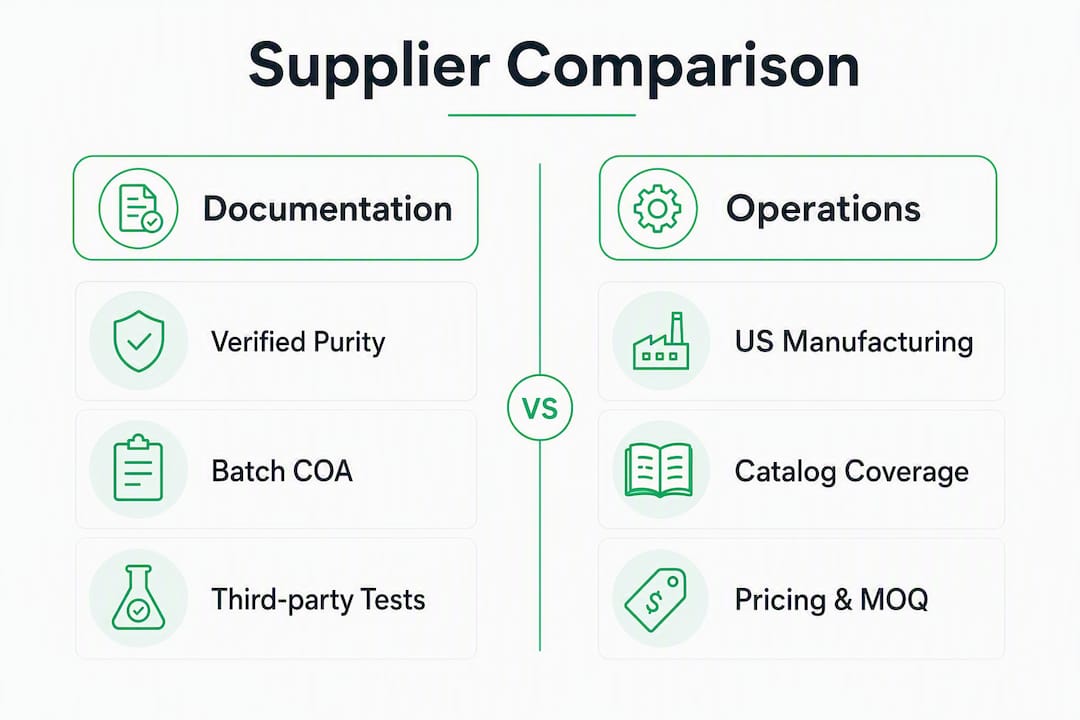
Reading the table: Any vendor scoring well on purity and COA documentation but poorly on support responsiveness is a procurement liability. Public COA access via QR code or searchable library is now a baseline expectation among institutional buyers. If a vendor’s COA is only available by emailing their support team, factor that friction into your procurement timeline.
Key verification steps for any category:
- Confirm the COA references the specific batch or lot number matching your order.
- Check that the testing laboratory is independent, not the vendor’s own facility.
- Ask whether endotoxin and heavy metal data are included or available separately.
What must procurement verify before switching peptide vendors?
A structured checklist prevents the most common errors labs make when transitioning under time pressure. Work through these in priority order.
- Batch-specific third-party COA (HPLC + mass spectrometry). This is the non-negotiable first criterion. A COA without an independent lab’s name and accreditation is not a COA for institutional purposes. Review what to look for in HPLC and MS reports before evaluating any vendor.
- Endotoxin and heavy metal assay data. For cell-based assays, in vivo work, or any application where contamination affects results, endotoxin and sterility data are critical, not optional.
- Explicit RUO labeling. Every product page and shipping label should state “for research use only — not for human or veterinary use.” Absence of this language is a compliance risk.
- Traceable business identity. Verify a US physical address, business registration, and a contactable procurement or customer service channel. A vendor with only a contact form and no verifiable address is a risk.
- Refund and quality dispute policy. Confirm in writing that the vendor accepts returns or provides credit for batches that fail your internal acceptance criteria.
- Shipping SLA documentation. Get a written or published shipping timeline to US labs, including cold-chain handling if applicable.
- Order minimum and bulk pricing structure. Confirm MOQs before committing to a pilot, and ask about volume pricing for anticipated annual usage.
- COA delivery timing. Confirm whether the COA is delivered with the shipment, before it, or only on request after delivery.
Eight questions to ask every vendor directly:
- Do you publish batch-specific HPLC and MS data for each lot?
- Can you provide endotoxin and sterility results for this specific batch?
- Is your testing performed by an independent, accredited third-party laboratory?
- What is your documented shipping SLA to US research labs?
- Do you maintain a physical US address and business registration?
- What is your return or credit policy for batches that fail purity acceptance criteria?
- Are your products explicitly labeled “for research use only”?
- Can I receive the COA before or at the time of shipment?
Red flags to avoid:
- COAs available “on request” only, with no public library or QR access
- In-house certificates with no independent lab name or accreditation number
- No verifiable US business address or registration
- Unrealistic lead times (same-day shipping on custom peptides)
- Support that deflects documentation requests or takes more than 48 hours to respond
Pro Tip: Run a 1–2 vial pilot order before committing to volume. Send one vial to an independent testing lab for purity and endotoxin confirmation. The cost of a single independent test is far lower than the cost of a failed experiment or a compliance audit.
What happened to Peptide Sciences and what does it mean for your lab?
Peptide Sciences ceased operations in 2026, creating an immediate supply gap for hundreds of US research labs that relied on it as a primary or backup peptide source. The shutdown’s practical consequences fall into three procurement risk categories.
- Supply disruption: Ongoing research protocols tied to specific Peptide Sciences SKUs now require vendor mapping. Labs without a secondary supplier face delays of weeks to months depending on catalog complexity.
- Opportunistic vendors: Vendor shutdowns increase the market risk of suppliers that appear to capture displaced demand but lack documentation or a traceable business identity. Several vendors have increased visibility specifically because of the Peptide Sciences gap, and not all of them meet institutional documentation standards.
- Increased enforcement exposure: Vendors making health claims or operating without clear RUO labeling face heightened regulatory scrutiny. Procurement teams that source from non-compliant vendors inherit that risk.
Immediate mitigations:
- Verify the domain and business identity of any new vendor before placing an order.
- Request a batch-specific COA before payment, not after delivery.
- Run a pilot order on a non-critical peptide before committing to volume.
- Confirm the vendor’s refund and quality dispute policy in writing.
As a procurement policy, require batch-specific COAs as a condition of purchase approval for any peptide previously sourced from Peptide Sciences.
Why Neolabpeptides is a verified replacement for US research labs
Neolabpeptides meets the documentation and compliance standards institutional procurement requires. Third-party HPLC and mass spectrometry testing is performed on every product, and batch-specific COAs are published and accessible, not held behind a request process.
Purity standard: Neolabpeptides verifies peptide purity via independent HPLC and mass spectrometry for every batch, ensuring high purity standards.
All products carry explicit “for research use only — not for human or veterinary use” labeling, satisfying the RUO requirement that institutional compliance offices expect. US-based shipping and fulfillment supports fast domestic delivery, reducing the lead-time risk that international suppliers introduce.
Peptides available from Neolabpeptides that directly map to common Peptide Sciences research protocols:
- IPAMORELIN
- CJC-1295
- TB-500 (Thymosin Beta-4)
- BPC-157
- GLP-1 analogs (including semaglutide analogs for research)
- NAD+
- GHK-CU
- Bacteriostatic water and peptide blends
For procurement teams mapping existing Peptide Sciences SKUs, the TB-500 research buying guide is a practical starting point for one of the most commonly displaced peptides. Quality disputes and COA requests are handled through a direct procurement contact channel, with documentation available before or at shipment.
How to transition your lab from Peptide Sciences to a new supplier
Follow this ordered checklist. Timeline estimates assume a standard US lab procurement cycle.
- Map your active Peptide Sciences SKUs (Days 1–3). List every peptide currently in protocol, including lot numbers, concentrations, and vial sizes. Cross-reference against the new vendor’s catalog to identify gaps.
- Identify your pilot peptide (Days 1–3). Choose a peptide from your active list that is not on a critical-path experiment. This becomes your verification sample.
- Place a pilot order of 1–2 vials (Days 3–5). Request the batch-specific COA before or at the time of order confirmation. Confirm the COA includes independent HPLC and MS data.
- Submit one vial to an independent testing lab (Days 5–14). Use a peptide testing kit for a preliminary check, then send to an accredited external lab for full purity and endotoxin confirmation.
- Review results against acceptance criteria (Days 14–21). Minimum acceptance: purity at or above 98% by HPLC, endotoxin within your protocol’s tolerance. If the batch passes, proceed to full catalog mapping.
- Scale orders after verification (Days 21–28). Place volume orders only after the pilot passes internal acceptance. Use the peptide price tool to compare vial sizes and bulk pricing before committing.
- Store all documentation in a retrievable procurement folder. Keep the COA, vendor lot number, and shipping manifest together in a single folder per order. Label by peptide name, lot number, and receipt date.
Pro Tip: Include a COA-delivery clause in your purchase order: “Vendor shall provide a batch-specific Certificate of Analysis from an independent accredited laboratory at or before shipment. Acceptance of delivery is contingent on COA receipt and internal purity verification within 10 business days.”
Sample COA request email (copy and adapt):
Subject: COA Request — [Peptide Name], Lot [XXX], Order [YYY]
Hello,
We are placing an order for [peptide name] and require the batch-specific Certificate of Analysis for Lot [XXX] prior to shipment. Please confirm that the COA includes independent HPLC and mass spectrometry data, the testing laboratory’s name and accreditation, and endotoxin results if available.
Please send the COA to [email] before dispatch. Our acceptance window for testing-based returns is 10 business days from receipt.
Thank you.
Shortlist of reliable Peptide Sciences alternatives (named vendors)
The vendors below represent the range of options US researchers are actively evaluating after the Peptide Sciences shutdown. Each is assessed on documentation, US availability, and catalog relevance.

Neolabpeptides leads this list for institutional procurement. Third-party HPLC and MS testing, batch-specific COAs, explicit RUO labeling, and US-focused fulfillment make it the closest like-for-like replacement for labs that prioritized documentation and compliance under Peptide Sciences.
Nova Life Peptides is a US-based supplier with a focus on research-grade peptides and published COA documentation. Catalog coverage includes several core peptides relevant to displaced Peptide Sciences orders.
Swiss Chems (US operations) maintains a US-accessible catalog with a range of research peptides. COA availability and testing documentation should be verified on a per-batch basis before institutional ordering.
PSPeptides operates with a research-use-only posture and publishes documentation for its catalog. Researchers report responsive customer service, which matters when COA requests need fast turnaround.
Protide Health focuses on research-grade peptides with documentation practices worth verifying directly. Confirm batch-specific COA availability before committing to volume orders.
Amino USA provides US-based sourcing for research peptides. Catalog depth and COA practices vary; request documentation before ordering.
Limitless Life Nootropics carries a range of research peptides alongside nootropic compounds. Documentation practices and RUO labeling should be confirmed for each peptide category.
Core Peptides is a US-based supplier with a catalog covering several common research peptides. Third-party testing documentation is available; verify batch specificity before ordering.
Pure Rawz offers a broad catalog of research compounds including peptides. COA practices and testing documentation vary by product; institutional buyers should request batch-specific data before purchase.
Raw Amino provides research-grade amino acids and peptides. Confirm COA format and independent testing credentials before placing institutional orders.
For all vendors on this list, apply the eight-question checklist from the buying-criteria section before committing to volume. Independent reporting on post-shutdown alternatives used a weighted scoring model that weighted COA verification at 30% of total vendor score, alongside price and reputation, reflecting how central documentation is to supplier selection.
Key Takeaways
Neolabpeptides is the most procurement-ready replacement for US research labs displaced by the Peptide Sciences shutdown, offering independently verified high purity and batch-specific COAs with every order.
| Point | Details |
|---|---|
| Require batch-specific COAs | Only accept COAs from independent, accredited labs that reference your exact lot number. |
| Run a pilot order first | Test 1–2 vials with an independent lab before scaling to volume orders. |
| Verify RUO labeling and business identity | Confirm explicit research-use-only statements and a traceable US address before ordering. |
| Store COAs with lot and manifest | Keep COA, lot number, and shipping manifest together for audit readiness. |
| Neolabpeptides as primary replacement | Neolabpeptides offers 98%+ purity, third-party HPLC/MS COAs, and US shipping for displaced research protocols. |
The documentation gap most labs overlook when switching suppliers
The Peptide Sciences shutdown has pushed procurement teams to move fast, and speed is where documentation standards slip. The vendors that look most attractive in a hurry are often the ones with the least verifiable paper trail, because they have optimized for visibility, not compliance.
What most transition guides understate is the difference between a COA that exists and a COA that is defensible. An in-house certificate with a vendor’s own logo and no independent lab accreditation number is not a COA in any institutional audit sense. It is a marketing document. The distinction matters when a PI has to justify a reagent source to an IRB, a grant auditor, or a journal reviewer asking about compound provenance.
The practical implication: procurement’s job is not just to find a supplier that ships fast. It is to find one whose documentation will hold up six months later when someone asks why you switched vendors and whether the new source was verified. Batch-specific, third-party COAs with HPLC and MS traces are the answer to that question. Everything else is secondary.
Add a single clause to your standard purchase order: COA delivery at or before shipment, with a 10-business-day acceptance window for testing-based returns. That clause costs nothing to add and gives your lab the contractual basis to reject a non-conforming batch without a dispute.
Neolabpeptides supports US labs with verified peptides and full documentation
Neolabpeptides provides research-grade peptides with 98%+ purity verified by independent HPLC and mass spectrometry, batch-specific COAs delivered with every order, explicit RUO labeling on all products, and US-based fulfillment for fast domestic shipping. The catalog covers the peptides most commonly displaced by the Peptide Sciences shutdown: IPAMORELIN, CJC-1295, TB-500, BPC-157, GLP-1 analogs, NAD+, and GHK-CU, among others.
For procurement teams ready to transition, the process is direct. Visit neolabpeptides.com to browse the catalog, request a batch-specific COA before purchase, or place a pilot order. Bulk pricing and documentation requests are handled through the site’s procurement contact channel. All products are for research use only and are not approved for human or veterinary use.
This article provides general procurement guidance for research professionals. It does not constitute legal, regulatory, or compliance advice. Confirm current regulatory requirements with the FDA or a qualified compliance professional before ordering.
Authoritative resources for peptide vendor verification
Bookmark these sources for ongoing vendor evaluation and documentation verification.
- FDA Drug Safety Communications: Primary regulatory reference for research chemical compliance and enforcement actions in the US.
- High-performance liquid chromatography (Wikipedia): Reference for understanding HPLC methodology and what a valid HPLC trace should contain.
- Peptide Third-Party Testing Guide — Neolabpeptides: Explains what to look for in HPLC and MS COAs and how to interpret test reports.
- GMP Quality Criteria — Neolabpeptides: Documentation and audit-readiness standards for peptide procurement.
- High Purity Peptides Supplier Guide — Neolabpeptides: Benchmarks for professional vendor selection and RUO labeling expectations.
If a vendor refuses to supply a batch-specific COA from an independent laboratory: decline the order or require independent testing on arrival before releasing the batch to any research protocol. A vendor that cannot produce documentation has not earned institutional trust, regardless of price or catalog breadth.
Recommended
This article summarizes published research for informational purposes. Products sold by Neo Lab Peptides are for laboratory research use only and are not intended for human or animal use.