
A peptide price tool is an interactive calculator that converts vial price and size into cost-per-milligram and cost-per-dose metrics, giving researchers a standardized basis for comparing vendors. Without this normalization, a $30 vial looks cheaper than a $40 vial until you account for size: a $30 vial at 5 mg costs $6.00/mg, while a $40 vial at 10 mg costs $4.00/mg. The cheaper sticker price is actually the more expensive purchase.
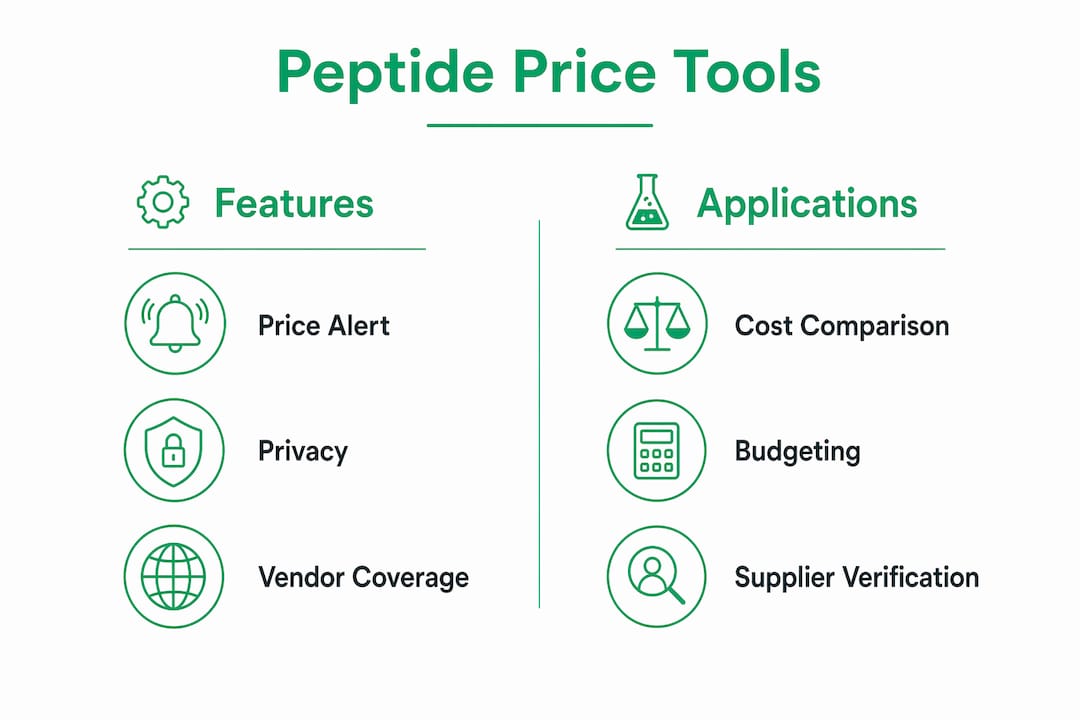
Key functions researchers should expect from any peptide pricing calculator:
- Cost-per-mg and cost-per-dose calculation from vial price, vial size, and dosing frequency
- Multi-vendor price comparison normalized to a standard unit so vial sizes do not distort the comparison
- Price alert functions that notify researchers when a tracked peptide drops below a target threshold
- Coverage of research-grade peptides including BPC-157, TB-500, CJC-1295, ipamorelin, GLP-1 analogs, and GHK-Cu
- Certificates of Analysis (COA) verification tools to cross-check purity claims from vendors
- User reviews and vendor ratings to flag suppliers with consistent quality and delivery records
- Verified local US supplier listings with confirmed business addresses and third-party testing documentation
Vendor trust signals matter as much as price. Lot-specific COAs verified by third parties confirm peptide purity and authenticity, which is the baseline for credible research outcomes.
Which peptide price tools give you the most accurate cost comparisons?
Researchers in 2026 have access to several independent tools, each with a distinct approach to pricing data and vendor coverage.

| Tool/App Name | Key Features | Price Comparison | Price Alert | Supported Peptide Types | Vendor Coverage | Supplier Trustworthiness |
|---|---|---|---|---|---|---|
| PeptidePricing | $/mg, $/dose, COA reader, reconstitution calc | Multi-vial, market average | Not listed publicly | Lyophilized, intranasal (Semax, Selank) | Multiple US vendors | COA-backed listings |
| Peptigrity | Cost per dose/day/week/month, vials needed | Private calculation, no vendor ranking | Not listed publicly | All research-grade peptides | Independent watchdog, no vendor promotion | Neutral; no affiliate ranking |
| PeptidesExplorer | Full cycle cost, vials needed, ancillary cost guidance | Per-mg and per-dose, cycle totals | Not listed publicly | All peptides, mg and IU inputs | Multiple vendors | Purity and COA guidance included |
| Peptide Price Checker | Daily price scans across 74 suppliers, per-mg normalization | 74 suppliers, daily refresh | Not listed publicly | Lyophilized powder, nasal spray, capsule, pre-mixed, topical | 74 US and international suppliers | Automated daily verification |
| PepCost | Real-time side-by-side pricing | Per-peptide, multi-vendor | Not listed publicly | BPC-157, TB-500, semaglutide, tirzepatide, NAD+, and more | Multiple trusted vendors | Real-time data |
| Peptide Price Lab | Bundle optimizer, shopping list, shipping cost calc | Bundle and single-vial optimization | Not listed publicly | All major research peptides | Multiple vendors | Shipping threshold tracking |
| PeptIQ | Cost per mg, per dose, 30-day totals | Per-mg and per-dose breakdown | Not listed publicly | Research-grade peptides | Not publicly listed | Not publicly listed |
| Peptide Finder App | Mobile price comparison, Google Play | Mobile vendor comparison | Not listed publicly | Research peptides | Multiple vendors | Not publicly listed |
| Peptide Critic Price Index | Per-mg price ranges, vendor reputation scoring | $/mg ranges across vendors | Not listed publicly | GLP-1s, BPC-157, GHK-Cu, MOTS-c, and more | Community-evaluated vendors | Quality and reputation scoring |
Peptigrity stands out for researchers who want a fully private calculation. It does not track inputs or rank vendors, which removes any marketing bias from the cost estimate. Peptide Price Checker covers the widest vendor pool at 74 suppliers with daily price refreshes, making it the strongest option for real-time market scanning. PeptidePricing adds a COA reader alongside its calculators, which is useful when you want to verify purity claims without switching tools.
Pro Tip: Run the same peptide through at least two tools before committing to a vendor. Peptigrity gives you a private baseline cost per dose, while Peptide Price Checker shows you where that price sits relative to the current market.
Verified local US peptide suppliers: who are they and where are they?
Price tools tell you what a peptide should cost. Verified local suppliers tell you who can actually deliver it with documentation. The nine suppliers below hold confirmed US business addresses and customer ratings.
| Supplier | Location | Rating | Reviews | COA / Third-Party Testing | Best For |
|---|---|---|---|---|---|
| Peptides for Sale | Johnson City, TN | 4.9★ | 53 | Verified business | Local researchers in TN |
| Peptides Supplies (Tampa, FL) | Tampa, FL | 5★ | 13 | Verified business | Labs seeking regional presence |
| peptides supplies (Santa Monica, CA) | Santa Monica, CA | 5★ | 13 | Verified business | California research labs |
| Peptides Supplies (Chicago, IL) | Chicago, IL | 5★ | 3 | Verified business | Midwest research institutions |
| Peptide supply US | Pleasanton, CA | 5★ | 3 | Verified business | West Coast labs |
| Peptide Suppy US | Lexington, KY | 5★ | 3 | Verified business | Eastern US researchers |
| Peptide Plugs | Liberty Hill, TX | 5★ | 2 | Verified business | Texas researchers |
| Pure Peptides Supplies | San Diego, CA | 4★ | 1 | Verified business | Southern California labs |
| Peptides Supplies | United States | 5★ | 13 | Verified business | General US research buyers |
Peptides for Sale, located at 1735 W State of Franklin Rd in Johnson City, TN, carries the deepest review base of any supplier on this list. That volume of feedback over time gives researchers in the Southeast a more complete picture of order consistency and product quality than a newer listing can offer.
Peptides Supplies operates verified storefronts in Tampa, Santa Monica, and Chicago, making it one of the few suppliers with confirmed physical presence across multiple US regions. For lab managers coordinating purchases across sites, that geographic spread reduces shipping time and simplifies vendor consolidation.
Peptide Plugs in Liberty Hill, TX and Peptide supply US in Pleasanton, CA both hold verified addresses and serve researchers who prefer a supplier within their state or region. Pure Peptides Supplies in San Diego has a verified address at 424 W Ivy St and suits Southern California labs that want a local point of contact.
When evaluating any supplier, confirmed business verification and COA availability are the baseline requirements. Purity above 98%, confirmed via HPLC or mass spectrometry on a lot-specific basis, is the standard that separates research-grade material from unverified product.
How to use a peptide cost estimator to budget your research purchases
Accurate peptide budgeting requires more than a vial price. Follow these steps to get a complete cost picture before placing an order.
- Enter vial size and unit. Input the total peptide content printed on the vial label (mg or IU). A 10 mg vial of BPC-157 and a 5 mg vial at the same price are not equivalent purchases.
- Enter vial price. Use the vendor’s listed price for one vial only, excluding shipping and ancillary supplies at this stage.
- Enter dose per administration. If your vial is in mg, enter your dose in mcg. A 10 mg vial at 250 mcg per dose yields 40 doses; a 5 mg vial at the same dose yields 20.
- Set dosing frequency and cycle length. The calculator returns cost per dose, cost per week, total cycle cost, and number of vials needed.
- Add ancillary costs. Bacteriostatic water, insulin syringes, and cold shipping fees are real line items. Ancillary supplies typically add a modest but consistent amount to total cycle cost across multi-week protocols.
- Compare cost per mg across vendors. A $40 vial of 10 mg BPC-157 costs $4.00/mg. A $30 vial of 5 mg costs $6.00/mg. The lower sticker price is actually the more expensive option per milligram.
Factors that drive 300–500% price variation across vendors include synthesis origin, testing standards, overhead costs, vial size, and included ancillary supplies. Cost per mg alone is insufficient without a verified COA confirming purity.
Key quality markers to verify before purchasing:
- Lot-specific COA from an independent third-party lab (not the vendor’s own facility)
- HPLC and mass spectrometry confirmation of purity at 98% or above
- Vendor rating history across multiple orders, not just a single review
- Confirmed US business address for shipping reliability and accountability
Pro Tip: Advanced researchers maintain reconstitution logs tracking vial open dates, storage conditions, and doses drawn. This practice reduces waste from degraded peptide and gives you accurate data for projecting future purchase volumes.
The most common budgeting error is comparing vial prices without standardizing units. A researcher who buys the cheapest vial without calculating cost per dose will consistently overpay across a multi-week protocol.
Neolabpeptides: research-grade peptides with verified purity for US labs
Neolabpeptides is a direct alternative for researchers who want verified purity documentation and fast US shipping without coordinating with a local storefront. Every product ships with a lot-specific COA confirming purity above 98% via HPLC and mass spectrometry, which is the same standard the price tools above use as their quality benchmark.
The catalog covers the peptides researchers most commonly budget for: BPC-157, CJC-1295, ipamorelin, TB-500, GLP-1 analogs, NAD+, and GHK-Cu, all supplied in lyophilized form. Bacteriostatic water and peptide blends are also available, so ancillary supply costs stay within a single order. For biotech labs and individual researchers running multi-peptide protocols, consolidating purchases at Neolabpeptides reduces vendor management overhead while keeping documentation consistent across compounds. All products are for research purposes only and are not approved for human or veterinary use.
Key Takeaways
Verified purity documentation and cost-per-milligram calculation are the two non-negotiable inputs for accurate peptide research budgeting in 2026.
| Point | Details |
|---|---|
| Cost-per-mg beats vial price | A $30 vial at 5 mg costs $6.00/mg; a $40 vial at 10 mg costs $4.00/mg. |
| Price variation is wide | Vendors show 300–500% price differences driven by testing standards, synthesis origin, and overhead. |
| COA verification is the quality baseline | Lot-specific COAs from independent labs confirming 98%+ purity are required for research-grade purchasing decisions. |
| Local US suppliers add accountability | Verified addresses across TN, FL, CA, IL, TX, and KY give researchers regional options with confirmed business status. |
| Neolabpeptides for documentation-first labs | Neolabpeptides ships BPC-157, CJC-1295, TB-500, and GLP-1 analogs with HPLC-verified COAs and fast US delivery. |
Recommended
This article summarizes published research for informational purposes. Products sold by Neo Lab Peptides are for laboratory research use only and are not intended for human or animal use.