
Transdermal peptides are synthetic or engineered peptides designed to permeate intact skin and deliver therapeutic effects systemically, without injection. The field has gained serious traction in biomedical research because it addresses two persistent problems in peptide therapeutics: bypassing first-pass metabolism and reducing patient burden from repeated injections. Peptides like BPC-157, GHK-Cu, and NAD+ are now actively studied in transdermal delivery formats, with microneedle patches and iontophoretic systems leading the evidence base. For researchers and clinicians, understanding how these systems work at the mechanistic level is the prerequisite for designing effective studies and interpreting clinical data.
How do transdermal peptides penetrate the skin barrier?
The stratum corneum is the primary obstacle. This outermost skin layer is 10–20 micrometers thick and functions as a lipophilic barrier that blocks most hydrophilic, high-molecular-weight molecules. Most therapeutic peptides exceed the molecular weight threshold for passive diffusion, which means unaided skin absorption is negligible.
Researchers have identified several mechanisms that overcome this barrier:
- Microneedles: Arrays of needles 50–900 micrometers in length physically breach the stratum corneum without reaching nerve endings or blood vessels. This length range is engineered to balance efficacy and tolerability.
- Iontophoresis: A mild electric current drives charged peptide molecules through skin layers. Iontophoretic patches use controlled current to enhance flux in a non-invasive, measurable way.
- Cell-penetrating peptides (CPPs): Short amino acid sequences that facilitate intracellular uptake and can co-transport cargo peptides across biological membranes.
- Chemical penetration enhancers: Compounds that temporarily disrupt lipid packing in the stratum corneum, increasing permeability for co-administered peptides.
The physics of skin permeability also depend on peptide charge, lipophilicity, and formulation pH. Iontophoresis works best for charged, hydrophilic peptides. Microneedles work regardless of charge, making them more versatile for large or complex peptide structures.
Pro Tip: When designing a transdermal peptide study, match the delivery mechanism to the physicochemical profile of your peptide. Iontophoresis suits charged, small peptides; microneedle arrays suit larger, neutral, or complex sequences.
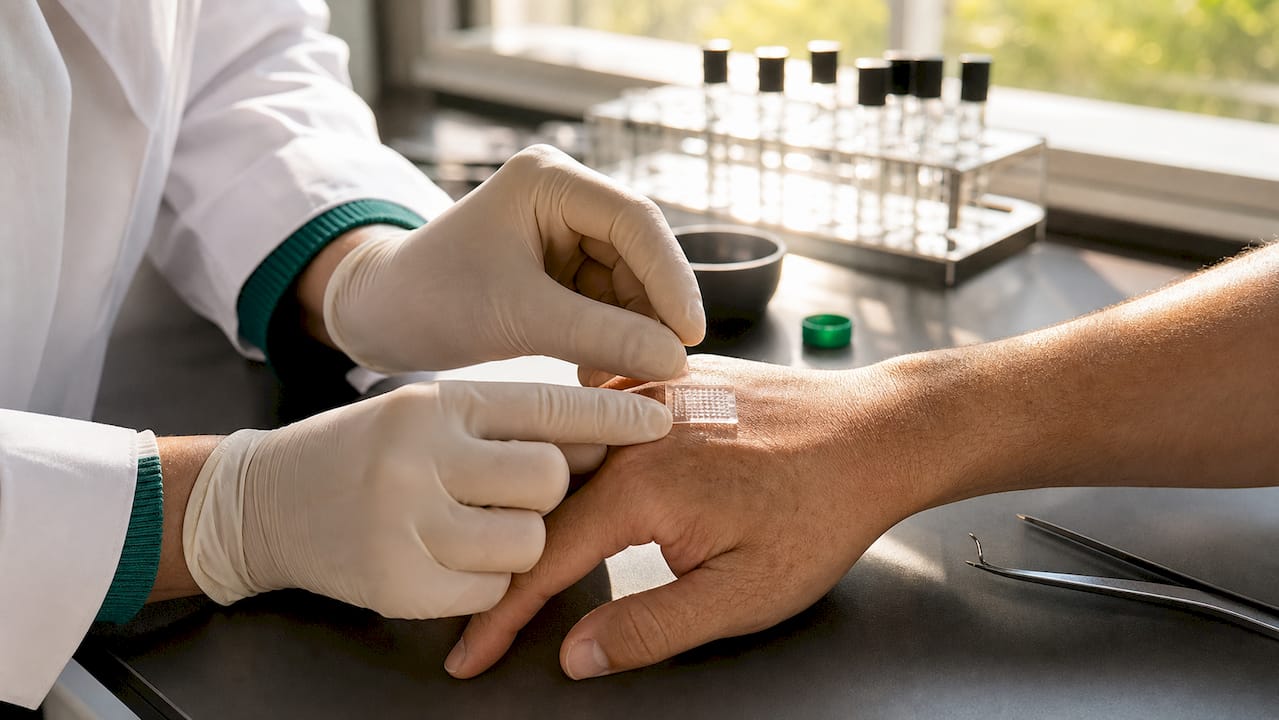
What are the main technological platforms for transdermal peptide delivery?
Microneedle patch technology divides into five main categories, each with distinct drug loading and release characteristics. Researchers need to select the right platform based on peptide stability, required dose, and target release kinetics.
| Platform type | Drug loading | Release profile | Key advantage | Limitation |
|---|---|---|---|---|
| Solid microneedles | Low (surface coating) | Rapid | Simple fabrication | Limited dose capacity |
| Coated microneedles | Moderate | Rapid to moderate | Precise dose control | Coating uniformity challenges |
| Dissolving microneedles | Moderate to high | Sustained | No sharps waste | Humidity sensitivity |
| Hollow microneedles | High | Controlled | Closest to injection kinetics | Clogging risk |
| Hydrogel microneedles | High | Sustained, tunable | Swells to absorb interstitial fluid | Complex manufacturing |
Beyond microneedle arrays, iontophoretic patches represent a distinct platform. These devices are designed for 12–14 hour wear time and deliver peptides like BPC-157, GHK-Cu, and NAD+ through a steady, current-driven flux. The current is mild and physiological, not painful.
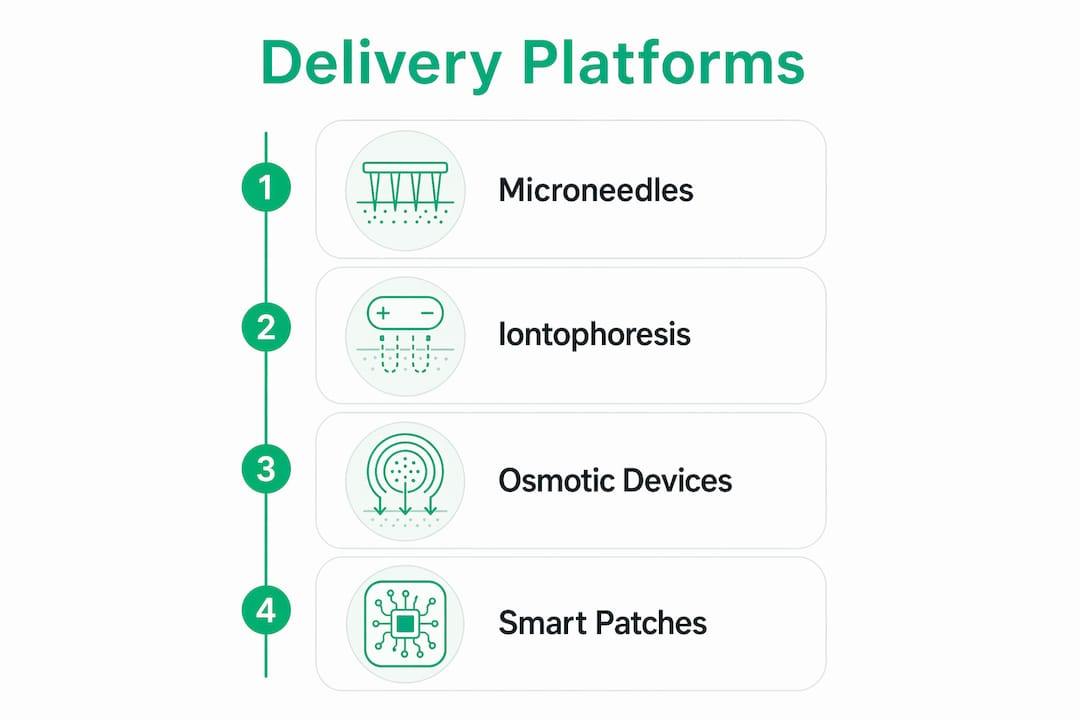
Emerging platforms include wearable osmotic microneedle devices. These can sustain peptide delivery for over a week without patch replacement, using osmotic pressure to drive drug release at a controlled rate. That duration is clinically significant for chronic disease management, where consistent plasma levels matter more than peak concentrations.
Smart patches represent the next tier. These integrate biosensors and AI-controlled release mechanisms that adjust drug delivery in real time based on physiological feedback. The technology is preclinical in most peptide applications, but the trajectory is clear.
What evidence supports the efficacy of transdermal peptide systems?
The preclinical data is specific and quantifiable. A microneedle patch delivering Pyr-Apelin-13 achieved 83–99% in vivo release efficiency in aged mice, with therapeutic outcomes comparable to intraperitoneal injections. Muscle fiber quality improved, and grip strength increased. That result matters because it shows a non-invasive format can replicate the pharmacodynamic profile of direct injection.
The patch used in that study incorporated “drug-in-resin” technology, which embeds multi-milligram peptide doses into the microneedle matrix while minimizing residual loss and skin irritation. This formulation approach addresses one of the field’s persistent problems: getting enough peptide into the patch without degrading it during manufacturing.
Pro Tip: When evaluating preclinical transdermal data, check the release efficiency metric alongside the pharmacodynamic endpoint. High release efficiency with no functional outcome signals a bioavailability problem, not a delivery problem.
Clinical data is accumulating. Abaloparatide, a parathyroid hormone-related peptide, has been studied in microneedle patch format through Phase 1b trials. Results showed systemic absorption and tolerability profiles consistent with subcutaneous injection, with reduced injection-site reactions. That comparison is the benchmark researchers use to validate new transdermal peptide formulations.
Patient compliance data reinforces the case. Eliminating sharps waste and injection discomfort removes two of the most cited barriers to adherence in chronic peptide therapy. For researchers designing long-duration studies, this translates directly into better protocol completion rates and cleaner outcome data.
What are the challenges and future directions in transdermal peptide development?
The technical barriers are real and not yet fully solved. The main challenges researchers face include:
- Drug loading limits: Most microneedle formats cannot accommodate the doses required for systemic effects with high-molecular-weight peptides. Hollow and hydrogel types push the boundary, but manufacturing complexity increases proportionally.
- Peptide stability: Stability during manufacturing is a critical formulation problem. Heat, mechanical stress, and pH shifts during patch fabrication can degrade peptide structure and reduce bioactivity.
- Skin tolerability: Repeated application at the same site causes cumulative irritation. Rotating application sites and optimizing needle geometry are standard mitigation strategies, but neither is fully standardized across the field.
- Regulatory pathway complexity: No established FDA regulatory pathway exists specifically for microneedle peptide patches. Developers navigate a combination of drug and device regulations, which extends timelines and increases development cost.
The most promising direction in formulation research is combining physical and biochemical penetration strategies. Pairing microneedle arrays with cell-penetrating peptides in the same formulation may maximize delivery efficiency beyond what either approach achieves alone.
“Smart transdermal patches using AI and bio-responsive materials represent next-generation drug delivery, enabling real-time, personalized administration. The integration of biosensors with peptide release mechanisms could redefine how chronic conditions are managed at the molecular level.”
Bio-responsive materials that release peptide payloads in response to local pH, glucose, or inflammatory markers are in active preclinical development. These systems would eliminate fixed dosing schedules entirely. For peptide researchers, this represents a shift from pharmacokinetic modeling to closed-loop therapeutic control.
Key Takeaways
Transdermal peptide delivery is validated by preclinical data, advancing through clinical trials, and constrained by formulation and regulatory challenges that are solvable with current technology.
| Point | Details |
|---|---|
| Stratum corneum is the primary barrier | Microneedles (50–900 µm) and iontophoresis are the two validated methods to breach it reliably. |
| Five microneedle types exist | Solid, coated, dissolving, hollow, and hydrogel formats differ in dose capacity and release kinetics. |
| Preclinical efficacy is strong | Pyr-Apelin-13 microneedle patches achieved 83–99% release efficiency with functional outcomes matching injection. |
| Stability and loading are the top formulation hurdles | Drug-in-resin technology and hollow formats partially address these, but no universal solution exists yet. |
| Smart patches are the next frontier | AI-controlled, bio-responsive systems are in preclinical development and could enable real-time personalized dosing. |
Why the field is moving faster than most researchers expect
I have followed peptide drug delivery research for over a decade, and the pace of progress in transdermal systems has surprised me. Five years ago, microneedle patches were largely a proof-of-concept technology. Today, you have Phase 1b clinical data on abaloparatide patches and preclinical studies showing injection-equivalent outcomes in sarcopenia models. That is a meaningful shift.
What I find underappreciated is the compliance advantage. Researchers often frame transdermal delivery as a convenience feature. It is not. For chronic peptide protocols, the difference between a patch and a daily injection is the difference between a study that completes and one that does not. Dropout rates in injection-based peptide trials are a real confound, and transdermal formats directly reduce that variable.
The regulatory gap is the honest obstacle. The FDA has not created a clear pathway for combination drug-device products like peptide microneedle patches. Developers are currently navigating this case by case. Researchers who want to move from bench to clinic need to engage regulatory consultants early, not after IND filing.
My advice for researchers working in this space: prioritize peptide stability data before you optimize your delivery platform. A well-characterized, stable peptide in a suboptimal patch will outperform a degraded peptide in a perfect one. Start with your peptide certificate of analysis and work forward from there.
— Stephan
Research-grade peptides for transdermal delivery studies
Neolabpeptides supplies research-grade peptides verified at over 98% purity through HPLC and mass spectrometry, with Certificates of Analysis included with every order. For researchers developing transdermal peptide formulations, starting material quality is not optional. Degraded or impure peptides produce unreliable release data and confound pharmacodynamic outcomes.

Neolabpeptides stocks peptides actively studied in transdermal formats, including BPC-157 and GHK-Cu, both supplied in lyophilized form with full documentation. Fast US shipping and third-party verification make Neolabpeptides a reliable source for labs that cannot afford formulation delays caused by purity failures. Visit Neolabpeptides to review current inventory and product specifications.
FAQ
What are transdermal peptides?
Transdermal peptides are therapeutic peptide compounds formulated to penetrate intact skin and achieve systemic or local biological effects without injection. They are delivered via platforms including microneedle patches, iontophoretic devices, and penetration-enhanced topical formulations.
How do microneedle patches deliver peptides without pain?
Microneedles are engineered to 50–900 micrometers in length, which is long enough to breach the stratum corneum but short enough to avoid nerve endings and blood vessels. This geometry produces effective skin penetration with minimal or no pain sensation.
What peptides are commonly studied in transdermal delivery systems?
BPC-157, GHK-Cu, NAD+, abaloparatide, and Pyr-Apelin-13 are among the peptides with documented transdermal delivery research. Each has been studied in microneedle or iontophoretic formats with measurable pharmacokinetic or pharmacodynamic outcomes.
Is the tingling sensation from iontophoretic patches a side effect?
The mild tingling from iontophoretic patches is physiological, not adverse. It indicates active current delivery driving peptide flux through the skin. Researchers should note this in study protocols to distinguish it from true adverse events.
What is the biggest regulatory challenge for transdermal peptide products?
No dedicated FDA regulatory pathway currently exists for peptide microneedle patches as combination drug-device products. Developers must navigate overlapping drug and device regulations, which extends approval timelines and requires early regulatory strategy planning.
Recommended
This article summarizes published research for informational purposes. Products sold by Neo Lab Peptides are for laboratory research use only and are not intended for human or animal use.