2–5 Minute Bench Peptide Aseptic Technique for Research Labs
September 12, 2026 · STEPHAN ZOHAR

For research reconstitution, follow a disciplined aseptic sequence: clean the bench, swab both septa and let them flash dry, draw with a fresh sterile needle, inject bacteriostatic water down the vial wall without shaking, then aliquot and store cold. This limits contamination and mechanical damage to the peptide. It applies strictly to laboratory research use with compounds like those Neolabpeptides supplies, not to clinical or veterinary administration.
TL;DR:
- Proper aseptic technique requires swabbing vial septa with alcohol and minimizing exposure time to reduce contamination risks.
- The choice of solvent depends on downstream use, with sterile water preferred for sensitive assays and DMSO or acetic acid for stubborn peptides, always labeled clearly.
- Reconstituted peptides should be aliquoted into single-use volumes, stored at 2–8°C for days or -20°C for months to prevent degradation and preserve potency.
- Visual inspection for cloudiness or particulates and logging any anomalies helps identify contamination early and maintain traceability.
- Neolabpeptides provides verified purity, detailed protocols, and documentation to support research-grade peptide handling.
Table of Contents
- Quick Prep Checklist and PPE for Bench Reconstitution
- How Do You Perform Sterile Peptide Reconstitution Step by Step?
- Which Solvent Should You Use for Peptide Reconstitution?
- Storing and Labeling Reconstituted Peptides Correctly
- What Are the Warning Signs of Peptide Contamination?
- How Neo Lab Peptides Supports Sterile Research Workflows
- Where to Source Research-Grade Peptides and Lab Consumables
- Sources
- FAQ
Quick Prep Checklist and PPE for Bench Reconstitution
A sterile reconstitution starts before the vial is even opened. The prep phase sets the contamination ceiling for everything that follows: a dirty bench or a dropped guard on hand hygiene undoes careful technique later.
Start with the workspace itself. Wipe down a clean, low-traffic section of the bench with 70% isopropyl alcohol, away from airflow sources like open doors or fans that stir up dust. Then move through hand hygiene: wash with soap, apply hand sanitizer, and put on powder-free nitrile gloves after removing rings or bracelets that can harbor residue or puncture gloves.
Gather every supply before you break a seal, so you’re not hunting for a syringe mid-procedure with an open vial sitting exposed:
- The peptide vial itself, inspected for an intact seal and normal powder appearance.
- Bacteriostatic or sterile water, matched to your intended use.
- Sterile syringes and fresh needles, unopened.
- Alcohol swabs, a sharps container, and labels.
A few habits round out the setup:
- Date any diluent vial the first time it’s opened, and note the manufacturer’s stated multi-use window on the label.
- Keep a sharps container and waste bag within arm’s reach so used needles never sit on the bench.
- Pre-print or pre-write labels so you’re not writing on a vial with gloved, potentially contaminated hands mid-procedure.
How Do You Perform Sterile Peptide Reconstitution Step by Step?
Sterile reconstitution is really a sequence problem. Get the order right and the open-vial time stays short; get it wrong and you introduce variables that are hard to trace later.
- Let vials warm to room temperature first. Cold glass causes condensation when opened, and moisture on an exposed septum or powder surface is an easy contamination path. Check the seal and confirm the powder looks normal (typically a fine white or off-white cake) before proceeding.
- Swab both septa with 70% isopropyl alcohol. Let each one flash dry for about 10 seconds. A wet septum can drag alcohol and airborne particulate straight through the puncture site as the needle enters, which defeats the purpose of swabbing in the first place, according to guidance on aseptic reconstitution technique.
- Draw the solvent with a fresh sterile needle. Never reuse a needle that has already touched another septum or surface.
- Inject slowly down the inside glass wall, at an angle. Do not aim the stream directly at the powder. A hard jet of liquid can cause foaming and shear the peptide’s structure mechanically, which is a distinct risk from chemical degradation, as reconstitution research notes.
- Roll or swirl gently to dissolve. Never shake or vortex. If the peptide resists dissolving, hold sonication or brief gentle warming in reserve as secondary steps rather than defaults.
- Draw the final solution with a new needle, and discard every used needle into the sharps container immediately, not at the end of the session.
Pro Tip: Treat the whole reconstitution as one continuous motion. Aim to move from first septum swab to capped, labeled vial in 2 to 5 minutes. A structured, uninterrupted flow of steps does more to limit contamination risk than reaching for extra equipment like a flow hood for routine bench work.
Consult a vial handling guide if you’re new to septum access technique, since small habits like needle angle and dwell time compound over repeated draws.
Which Solvent Should You Use for Peptide Reconstitution?
Solvent choice depends on how the vial will be used, not just what dissolves fastest. Getting this wrong can either compromise an assay or leave a peptide poorly dissolved.
That preservative is a safety margin, not a substitute for sterile handling. Poor aseptic discipline can overwhelm it, according to a peptide research safety guide. A side-by-side breakdown of when each diluent makes sense is covered in this bacteriostatic versus sterile water comparison.
Sterile water without preservative is the better call for single-use vials or for assays sensitive to benzyl alcohol, since even trace preservative can interfere with certain cell culture or binding studies.
For solubility problems, work through a graduated sequence:
- Try gentle warming to near body temperature, well below anything that risks thermal damage.
- Move to low-power sonication in short bursts.
- For hydrophobic peptides, a small-volume DMSO pre-dissolve followed by dilution, or a mild 0.1% acetic acid solution, can help bring stubborn peptides into solution. NIBSC’s peptide storage guidance describes moving through increasingly assertive solvents as solubility demands, with the caveat that solvent choice always has to account for downstream assay compatibility.
DMSO warrants a caution of its own: it permeates standard nitrile gloves faster than most lab staff expect, and even small residual amounts can alter results in sensitive cell-based assays. A dilute acetic acid protocol is worth reviewing before using it on solubility-resistant peptides. Whatever solvent you land on, write it on the label along with your reasoning, since a lab notebook without that detail makes troubleshooting the next batch far harder.
Storing and Labeling Reconstituted Peptides Correctly
Peptides in solution degrade faster than lyophilized powder sitting in a sealed vial. That single fact should drive most of your post-reconstitution decisions.
Aliquot immediately after reconstitution, into single-use volumes sized for one experiment. Short-term storage runs at 2–8°C in a standard refrigerator; anything intended for weeks or months belongs at -20°C or colder, per NIBSC’s peptide storage guidance. Skip frost-free freezers if you can. Their automatic defrost cycles put reconstituted samples through repeated freeze-thaw swings that degrade peptide integrity over time.
Every aliquot needs a label that carries:
- Peptide name and lot number
- Concentration in mcg/mL
- Solvent used
- Date and time of reconstitution
- Operator initials
Stability windows vary by peptide, so check the Certificate of Analysis or supplier documentation before committing to a long-term storage plan. A lyophilized peptide storage guide and an aliquoting stability reference both cover typical windows in more depth.
| Storage stage | Condition | Key risk if skipped |
|---|---|---|
| Immediately after reconstitution | Aliquot into single-use volumes | Repeated freeze-thaw degradation |
| Short-term (days) | 2–8°C refrigerated | Bacterial growth in unpreserved solvent |
| Long-term (weeks+) | -20°C or colder, non frost-free | Structural breakdown, potency loss |
| Every aliquot | Full label: name, concentration, solvent, date, initials | Lost traceability if contamination is suspected |
What Are the Warning Signs of Peptide Contamination?
Visual inspection before every use is a two-second habit that catches most problems before they reach an experiment. Cloudiness, visible particulates, an unexpected color shift, an unusual odor, or any sign of visible growth are all reasons to discard the vial outright and log the lot number and Certificate of Analysis reference rather than guess.
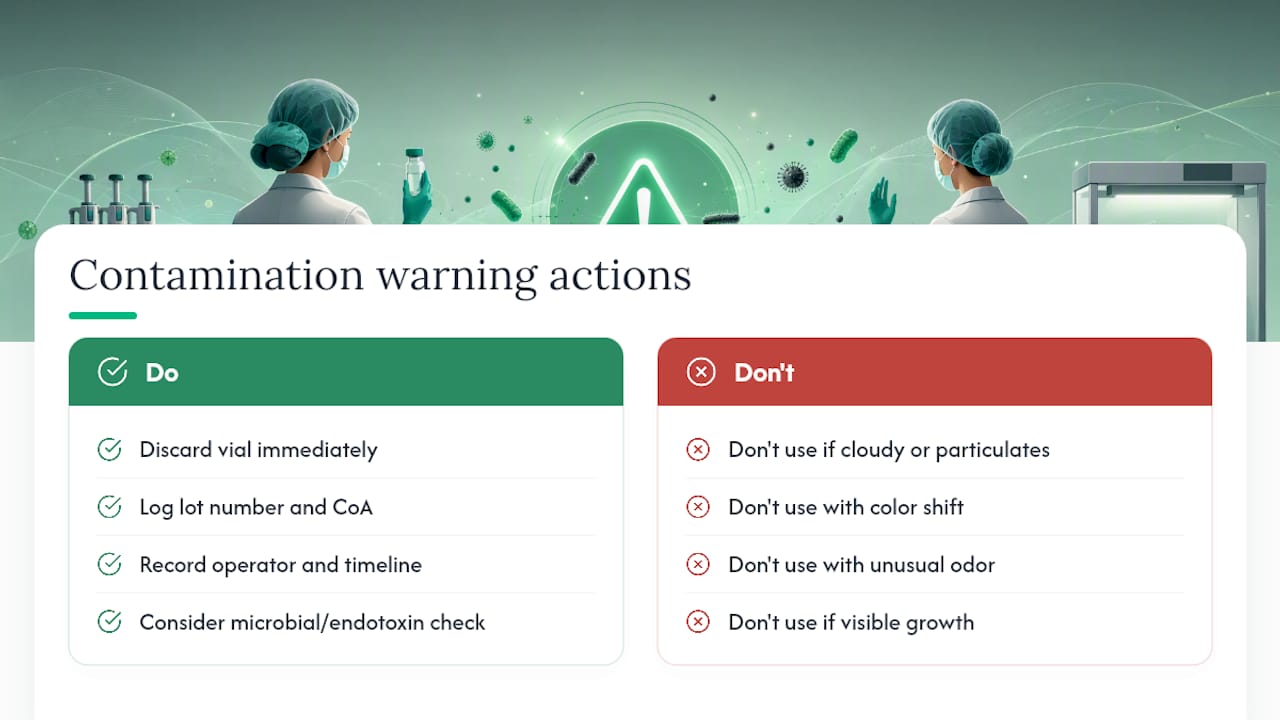
If a peptide simply will not dissolve, work through the documented troubleshooting sequence covered above, gentle warming, sonication, then a solvent adjustment. If it stays cloudy after those steps, do not use it. Persistent cloudiness usually signals either aggregation or actual contamination, and neither resolves by pushing forward.
For assays with tight sensitivity margins, basic microbial culture or an endotoxin check may be worth the extra time, particularly for cell-based work where contamination can silently skew results for weeks before anyone notices. Whatever the outcome, log it: lot number, CoA reference, the operator who prepared the vial, and a timeline of when it was reconstituted and when the issue appeared. Traceability guidance from Peptidings’ reconstitution guide makes clear that this documentation is what actually lets a lab isolate whether a problem was one bad vial or a systemic technique issue.
How Neo Lab Peptides Supports Sterile Research Workflows
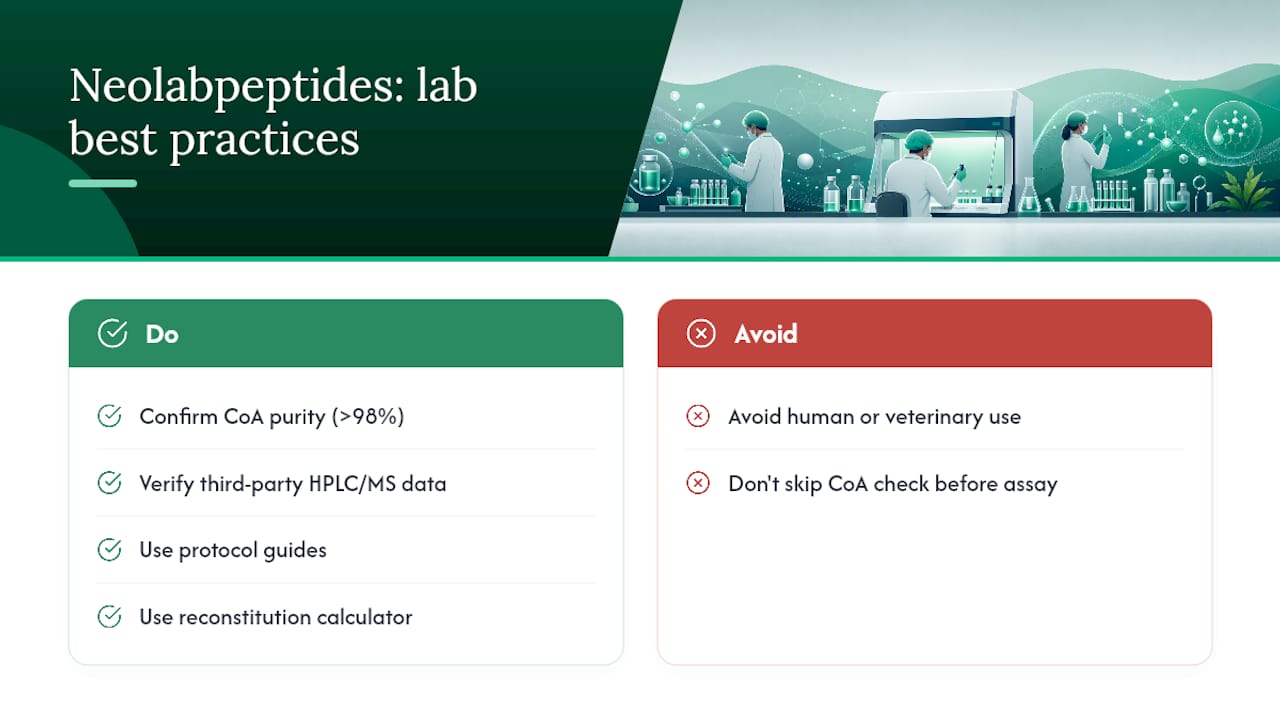
Neolabpeptides supplies lyophilized research peptides verified above 98% purity through third-party HPLC and mass spectrometry testing, with a Certificate of Analysis included on every product. That documentation gives researchers a verified starting point before reconstitution even begins, which matters more than most labs realize when a batch behaves unexpectedly.
Beyond the vial itself, protocol guides and a reconstitution calculator help convert dosing math into concentration and volume decisions. Always check the peptide-specific CoA before committing to long-term storage or a sensitive assay. Every product remains strictly for research use, never for human or veterinary administration.
— Stephan
Where to Source Research-Grade Peptides and Lab Consumables
Sourcing matters as much as technique. A perfect aseptic protocol still starts with a vial you can trust, and that means verified purity data before the first septum swab. Neolabpeptides supplies lyophilized research peptides with Certificates of Analysis on every product, alongside bacteriostatic water and the protocol resources referenced throughout this guide.

Whether you’re stocking a new bench setup or replacing depleted diluent, the Neolabpeptides catalog covers both the compounds and the consumables in one order, cutting down the supplier juggling that slows down a research schedule. Browse the current lineup, check the CoA for your compound of interest, and download the relevant protocol guide before your next reconstitution session. All products are supplied strictly for laboratory research use.
Sources
- Aseptic technique — research reconstitution | Peptide Research Reviews
- Peptide Research Safety Guide: Handling, Contamination Prevention, and Lab Best Practices (2026)
- Peptide storage | NIBSC
- How to reconstitute lyophilized peptides | Peptidings
FAQ
What Is the Correct Order of Steps for Aseptic Reconstitution?
Warm the vial, swab both septa with 70% isopropyl alcohol and let them flash dry, draw solvent with a fresh needle, inject slowly down the vial wall, swirl gently without shaking, then aliquot and store cold.
Can You Use Bacteriostatic Water for Multiple Draws?
Yes.
Why Should You Avoid Shaking a Peptide Vial?
Shaking or vortexing causes foaming and mechanical shear that can damage the peptide’s structure; gentle rolling or swirling dissolves the powder without that risk.
How Long Can Reconstituted Peptides Be Stored?
Stability windows are peptide-specific, but general practice is 2–8°C for short-term use and -20°C or colder for longer storage, always aliquoted to avoid repeated freeze-thaw cycles.
What Should You Do if a Reconstituted Peptide Looks Cloudy?
Discard the vial and log the lot number and Certificate of Analysis reference. Cloudiness after troubleshooting steps like gentle warming or sonication usually signals aggregation or contamination, not a solvent issue.
Does Neolabpeptides Provide Documentation for Traceability?
Yes. Products include a Certificate of Analysis verified through third-party HPLC and mass spectrometry testing, which supports the lot-tracking researchers need for reproducible results.
Recommended
This article summarizes published research for informational purposes. Products sold by Neo Lab Peptides are for laboratory research use only and are not intended for human or animal use.