Bacteriostatic Water vs Sterile Water: What Researchers Need to Know
August 5, 2026 · STEPHAN ZOHAR

Bacteriostatic water contains sterile water for injection plus benzyl alcohol at a concentration of approximately 0.9% as a preservative. Sterile water for injection (SWFI) contains no preservative at all. The practical rule: use bacteriostatic water when your protocol requires repeated withdrawals from the same vial over days or weeks; use sterile water for injection when the application is single-use, preservative-sensitive, neonatal, or intrathecal.
Quick reference before you read further:
- Bacteriostatic water (BAC water): USP-grade SWFI + 0.9% benzyl alcohol; multi-dose; discard within 28 days after first puncture as a safety convention
- Sterile water for injection: Preservative-free; single-dose only; discard any remainder after opening
- Absolute contraindications for bacteriostatic water: neonates; intrathecal or epidural administration
- Concentration math: unchanged by diluent choice — mg ÷ mL = mg/mL regardless of which water you use
Table of Contents
- What is bacteriostatic water and how does it work?
- What is sterile water for injection and when is it required?
- How do bacteriostatic water and sterile water compare across key decision criteria?
- When should you use bacteriostatic water versus sterile water?
- How to reconstitute, withdraw, and store diluents safely
- Safety warnings and U.S. regulatory guidance you need to follow
- Where to obtain bacteriostatic and sterile water in the United States
- Research-grade considerations for peptide work and supplier quality
- Key Takeaways
- The mistake most researchers make with diluent selection
- Neolabpeptides research-grade bacteriostatic water for your lab
- Useful sources
What is bacteriostatic water and how does it work?
Bacteriostatic water is USP-grade water for injection with benzyl alcohol added at a concentration of approximately 0.9%. That single additive is what separates it from plain sterile water and what makes multi-dose vial access practical.
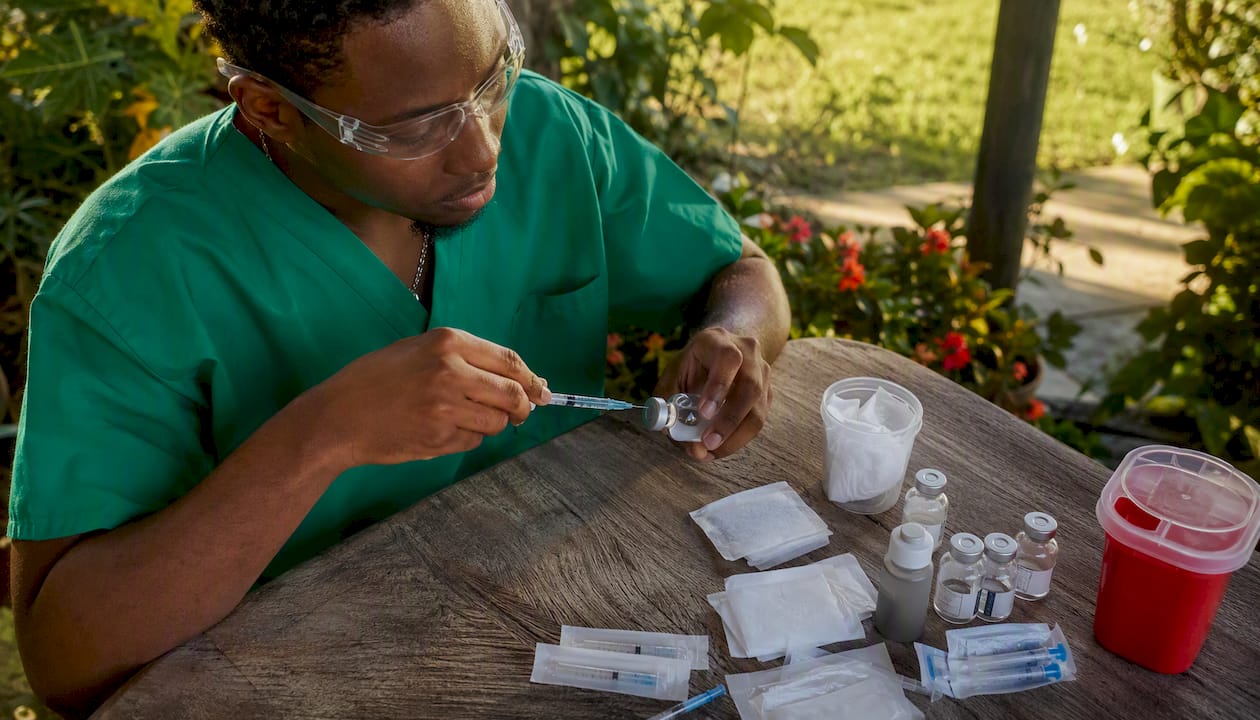
The mechanism matters: benzyl alcohol is bacteriostatic, not bactericidal. It inhibits microbial growth rather than killing existing contaminants. A vial that was contaminated before or during preparation will not be rescued by the preservative. Proper aseptic technique remains the primary defense against contamination; the preservative only extends the window during which repeated needle entries are relatively safe.
Practical implications of the preservative action:
- multi-dose vials can be accessed repeatedly, with a commonly recommended in-use time limit starting from the first puncture
- Unopened shelf life and in-use life are distinct; the manufacturer’s expiration date applies only to an intact, unpunctured vial
- Benzyl alcohol can interfere with certain peptide formulations, causing precipitation or denaturation in sensitive compounds
- Assay carryover is a real concern in HPLC and mass spectrometry workflows where benzyl alcohol peaks may obscure analyte signals
Both bacteriostatic water and sterile water for injection can meet USP-grade specifications. The choice is not about quality — it is about whether preservative presence is compatible with your protocol and patient population. Empower Pharmacy frames this as a trade-off between multi-dose convenience and preservative-free purity.
When evaluating any bacteriostatic water product, the Certificate of Analysis (CoA) should confirm USP grade, benzyl alcohol concentration, sterility testing, and endotoxin limits. A lot number and per-lot testing are non-negotiable for reproducible research.
What is sterile water for injection and when is it required?
Sterile water for injection contains no bacteriostat, no antimicrobial agent, and no added buffer. It is supplied in single-dose containers by design. Once the seal is broken, any unused portion must be discarded immediately.
SWFI meets USP/WFI (Water for Injection) quality standards for sterility and endotoxin limits, but its purity is defined by what it lacks, not what it contains. That absence of additives is precisely what makes it mandatory in specific clinical and laboratory contexts:
- Neonatal applications: benzyl alcohol is toxic to neonates; SWFI is the required diluent
- Intrathecal and epidural administration: preservatives are contraindicated in the central nervous system space
- Certain IV workflows: when the downstream formulation requires a preservative-free base before isotonic adjustment
- Trace-sensitive assays: HPLC and MS protocols where any chemical background must be minimized
Sterile water for injection is not isotonic. Plain water is hypotonic relative to physiological fluids. Before IV administration, appropriate isotonic adjustment is required — SWFI alone is not suitable for direct intravenous infusion without further formulation.
A critical point for lab workflows: “sterile” does not mean “superior for every use.” Both product categories can carry USP-grade certification. The decision turns on reuse requirements and preservative compatibility, not on one being inherently cleaner than the other.
How do bacteriostatic water and sterile water compare across key decision criteria?
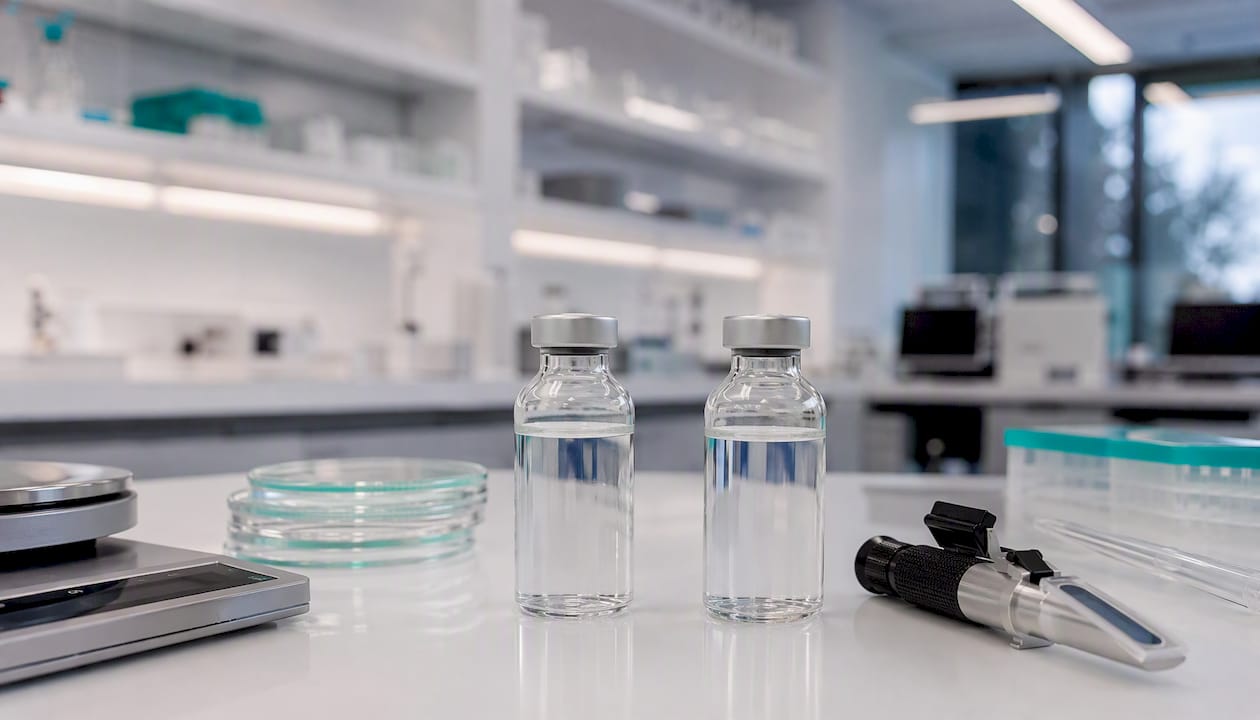
The single chemical difference — presence or absence of benzyl alcohol — drives every downstream difference in packaging, handling, clinical constraints, and shelf life. The table below maps that difference across the dimensions that matter most for procurement and protocol design.
| Dimension | Bacteriostatic Water | Sterile Water for Injection |
|---|---|---|
| Preservative | benzyl alcohol at a concentration of approximately 0.9% | None |
| Container type | Multi-dose vial | Single-dose container |
| In-use shelf life after puncture | ~28 days (discard convention) | Discard immediately after use |
| Common use cases | Peptide reconstitution, multi-draw protocols, HCG | Single-shot reconstitution, neonatal, IV base |
| Contraindications | Neonates; intrathecal/epidural | None from preservative (see isotonicity note) |
| Peptide stability | Risk of precipitation/denaturation with BA-sensitive peptides | Preferred for BA-incompatible compounds |
| Isotonicity | Not isotonic | Not isotonic |
| IV suitability | Not suitable without isotonic adjustment | Not suitable without isotonic adjustment |
Both products require isotonic adjustment before IV administration. Neither is ready for direct intravenous infusion as supplied. That point is frequently overlooked when researchers move from subcutaneous reconstitution to IV dilution protocols.
When saline tonicity is also required, bacteriostatic normal saline (0.9% NaCl with benzyl alcohol) is a fourth diluent category worth knowing. The correct choice across all four options depends on tonicity needs, preservative requirements, and the specific compound being reconstituted.
When should you use bacteriostatic water versus sterile water?
The decision comes down to five practical criteria. Work through them in order before selecting a diluent.
Decision checklist:
- Number of expected withdrawals. More than one draw from the same vial? Bacteriostatic water is the conventional default for multi-dose peptide reconstitution, provided the compound tolerates benzyl alcohol.
- Protocol-specified diluent. Always follow the manufacturer’s reconstitution instructions first. If the label specifies SWFI, use SWFI regardless of convenience.
- Patient population or administration route. Neonates or intrathecal/epidural? SWFI only, no exceptions.
- Assay sensitivity. Running HPLC or MS after reconstitution? Benzyl alcohol will appear in the chromatogram. Use SWFI for trace-sensitive analytical work.
- Downstream IV requirements. Both options need isotonic adjustment before IV use; confirm the full formulation plan before choosing a diluent.
Common use-case mapping:
- Peptide multi-dose vials (BPC-157, TB500, IPAMORELIN, CJC-1295): bacteriostatic water, assuming BA compatibility is confirmed
- Single-shot reconstitution: SWFI is sufficient and avoids unnecessary preservative exposure
- HCG and similar multi-draw protocols: bacteriostatic water is standard clinical practice
- IV dilution: start with SWFI, then adjust tonicity with an appropriate isotonic solution
Compatibility checks belong at the protocol design stage, not after reconstitution. Review the compound’s CoA and manufacturer documentation for any explicit notes on benzyl alcohol incompatibility. For peptides without published compatibility data, formulation stability testing before committing to a diluent is the responsible approach.
Pro Tip: Count your expected draws before you order. If a protocol calls for 10 draws over 20 days, a 10 mL bacteriostatic water vial gives you 1 mL per draw with minimal waste. Matching vial volume to protocol reduces both contamination risk and disposal burden.
How to reconstitute, withdraw, and store diluents safely
Aseptic technique is the foundation. The preservative in bacteriostatic water extends the in-use window; it does not compensate for poor handling.
Stepwise reconstitution checklist:
- Wash hands and work in a clean environment; use a laminar flow hood when available.
- Inspect the diluent vial: check the label for USP grade, lot number, expiration date, and preservative content.
- Wipe the vial septum with a 70% isopropyl alcohol swab and allow it to dry before every needle entry.
- Draw the required volume of diluent slowly; inject it gently down the side of the peptide vial to avoid foaming or shear stress on the lyophilized powder.
- Swirl gently to dissolve; do not vortex.
- Label the reconstituted vial with the date, time, diluent type, lot number, and your initials.
- For bacteriostatic water vials: record the first-puncture date and discard at 28 days regardless of remaining volume.
- For SWFI vials: discard any unused portion immediately after the single draw.
Reconstitution math reminder:
Diluent choice does not affect dose calculation. mg ÷ mL = mg/mL regardless of whether you use bacteriostatic water or SWFI. A 5 mg peptide vial reconstituted in 2 mL yields 2.5 mg/mL in both cases.
Storage and disposal guidance:
- Reconstituted peptide vials: refrigerate at 2–8°C unless the manufacturer specifies otherwise; do not freeze reconstituted solutions
- Bacteriostatic water vials: refrigerate after first puncture; discard at 28 days
- SWFI vials: room temperature storage per label; discard after single use
- Used vials and sharps: dispose through a licensed sharps disposal container; do not recap needles
- Chemical disposal: benzyl alcohol-containing waste may require disposal as chemical waste per your institution’s environmental health and safety guidelines; confirm local requirements before disposal
Safety warnings and U.S. regulatory guidance you need to follow
The FDA drug label for bacteriostatic water carries explicit contraindications that are not discretionary. These are hard stops, not clinical judgment calls.
“Benzyl alcohol, a preservative in Bacteriostatic Water for Injection, has been associated with serious adverse events and death, particularly in pediatric patients.” The label prohibits use in neonates and for intrathecal or epidural administration. FDA/DailyMed drug label
Beyond the neonatal and intrathecal contraindications, U.S. regulatory expectations for both diluents include:
- USP grade: — both bacteriostatic water and SWFI should meet USP specifications for sterility, endotoxin limits, and pH; confirm via the product’s CoA
Neither product is isotonic, and direct IV administration without tonicity adjustment is a safety risk regardless of which diluent you use.
For research protocols that fall outside standard clinical use, institutional review board (IRB) consultation and pharmacy or compounding staff involvement are appropriate before proceeding. Off-label reconstitution in a research context does not exempt the researcher from following established safety constraints.
This article provides general scientific information, not medical or clinical advice. Confirm current regulatory requirements and product labeling with the FDA, USP, or a qualified clinical pharmacist before use.
Where to obtain bacteriostatic and sterile water in the United States
Legitimate U.S. sources for both diluents include:
- Compounding pharmacies: can supply USP-grade bacteriostatic water and SWFI with full documentation; appropriate for clinical and research settings requiring pharmacy oversight
- Medical supply distributors: carry FDA-labeled, commercially manufactured vials; suitable for institutional procurement
- Research chemical suppliers: Neolabpeptides supplies USP-grade bacteriostatic water with Certificates of Analysis, designed for laboratory and research use
- National pharmacy chains: may stock bacteriostatic water with a prescription; availability varies by location and state
What to verify on every order:
- USP-grade designation on the label
- Preservative content and concentration (0.9% benzyl alcohol for BAC water; none for SWFI)
- Lot number and per-lot CoA with sterility and endotoxin data
- Expiration date on the sealed vial
- Storage conditions and container type (single-dose vs. multi-dose)
Procurement decisions should account for supplier traceability and QA documentation. A supplier that cannot provide a per-lot CoA is not a suitable source for research-grade work.
Pro Tip: Order vial sizes that match your expected use volume. A 30 mL bacteriostatic water vial opened for a single 1 mL draw and then stored for weeks is a contamination risk waiting to happen. Match vial size to protocol volume.
Research-grade considerations for peptide work and supplier quality
For peptide research specifically, the diluent choice intersects with compound chemistry in ways that can compromise both safety and data quality.
Benzyl alcohol compatibility is compound-specific. Some peptides and sensitive formulations precipitate or denature on contact with benzyl alcohol. This is not a theoretical concern; it is documented for certain classes of peptides. If the manufacturer’s reconstitution instructions specify SWFI, that specification exists for a reason. When documentation is absent, stability testing before committing to a diluent is the responsible approach.
Why CoAs and third-party testing matter:
- HPLC and mass spectrometry data on the peptide confirm identity and purity before reconstitution
- A per-lot CoA from the diluent supplier confirms sterility, endotoxin levels, and benzyl alcohol concentration
- Supplier traceability allows lot-to-lot comparison if results vary across experiments
- GLP-like documentation practices, including lot tracking and storage logs, support audit readiness
Neolabpeptides verifies all peptide products at greater than 98% purity via third-party HPLC and mass spectrometry, and includes a CoA with every order. For researchers building reproducible protocols, that documentation chain from peptide to diluent to reconstituted solution is what separates publishable data from ambiguous results. The GMP compliance guide on the Neolabpeptides site covers supplier QA expectations in detail.
Pro Tip: For trace-sensitive analytical work, run a blank control using your chosen diluent before reconstituting the compound. Review the HPLC or MS trace for benzyl alcohol peaks (retention time varies by column and method). If BA interferes with your analyte window, switch to SWFI before proceeding.
Key Takeaways
Bacteriostatic water is the correct diluent for multi-dose protocols when the compound tolerates benzyl alcohol; sterile water for injection is mandatory for neonatal, intrathecal, and preservative-sensitive applications.
| Point | Details |
|---|---|
| One chemical difference drives all constraints | Benzyl alcohol (0.9%) in BAC water enables multi-dose use; its absence in SWFI makes single-dose mandatory. |
| 28-day in-use window is non-negotiable | Discard bacteriostatic water vials 28 days after first puncture, regardless of remaining volume. |
| Hard contraindications for BAC water | Never use bacteriostatic water for neonates or intrathecal/epidural administration. |
| Concentration math is diluent-independent | mg ÷ mL = mg/mL whether you use BAC water or SWFI; diluent choice affects safety, not dose calculation. |
| Neolabpeptides supplies USP-grade BAC water | Per-lot CoA, sterility and endotoxin data, and third-party HPLC/MS verification support research-grade QA. |
The mistake most researchers make with diluent selection
The conventional framing of bacteriostatic water vs sterile water treats the choice as binary: multi-dose gets BAC water, single-dose gets SWFI. That framing is correct as far as it goes, but it misses the more consequential error that shows up repeatedly in lab settings.
Researchers routinely treat “sterile” as a quality tier rather than a product specification. They assume that because SWFI has no preservative, it is somehow purer or safer in all contexts. The result is that some researchers use SWFI for multi-dose protocols to avoid benzyl alcohol, then re-enter the vial multiple times without any preservative protection. That practice eliminates the contamination buffer that bacteriostatic water provides, without any compensating benefit unless the compound genuinely requires preservative-free conditions.
The inverse error is equally common: defaulting to bacteriostatic water for every reconstitution because it is convenient, without checking whether the specific peptide or compound tolerates benzyl alcohol. For BA-sensitive formulations, that default can degrade the compound before the first experiment runs.
The practical rule for daily lab work is straightforward: count your draws, check the compound’s compatibility documentation, confirm the patient population and administration route, then choose. Label every opened vial with the first-puncture date and your initials. That single habit enforces the 28-day convention and creates an audit trail without adding meaningful time to the workflow.
Diluent selection is not a minor procedural detail. It is a formulation decision with direct consequences for data quality and, in clinical contexts, patient safety. Treat it accordingly.
Neolabpeptides research-grade bacteriostatic water for your lab

Neolabpeptides supplies USP-grade bacteriostatic water with per-lot Certificates of Analysis covering sterility, endotoxin limits, and benzyl alcohol concentration. Every peptide in the catalog, including IPAMORELIN, CJC-1295, TB500, BPC-157, and GLP-1 analogs, ships with third-party HPLC and mass spectrometry verification at greater than 98% purity. That documentation chain, from diluent to lyophilized compound, is what reproducible research requires.
All products are for research purposes only and are not approved for human or veterinary use. Researchers should confirm diluent selection against their protocol’s specific requirements and applicable institutional guidelines.
Browse the full catalog and request CoA documentation at neolabpeptides.com.
Useful sources
The following primary and practitioner sources were used in preparing this article. Each is worth consulting directly for label language, reconstitution protocols, and clinical warnings.
- DailyMed — FDA Drug Label: Bacteriostatic Water for Injection: Official FDA label text covering contraindications, benzyl alcohol toxicity warnings, and storage requirements.
- Neolabpeptides — Bacteriostatic Water for Peptides: Alternatives: Practical coverage of reconstitution alternatives and best practices for peptide research protocols.
Recommended
This article summarizes published research for informational purposes. Products sold by Neo Lab Peptides are for laboratory research use only and are not intended for human or animal use.