How Ipamorelin's Mechanism Drives Pulsatile GH Release
August 10, 2026 · STEPHAN ZOHAR

Ipamorelin (Aib-His-D-2-Nal-D-Phe-Lys-NH2) is a selective agonist at the growth-hormone secretagogue receptor type 1a (GHS-R1a, the ghrelin receptor) that triggers pulsatile GH release by coupling to Gαq/11 in pituitary somatotrophs, activating phospholipase C, and mobilizing intracellular Ca2+ to drive secretory granule exocytosis, while simultaneously reducing hypothalamic somatostatin inhibitory tone. The foundational pharmacology, established by Raun et al. in 1998, places its in vitro potency at an EC50 of approximately 1.3 nmol/L with an Emax of approximately 85% in rat pituitary cells, and documents a notably clean endocrine footprint: no significant ACTH or cortisol elevation even at doses far exceeding the GH ED50.
Key Takeaways
Ipamorelin’s mechanism is defined by selective GHS-R1a agonism that drives Gαq/11-PLC-IP3/Ca2±mediated GH exocytosis in pituitary somatotrophs, with simultaneous suppression of hypothalamic somatostatin tone, producing a clean pulsatile GH signal without meaningful ACTH or cortisol co-release.
| Point | Details |
|---|---|
| Selective GHS-R1a agonism | Ipamorelin binds GHS-R1a with EC50 ~1.3 nmol/L and Emax ~85%, producing GH release without significant ACTH or cortisol elevation. |
| Gαq/11-PLC-Ca2+ cascade | Receptor activation triggers PLC-β, generating IP3 and DAG, which mobilize intracellular Ca2+ to drive somatotroph exocytosis. |
| Pulsatile vs sustained GH | Short half-life and rapid clearance produce discrete GH pulses that preserve hepatic receptor sensitivity and yield a more physiological IGF-1 response than continuous GH exposure. |
| Animal-to-human translation limits | Rodent GI motility and adiposity signals do not translate reliably to human clinical benefit; human POI trials were negative, and long-term human safety data are absent. |
| Research-only regulatory status | Ipamorelin is not FDA-approved for any therapeutic use in the U.S.; in-human research requires IRB oversight and appropriate regulatory authorization. |
Table of Contents
- What is ipamorelin’s chemical identity and structure?
- How does ipamorelin bind GHS-R1a and why does selectivity matter?
- What intracellular signaling cascade does GHS-R1a activation trigger?
- What are ipamorelin’s pharmacokinetics and pharmacodynamics?
- How does ipamorelin compare to other GH secretagogues?
- What downstream physiological effects does ipamorelin produce?
- What does the primary evidence base actually support?
- What is ipamorelin’s safety profile and U.S. regulatory status?
- Practical laboratory notes for researchers using ipamorelin
- Authoritative references and primary sources
- The selectivity claim deserves more scrutiny than it usually gets
- Sources
What is ipamorelin’s chemical identity and structure?
Ipamorelin is a synthetic pentapeptide classified as a growth-hormone secretagogue (GHS) and, more specifically, as a growth-hormone-releasing peptide (GHRP). Its sequence, Aib-His-D-2-Nal-D-Phe-Lys-NH2, encodes five residues with deliberate non-natural substitutions that define both its pharmacological profile and its metabolic stability.
Key structural features:
- Aib (alpha-aminoisobutyric acid) at position 1: A non-proteinogenic alpha-methyl amino acid that constrains backbone conformation, reducing proteolytic susceptibility and stabilizing the helical turn needed for receptor engagement.
- D-2-Nal at position 3: A D-configured naphthylalanine residue. The D-configuration resists peptidase cleavage; the bulky naphthyl ring makes critical hydrophobic contacts within the GHS-R1a binding pocket.
- D-Phe at position 4: Another D-amino acid substitution that contributes to proteolytic resistance and receptor selectivity.
- C-terminal amide (Lys-NH2): The amide cap prevents carboxypeptidase degradation and is a common feature of synthetic peptide drugs designed for in vivo stability.
- Molecular weight: Approximately 711 Da, consistent with a small peptide that distributes systemically after parenteral administration and reaches anterior pituitary somatotrophs via the bloodstream.
The PubChem entry for ipamorelin (CID 20515892) provides the canonical structure, molecular formula, and registry identifiers researchers need for experimental planning and compound verification.
A single-peak HPLC trace with correct MS confirmation is the minimum acceptable identity check; anything less introduces ambiguity into your dose-response data. See Neolabpeptides’ peptide third-party testing guide for a practical COA review checklist.*
How does ipamorelin bind GHS-R1a and why does selectivity matter?
GHS-R1a is the canonical ghrelin receptor, a class A GPCR expressed most densely in anterior pituitary somatotrophs and hypothalamic nuclei, with additional peripheral expression in enteric neurons, pancreatic islets, and other GI tissues. Ipamorelin engages the orthosteric binding site of GHS-R1a, the same site occupied by the endogenous ligand ghrelin, and activates the receptor’s full signaling capacity.
Ipamorelin, as a full agonist, amplifies this existing tone rather than switching the receptor from a fully silent state. This has interpretive consequences for in vitro assays, where the apparent Emax reflects the increment above constitutive activity rather than the absolute ceiling of receptor output.
Selectivity in this context means that ipamorelin produces a GH signal without meaningful co-activation of the corticotropic or lactotropic axes. In swine and rat studies, ipamorelin raised GH markedly while ACTH and cortisol remained at levels comparable to GHRH stimulation, even at doses exceeding 200 times the GH ED50. This distinguishes it pharmacologically from GHRP-6 and GHRP-2, both of which produce dose-dependent ACTH and cortisol elevations.
The tissue distribution of GHS-R1a explains the full scope of ipamorelin’s pharmacological footprint. At the anterior pituitary, direct somatotroph stimulation is the primary GH-releasing mechanism. At hypothalamic nuclei, GHS-R1a activation suppresses somatostatin release from periventricular neurons, reducing the inhibitory brake on GH secretion and amplifying the net pulsatile output. Peripheral GHS-R1a expression in the gut and pancreas accounts for the GI motility and appetite-related effects observed in animal models, effects that are mechanistically distinct from the pituitary GH axis.
The Raun et al. 1998 paper remains the primary pharmacological reference for ipamorelin’s receptor selectivity, reporting in vitro EC50 and Emax data alongside in vivo dose-response curves that confirm the absence of meaningful corticotropic spillover.
What intracellular signaling cascade does GHS-R1a activation trigger?
The proximate signaling pathway from GHS-R1a engagement to GH exocytosis in somatotrophs is well characterized and proceeds through a defined sequence of molecular events.
The primary signaling cascade:
- Ipamorelin binds GHS-R1a at the orthosteric site, stabilizing an active receptor conformation.
- The activated receptor couples to the heterotrimeric G-protein Gαq/11.
- Gαq/11 activates phospholipase C-beta (PLC-β).
- PLC-β cleaves phosphatidylinositol 4,5-bisphosphate (PIP2) into two second messengers: inositol 1,4,5-trisphosphate (IP3) and diacylglycerol (DAG).
- IP3 binds IP3 receptors on the endoplasmic reticulum, releasing stored Ca2+ into the cytoplasm.
- DAG activates protein kinase C (PKC), which phosphorylates downstream targets that facilitate exocytosis.
- The rise in cytoplasmic Ca2+ triggers fusion of GH-containing secretory granules with the plasma membrane, releasing GH into the portal circulation.
This Gαq/11-PLC-IP3/DAG-Ca2+ cascade is the dominant mechanism for acute GH exocytosis in somatotrophs.
Complementary central effects:
- GHS-R1a activation in hypothalamic periventricular neurons reduces somatostatin (SST) secretion into the hypophyseal portal blood.
- Lower SST tone at the pituitary disinhibits somatotrophs, amplifying the GH pulse amplitude and duration.
- Simultaneously, GHS-R1a activity in the arcuate nucleus can stimulate GHRH release, creating a synergistic central amplification of the pituitary signal.
Biased signaling considerations: GHS-R1a can also couple to Gi/o and recruit beta-arrestin, pathways that modulate receptor desensitization and internalization. A current hypothesis in the field is that ipamorelin’s endocrine selectivity, its failure to activate the corticotropic axis, may partly reflect differential engagement of these downstream effectors compared with less selective GHRPs. This remains a hypothesis; pathway-resolved data in corticotrophs versus somatotrophs are limited, and the PMC review appropriately flags this as an open mechanistic question.
What are ipamorelin’s pharmacokinetics and pharmacodynamics?
Ipamorelin’s PK/PD profile is defined by rapid onset, a short plasma half-life, and a discrete GH pulse that mirrors the physiological pulsatile pattern of endogenous GH secretion.
| PK/PD Parameter | Observed Value / Range | Source / Notes |
|---|---|---|
| Route of administration | Subcutaneous or IV injection | Peptide; oral bioavailability negligible |
| Time to peak GH pulse | Approximately 15–30 min post-injection | Animal and limited human data |
| Plasma half-life | Short (minutes range); peptide subject to proteolysis | Structural modifications extend vs unmodified peptides |
| In vitro EC50 (rat pituitary cells) | ~1.3 nmol/L | Raun et al. 1998 |
| In vitro Emax (rat pituitary cells) | ~85% | Raun et al. 1998 |
| GH pulse duration | Approximately 1–2 hours before return to baseline | Animal data |
| IGF-1 induction | Delayed; rises over days to weeks with repeat dosing | Downstream hepatic response |
Practical PD implications for researchers:
- Pulsatile GH release from ipamorelin more closely mimics physiological secretory patterns than continuous GH infusion, which matters for downstream receptor sensitivity and IGF-1 induction kinetics.
- Sustained GH exposure (as from continuous infusion or long-acting analogs) desensitizes hepatic GH receptors; pulsatile exposure preserves receptor responsiveness and produces a more physiological IGF-1 profile.
- IGF-1 rises are not immediate. In repeat-dose animal protocols, meaningful IGF-1 elevation typically requires days to weeks of consistent dosing, making single-injection studies inadequate for assessing the full anabolic axis.
- Route of administration is non-negotiable for a peptide of this size: subcutaneous or intravenous injection is required. Oral administration results in rapid proteolytic degradation in the GI tract despite the structural stabilization built into the sequence.
The ipamorelin/CJC-1295 combination protocol exploits the PD synergy between a GHS-R1a agonist (ipamorelin) and a GHRH receptor agonist (CJC-1295): the two pathways converge on somatotroph exocytosis through independent second-messenger systems, producing additive to synergistic GH release in preclinical models.
How does ipamorelin compare to other GH secretagogues?
Understanding ipamorelin’s pharmacological position requires comparing it across the major secretagogue classes: the GHRPs (GHRP-6, GHRP-2), the non-peptide oral GHS (ibutamoren/MK-677), and GHRH analogs. Each differs in potency, selectivity, route, and downstream endocrine consequences.
| Parameter | Ipamorelin | GHRP-6 | GHRP-2 | Ibutamoren (MK-677) | GHRH analogs |
|---|---|---|---|---|---|
| Receptor target | GHS-R1a | GHS-R1a | GHS-R1a | GHS-R1a | GHRHR |
| GH potency (EC50) | ~1.3 nmol/L | Comparable | Higher potency | Oral active; nM range | Varies by analog |
| ACTH/cortisol elevation | Minimal | Significant | Significant | Moderate | Minimal |
| Prolactin elevation | Minimal | Moderate | Moderate | Moderate | Minimal |
| Route | Injection | Injection | Injection | Oral | Injection |
| Half-life / duration | Short (minutes) | Short (minutes) | Short (minutes) | Long (~24 h) | Variable |
| Appetite stimulation | Mild | Pronounced | Moderate | Pronounced | Minimal |
| Tachyphylaxis risk | Lower than hexarelin | Moderate | Moderate | Lower (oral, long t½) | Low |
Key distinctions by agent class:
- GHRP-6 and GHRP-2 share the GHS-R1a target with ipamorelin but produce dose-dependent ACTH and cortisol co-release, a pharmacological liability that complicates interpretation in stress-axis-sensitive experimental designs. GHRP-6 also stimulates appetite more strongly via central GHS-R1a, a confound in metabolic studies.
- Ibutamoren (MK-677) is an orally bioavailable non-peptide GHS-R1a agonist with a long half-life (~24 hours), which produces sustained rather than pulsatile GH elevation. Oral availability is a practical advantage for certain protocols, but the sustained GH profile differs fundamentally from the pulsatile physiology ipamorelin replicates. Moderate cortisol and prolactin elevations have been reported.
- GHRH analogs (such as CJC-1295) act on a completely separate receptor (GHRHR) via a cAMP/PKA pathway rather than the Gq/PLC/Ca2+ cascade. They produce minimal corticotropic spillover, similar to ipamorelin, but their mechanism is additive rather than redundant, which is why coadministration produces synergistic GH release.
- Hexarelin, a hexapeptide GHRP, is worth noting as a structural comparator: it is among the most potent GHS-R1a agonists but produces significant ACTH/cortisol elevation and has off-target activity at the CD36 receptor, which mediates cardioprotective effects independent of GH. This off-target pharmacology illustrates how receptor selectivity profiles diverge even within the GHRP class. A detailed hexarelin vs ipamorelin comparison documents these distinctions.
Ipamorelin’s defining advantage is its endocrine selectivity. For experiments where GH axis activation must be isolated from stress-axis confounds, it is the cleaner tool among injectable GHRPs.
What downstream physiological effects does ipamorelin produce?
The downstream biology of ipamorelin-driven GH pulses follows the canonical GH signaling axis, with some animal-specific findings that do not translate straightforwardly to human physiology.
The mechanistic chain from GH pulse to peripheral effects:
- Pituitary GH release enters portal and systemic circulation, binding hepatic GH receptors.
- Receptor engagement activates JAK2, which phosphorylates STAT5b.
- Phosphorylated STAT5b translocates to the nucleus and drives transcription of IGF-1 and other GH-responsive genes.
- Circulating IGF-1 mediates the anabolic, lipolytic, and growth-promoting effects classically attributed to GH axis activation.
Animal data add important nuance. A 9-week mouse study summarized in the PMC review showed that ipamorelin produced early weight gain and increased relative fat pad weights compared with saline controls, with organ weight changes that differed from those seen with exogenous GH treatment. This adipogenic signal in mice is a notable divergence from the lipolytic effects typically associated with pharmacological GH, and likely reflects the broader GHS-R1a pharmacology beyond pituitary GH release.
The GI effects of ipamorelin in rodent models are mechanistically distinct from its pituitary actions. Peripheral GHS-R1a expression in enteric neurons drives gastric emptying and gut motility responses that are independent of GH secretion. Ipamorelin increased gastric emptying and reversed postoperative ileus in rodent models, but human POI trials failed to show consistent clinical benefit, illustrating the species-translation gap that researchers must account for when extrapolating rodent GI data.
Appetite stimulation is a documented peripheral GHS-R1a effect, though less pronounced with ipamorelin than with GHRP-6. In whole-animal studies, this creates a potential confound: changes in food intake can independently alter body composition endpoints, making it difficult to attribute adiposity or weight changes solely to GH axis activation. Appropriate pair-fed control groups are necessary to isolate GH-mediated effects from appetite-driven ones.
What does the primary evidence base actually support?
The evidence for ipamorelin’s mechanism and effects is strongest in preclinical models and thins considerably when extrapolated to human clinical outcomes.
Foundational preclinical evidence:
- Raun et al. 1998 is the primary pharmacological reference. It established EC50 (~1.3 nmol/L), Emax (~85%), and in vivo dose-response data in rats and swine, and documented the absence of meaningful ACTH/cortisol elevation at doses far above the GH ED50. This paper defines the selectivity claim that subsequent literature has built upon.
- Animal studies confirmed GI motility effects in rodent postoperative ileus models, with dose-dependent improvement in gastric emptying.
- The 9-week mouse adiposity study showed body composition effects that diverge from exogenous GH, raising questions about the net metabolic outcome of chronic GHS-R1a activation.
Human data: limited and mixed:
- Human trials for ipamorelin have been small in number and size, with endpoints focused on GH pulse characteristics rather than long-term clinical outcomes.
- The most clinically motivated human program, postoperative ileus trials in bowel resection patients, produced negative or neutral results, failing to demonstrate statistically significant clinical benefit despite the strong rodent signal.
- No large, long-term human safety or efficacy trials have been completed.
Methodological cautions researchers should carry:
- GH axis physiology differs substantially between rodents and humans in pulse frequency, amplitude, and feedback regulation. ED50 values from rat or swine studies do not scale directly to human doses.
- GH assay variability is significant. Immunoassay-based GH measurements can differ by 2-fold or more depending on antibody specificity and calibration standard. IGF-1 is a more stable biomarker for sustained axis activation but lags the GH pulse by days.
- Proving GHS-R1a mediation in human studies requires receptor antagonist or blockade experiments that have not been widely conducted.
- The PMC review explicitly calls for more human data before mechanistic conclusions from animal models are generalized to clinical populations.
What is ipamorelin’s safety profile and U.S. regulatory status?
Ipamorelin’s documented safety signals in preclinical models are relatively limited compared with less selective GHRPs, largely because of its clean endocrine footprint.
Documented adverse effect profile:
- No significant ACTH or cortisol elevation in animal studies, even at high multiples of the GH ED50, distinguishing it from GHRP-6 and GHRP-2.
- Appetite stimulation is present but mild relative to other GHRPs.
- Adipogenic effects in mice at chronic doses (as noted above) represent a signal that warrants monitoring in extended animal protocols.
- Organ weight differences versus exogenous GH treatment suggest that GHS-R1a agonism produces a distinct physiological state, not a simple GH mimetic.
Tachyphylaxis and desensitization:
Receptor desensitization with extended dosing is a real consideration. Ipamorelin shows less tachyphylaxis than hexarelin, but diminished GH pulse amplitude with prolonged dosing has been reported in protocol guidance and comparative reviews. Cycling strategies (typically 4–8 weeks on, 2–4 weeks off) are used in practice to mitigate this, though these are practitioner conventions rather than evidence-backed safety rules derived from controlled trials.
Ipamorelin is not FDA-approved for any therapeutic indication in the United States. It is classified as an investigational compound, available for research use only. Any in-human use requires IRB oversight and, depending on the study design, an IND application to the FDA. Researchers should confirm current regulatory status with their institutional compliance office before initiating any human-subject protocols involving ipamorelin.
Pro Tip: For in vivo animal studies, establish baseline GH and IGF-1 measurements before the first dose and collect timed post-injection samples (15–30 min for peak GH, 24–48 h for IGF-1 changes) to capture the full PD profile. If your protocol runs beyond 4 weeks, include a cortisol or corticosterone measurement at study midpoint to confirm the absence of corticotropic drift, even though ipamorelin’s selectivity profile makes this unlikely.
Practical laboratory notes for researchers using ipamorelin
Reproducible results with ipamorelin depend on procurement quality, handling discipline, and assay design that accounts for the peptide’s pulsatile pharmacology.
Procurement checklist:
- Verify ≥98% purity by HPLC (single-peak chromatogram) and confirm molecular identity by mass spectrometry on the COA.
- Request lot-specific COA documentation; batch-to-batch variability in synthetic peptides is real and can affect dose-response reproducibility.
- Confirm storage recommendations on the COA; lyophilized ipamorelin is typically stable at -20°C when protected from moisture and light.
- Cross-reference the CAS number and molecular weight against the PubChem entry as an independent identity check.
Storage and reconstitution:
- Store lyophilized peptide at -20°C in a desiccated environment. Do not expose to repeated freeze-thaw cycles; aliquot into single-use volumes before freezing.
- Reconstitute in sterile bacteriostatic water or an appropriate sterile diluent. Avoid acidic or basic conditions that can accelerate hydrolysis of the peptide backbone.
- Once reconstituted, store at 4°C and use within the manufacturer’s recommended window, typically 2–4 weeks.
Assay and experimental design:
- Time blood or tissue sampling to capture the GH pulse: 15–30 minutes post-injection for peak GH, with a return-to-baseline sample at 90–120 minutes to confirm pulse kinetics.
- Use validated, species-appropriate GH immunoassays. Cross-reactivity and calibration differences between assay platforms can introduce systematic error; use the same platform throughout a study.
- For protocols combining ipamorelin with GHRH analogs (e.g., CJC-1295), include single-agent arms to quantify the synergistic contribution of each pathway independently.
- Peripheral GHS-R1a expression in enteric neurons can generate GI and metabolic signals that confound pituitary-focused endpoints in whole-animal studies. Consider route of administration, sampling site, and appropriate control arms to isolate pituitary output.
Pro Tip: To mitigate tachyphylaxis in repeat-dose protocols, consider alternating ipamorelin with a GHRH analog on a structured schedule rather than dosing ipamorelin alone daily. This exploits the independent receptor pathways (GHS-R1a vs GHRHR) to maintain GH pulse amplitude while reducing the receptor-level desensitization that accumulates with continuous GHS-R1a stimulation. Include a washout arm in your design to quantify any desensitization that does occur.
For research-grade ipamorelin with verified ≥98% purity and lot-specific HPLC/MS COA documentation, Neolabpeptides offers ipamorelin 10mg and a quality criteria guide to help researchers evaluate supplier documentation before ordering.
Authoritative references and primary sources
The sources below substantiate the claims in this article and represent the primary reading list for researchers building on this pharmacology.
- Raun et al. 1998 (PubMed 9849822): The foundational pharmacology paper. Provides in vitro EC50 and Emax data from rat pituitary cells, in vivo dose-response curves in rats and swine, and the primary evidence for selective GH release without ACTH/cortisol co-elevation. Start here.
- PMC review (PMC7108996): Open-access synthesis of preclinical and clinical ipamorelin data. Covers adipogenic effects in mice, GI motility work, and human POI trial outcomes. Useful for understanding the full scope of GHS-R1a biology and where the evidence thins.
- PubChem CID 20515892: Canonical chemical identity entry. Provides molecular formula, molecular weight, structure, and registry identifiers for experimental planning and compound verification.
- Wiley/RCO2 clinical review: Translational context for GH secretagogues, including ipamorelin’s rodent GI data and the human POI trial results. Critical reading for anyone designing translational studies.
- Peptide Protocol Wiki: hexarelin vs ipamorelin: Comparative review covering tachyphylaxis risk, cycling protocols, and receptor selectivity differences across the GHRP class. Useful for protocol design decisions.
- Peptide: Accessible mechanistic summary of the Gαq/11-PLC-Ca2+ cascade and hypothalamic somatostatin modulation; useful as a secondary mechanistic reference alongside the primary literature.
The selectivity claim deserves more scrutiny than it usually gets
The narrative around ipamorelin in the research community has settled into a comfortable consensus: it is the “clean” GHRP, the one that gives you GH without the cortisol noise. That framing is accurate as far as it goes, but it tends to be repeated without the caveats that make it scientifically defensible.
The selectivity data come almost entirely from Raun et al. 1998 and a small set of subsequent animal studies. The species are rats and swine. The endpoints are acute hormonal measurements, not chronic endocrine profiling. The mechanistic explanation for why ipamorelin spares the corticotropic axis, whether it is biased signaling, differential receptor expression in corticotrophs versus somatotrophs, or something else entirely, remains genuinely unresolved. The PMC review is honest about this: it flags the selectivity mechanism as a hypothesis space, not settled science.
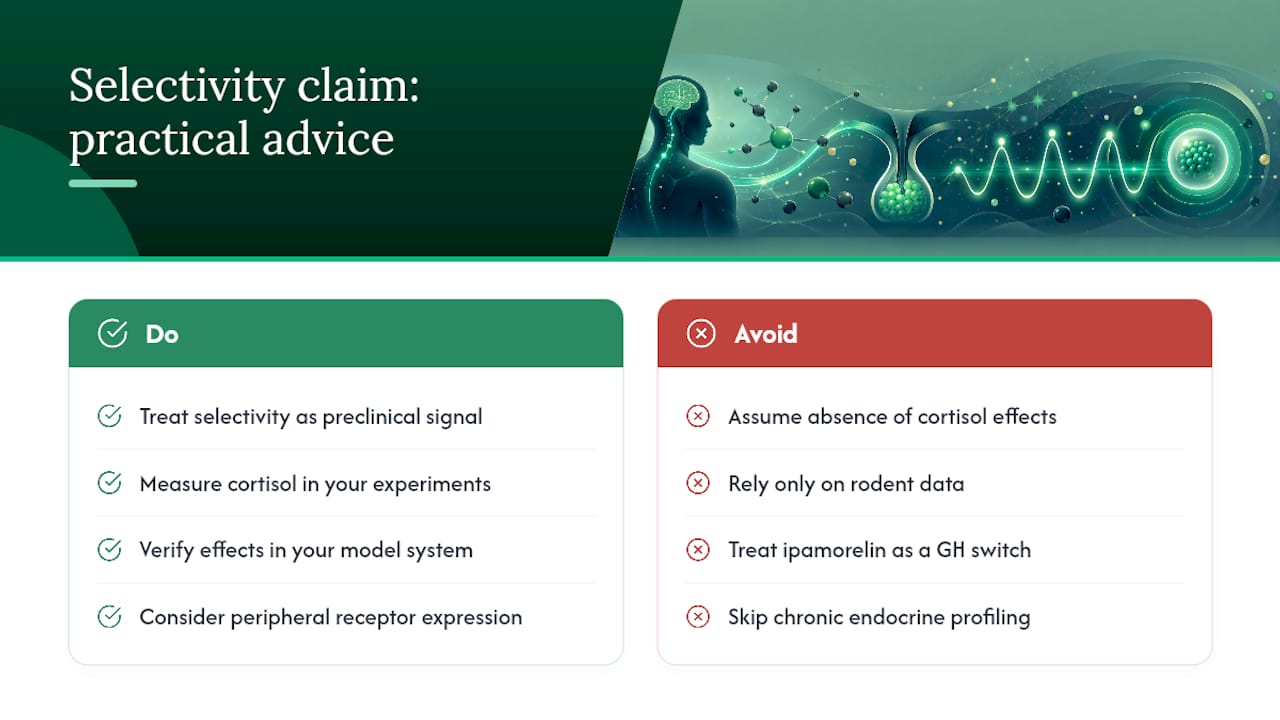
What this means practically is that researchers should treat the selectivity claim as a strong preclinical signal, not a proven pharmacological law. If your experimental design depends on the absence of cortisol effects, build in the measurement rather than assuming it. The animal data give you good reason to expect a clean GH signal, but they do not exempt you from verifying it in your own model system.
The second thing the consensus undersells is the translation gap. The GI motility story is instructive: compelling rodent data, failed human trials. The adipogenic signal in mice runs counter to what most researchers expect from GH axis activation. These are not anomalies to explain away; they are signals that GHS-R1a biology in whole animals is more complex than the pituitary-centric mechanism suggests. Peripheral receptor expression matters, and in whole-animal studies, you are always measuring the sum of all GHS-R1a-expressing tissues, not just the somatotrophs.
The researchers who will get the most out of ipamorelin are the ones who treat it as a precise pharmacological tool with a well-characterized but incompletely understood mechanism, not as a GH switch with a clean label.
This article is general information, not a substitute for advice from a qualified doctor. Consult a qualified healthcare professional about your own circumstances before acting on anything here.
Sources
Recommended
This article summarizes published research for informational purposes. Products sold by Neo Lab Peptides are for laboratory research use only and are not intended for human or animal use.