Tesamorelin, MGF, and Ipamorelin: US Research-Grade Guide
July 29, 2026 · STEPHAN ZOHAR

Tesamorelin, MGF (Mechano Growth Factor), and ipamorelin are all available for US laboratory research, but only as research-use-only (RUO) material. Before placing any order, your lab should require a Certificate of Analysis (CoA) with HPLC chromatogram and mass spectrometry data, confirmed purity of ≥98%, and traceable lot numbers. The AMA warns that many peptides sold online lack FDA oversight and carry real contamination risk. Neolabpeptides supplies lyophilized tesamorelin and ipamorelin with full CoA documentation and RUO labeling for US researchers.
- Require CoA with HPLC + mass spectrometry before purchase
- Confirm stated purity ≥98% and traceable lot/batch numbers
- Verify RUO labeling and explicit “not for human or veterinary use” terms
- Source from suppliers with documented third-party testing and US shipping
Pro Tip: Request the raw HPLC chromatogram file, not just a summary purity percentage. A single-peak chromatogram with no shoulder peaks is the first sign of a clean lot.
Table of Contents
- What do tesamorelin, MGF, and ipamorelin do in research?
- US regulatory status: RUO vs. FDA-approved therapeutics
- What your supplier’s CoA must include
- How to handle, store, and reconstitute lyophilized peptides
- Gray-market peptide risks and how to verify a supplier
- Ordering and shipping checklist for US labs
- Why Neolabpeptides is a reliable source for US research labs
- Key Takeaways
- The case for documentation-first procurement
- Neolabpeptides: research-grade peptides with full documentation
- Useful sources and suggested PubMed searches
What do tesamorelin, MGF, and ipamorelin do in research?
Each peptide targets a distinct node in the growth hormone axis, which is why the combination appears frequently in preclinical GH-axis studies.
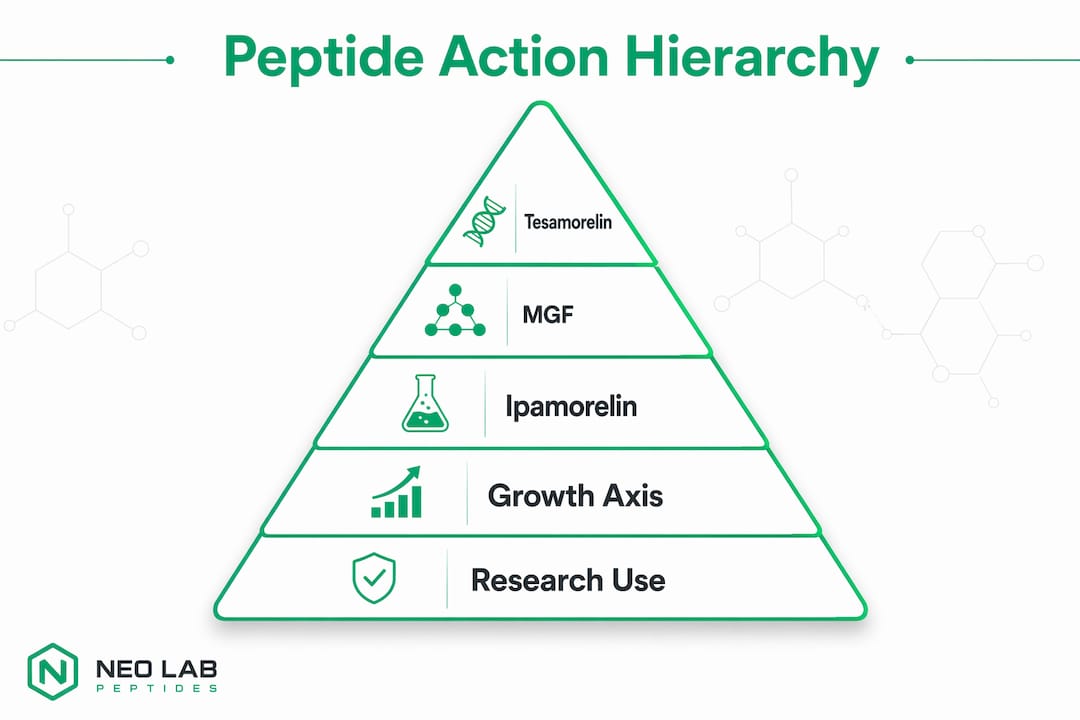
Tesamorelin is a synthetic analog of growth hormone-releasing hormone (GHRH). It binds GHRH receptors in the pituitary to stimulate endogenous GH secretion. Clinically, the FDA approved tesamorelin (Egrifta) for HIV-associated lipodystrophy, making it the only member of this trio with an approved therapeutic indication. Preclinical researchers use it to study visceral fat reduction, GH axis modulation, and metabolic signaling. As MDPI’s therapeutic peptides review notes, tesamorelin is a potent GHRH analog with clinical evidence for reducing visceral fat in specific patient populations, though broader performance or orthopedic claims lack robust human data.
MGF (Mechano Growth Factor) is a splice variant of IGF-1, expressed locally in response to mechanical stress or tissue damage. Unlike systemic IGF-1, MGF acts on satellite cells and promotes local muscle repair and hypertrophy signaling. It is widely used in muscle regeneration models and cell-culture studies examining myoblast proliferation. Most of the supporting evidence remains in animal models and in vitro systems.
Ipamorelin is a selective growth hormone-releasing peptide (GHRP) that acts at the ghrelin receptor (GHS-R1a). Its key research advantage: it raises GH without significantly elevating cortisol or ACTH, unlike GHRP-2 or GHRP-6. That selectivity makes ipamorelin particularly useful for studying pulsatile GH release and downstream IGF-1 effects without confounding stress-hormone variables.
Evidence-level note: Most positive data for MGF and ipamorelin come from preclinical models. A PubMed literature review found that human trials for many injectable peptides are sparse or methodologically limited. Researchers should prioritize peer-reviewed human data where available and treat preclinical findings as hypothesis-generating.
US regulatory status: RUO vs. FDA-approved therapeutics
The regulatory picture for this peptide group is not uniform.
- Tesamorelin: FDA-approved as a therapeutic drug (Egrifta) for HIV-associated lipodystrophy only. Research-grade tesamorelin sold as RUO material is a separate category and is not interchangeable with the pharmaceutical product.
- MGF and ipamorelin: No FDA-approved therapeutic indication. Both are sold exclusively as RUO research reagents in the US.
- The tesamorelin/MGF/ipamorelin combination: Not FDA-approved in any form. Per PubMed’s injectable peptide therapy primer, blended peptide combinations are experimental and must be treated as RUO.
RUO labeling means the material is manufactured and sold for laboratory research only. It is not subject to the same manufacturing controls as a pharmaceutical drug, and it carries no established dosing or safety profile for human use, as Harvard Health confirms. Institutional policies, IACUC protocols, and IRB documentation should reflect this status explicitly.
Pro Tip: When submitting a purchase order through your institution, attach the supplier’s RUO terms of sale alongside the CoA. Compliance officers increasingly require both documents before approving peptide reagent purchases.

What your supplier’s CoA must include
Accepting a summary purity number is not sufficient. Practitioner guidance is clear: verify raw chromatograms and MS traces to confirm peak identity and impurity profiles.
- HPLC chromatogram: Single dominant peak at the expected retention time; impurity peaks should be minimal and identified
- Mass spectrometry data: Molecular ion match to the theoretical mass of the peptide sequence; check for adducts and fragmentation patterns
- Stated purity: ≥98% preferred; the figure must derive from the HPLC area-under-curve, not a visual estimate
- Lot/batch number: Traceable to the specific synthesis run; must match the number on the vial label
- Endotoxin and sterility statements: Especially relevant for in vivo rodent studies
- Storage and shelf-life data: Lyophilized vs. reconstituted stability windows
- Third-party testing statement: Identifies the independent laboratory that ran the analysis
| CoA Element | What to Check |
|---|---|
| HPLC chromatogram | Single dominant peak; no unidentified shoulder peaks |
| MS molecular ion | Matches theoretical peptide mass; adducts noted |
| Purity (%) | ≥98% by HPLC area; source method stated |
| Lot number | Printed on vial label; matches CoA document |
| Endotoxin result | EU/mg value stated; relevant for in vivo use |
| Third-party lab | Named independent facility; not in-house only |
For peptide third-party testing, the named testing laboratory should be identifiable and verifiable. If a vendor lists “internal QC” as the sole testing source, treat that as a red flag.
How to handle, store, and reconstitute lyophilized peptides
Lyophilized peptides are stable at room temperature during short transit periods, but long-term storage requires controlled conditions.
- Receive and inspect. Check seal integrity, vial labeling, and temperature log on arrival. Photograph the CoA and assign an internal lot ID before placing the vial in storage.
- Store lyophilized material. Keep at -20°C for long-term storage (up to 24 months for most lyophilized peptides under dry conditions); -80°C extends stability further for sensitive sequences like MGF.
- Choose your reconstitution solvent. For in vitro cell-culture work, sterile PBS or acetic acid (0.1–1% v/v) is standard. Bacteriostatic water (0.9% benzyl alcohol) is used in RUO injectable preparations. MGF is particularly sensitive to pH; reconstitute in slightly acidic conditions to prevent aggregation.
- Calculate your target concentration. Use a reconstituting peptides calculator to confirm volume and molarity before adding solvent. Typical in vitro working concentrations range from 1–100 nM for ipamorelin GH-release assays and 10–200 ng/mL for MGF myoblast studies.
- Aliquot immediately. Single-use aliquots prevent repeated freeze-thaw cycles. Each freeze-thaw cycle can degrade peptide integrity, particularly for MGF.
- Label and log. Each aliquot should carry the internal lot ID, peptide name, concentration, solvent, and preparation date.
Pro Tip: Avoid vortexing reconstituted peptides. Gentle swirling or end-over-end rotation preserves secondary structure, especially for longer sequences like tesamorelin (44 amino acids).
Gray-market peptide risks and how to verify a supplier
The AMA’s guidance on injectable peptides is direct: many peptides sold online are produced without standard manufacturing controls, creating real contamination and mislabeling risk. For a research lab, a contaminated lot does not just waste budget. It invalidates data.
Red flags on a vendor site:
- No physical laboratory address or contact information
- CoA available only after purchase, or not at all
- Language implying suitability for human use
- No named third-party testing laboratory
- No lot-specific documentation (generic CoA covering multiple batches)
Verification steps before ordering:
- Request the raw HPLC file and MS spectrum for the specific lot you intend to purchase.
- Cross-reference the lot number on the CoA against the number printed on the vial when it arrives.
- Confirm the named third-party lab is a real, independently verifiable facility.
- Request shipping and origin documentation, including cold-chain records if applicable.
- Review the return and recall policy in writing before completing the purchase.
Ordering and shipping checklist for US labs
Documentation to request with every order:
- RUO invoice with explicit “not for human or veterinary use” terms
- CoA accompanying the shipment (not emailed separately after delivery)
- Safety Data Sheet (SDS) where applicable
- Batch/lot traceability records
Shipping requirements: Lyophilized peptides are generally stable with cold packs for domestic US transit of 2–5 business days. For longer transit or warm-season shipping, dry ice is preferred. Confirm the vendor’s cold-chain protocol before ordering. International vendors shipping to the US must comply with US import documentation requirements; request a commercial invoice with HS code and country of origin.
On arrival: Check seal integrity, confirm temperature log is within range, photograph the CoA, and log the internal lot ID in your lab’s inventory system before placing the vial in storage.
Pro Tip: For institutional orders, request that the vendor include the RUO terms of sale as a separate document inside the shipment box, not just in the online order confirmation. This simplifies compliance audits.
Why Neolabpeptides is a reliable source for US research labs
Neolabpeptides supplies lyophilized research-grade peptides, including tesamorelin and ipamorelin, with Certificates of Analysis covering HPLC and mass spectrometry data and reported purity of ≥98%. All products carry RUO labeling with explicit “not for human or veterinary use” terms of sale.
| Trust Signal | Neolabpeptides Standard |
|---|---|
| Purity | ≥98% reported by HPLC |
| CoA documentation | HPLC chromatogram + MS data included |
| Testing type | Third-party verified |
| Product form | Lyophilized vials |
| Labeling | RUO; not for human or veterinary use |
| US shipping | Domestic shipping available |
What researchers can expect in a typical product package from Neolabpeptides:
- Lyophilized vial with lot number printed on label
- CoA with HPLC and MS data accessible at purchase
- Storage and reconstitution notes
- RUO terms of sale included with order documentation
For labs building a GMP-aligned procurement checklist, Neolabpeptides’s documentation package maps directly to the CoA, purity, and traceability requirements outlined above.
Key Takeaways
Tesamorelin, MGF, and ipamorelin are available for US laboratory research only as RUO material, and procurement decisions must be driven by CoA quality, purity verification, and traceable lot documentation.
| Point | Details |
|---|---|
| RUO status is non-negotiable | All three peptides must be purchased as research-use-only; the combination is not FDA-approved in any form. |
| CoA must include raw data | Require HPLC chromatogram and MS molecular ion data, not just a stated purity percentage. |
| Purity threshold | ≥98% by HPLC area-under-curve is the minimum acceptable standard for reproducible research. |
| Storage and aliquoting | Store lyophilized material at -20°C; aliquot after reconstitution to avoid freeze-thaw degradation. |
| Neolabpeptides | Supplies lyophilized tesamorelin and ipamorelin with HPLC/MS CoA, ≥98% reported purity, and RUO labeling for US labs. |
The case for documentation-first procurement
The peptide research market has a real documentation problem. Vendors routinely publish a single purity number without showing the chromatogram that generated it. For a researcher designing a GH-axis study, that gap is not a minor inconvenience. It is a reproducibility risk. A contaminated or mislabeled lot can corrupt months of data, and no institutional review board will accept results from a reagent with no traceable lot number.
The guidance here is not about being overly cautious. It reflects what rigorous science actually requires: a CoA with raw HPLC and MS data, a named third-party testing lab, and a vendor whose RUO terms are explicit and documented. Tesamorelin, MGF, and ipamorelin are genuinely useful research tools when sourced correctly. The procurement process is where that usefulness either gets protected or undermined.
This article is general research information, not regulatory or legal advice. Confirm current RUO requirements and institutional policies with your compliance office or a qualified regulatory professional.
Neolabpeptides: research-grade peptides with full documentation
Neolabpeptides provides lyophilized tesamorelin, ipamorelin, and a growing catalog of research-grade peptides, each backed by HPLC and mass spectrometry Certificates of Analysis and ≥98% reported purity. Every product ships with RUO labeling and explicit “not for human or veterinary use” terms, giving procurement teams and compliance officers the documentation they need from the first order.

For institutional orders, batch documentation requests, or CoA review before purchase, visit Neo Lab Peptides to access product pages, download CoAs, and contact the team directly.
Useful sources and suggested PubMed searches
Primary references used in this article:
- Injectable peptide therapy: a primer for orthopaedic and sports medicine physicians (PubMed)
- Therapeutic peptides in aesthetic, metabolic and endocrine conditions (MDPI)
- What doctors want patients to know about injectable peptides (AMA)
- Peptides: What they are, potential benefits, and safety concerns (Harvard Health)
- Neo Lab Peptides tesamorelin product page
- Neo Lab Peptides ipamorelin product page
Suggested PubMed search queries for protocol planning:
| Research Goal | Suggested Search Query |
|---|---|
| Tesamorelin GH axis studies | “tesamorelin” AND “growth hormone” AND “preclinical” |
| MGF muscle regeneration | “mechano growth factor” AND “myoblast” OR “muscle repair” |
| Ipamorelin GH selectivity | “ipamorelin” AND “GHRP” AND “cortisol” |
| Peptide purity standards | “research-grade peptide” AND “HPLC” AND “mass spectrometry” |
| RUO peptide procurement | “research use only” AND “peptide” AND “quality control” |
Recommended
This article summarizes published research for informational purposes. Products sold by Neo Lab Peptides are for laboratory research use only and are not intended for human or animal use.