Researchers: 5 Lab Ready Lyoprotectant Formulations for Peptides
September 23, 2026 · STEPHAN ZOHAR

For most peptides, non-reducing disaccharides, sucrose or trehalose, used with a crystalline bulking agent when cake strength is a concern, provide the most reliable starting point for lyophilization. That default holds up across a wide range of sequences, but it is a starting point, not a guarantee. Confirm the choice with a glass transition (Tg′) measurement, a residual moisture check, and an aggregation assay before you commit a formulation to a stability program.
TL;DR:
- Sucrose and trehalose are the most common lyoprotectants, but screening for their glass transition temperature and residual moisture is essential for optimal stability.
- Proper annealing during freezing is critical, especially for formulations with mannitol, to ensure consistent crystallization and prevent cake collapse.
- Combining disaccharides with secondary excipients like amino acids or bulking agents reliably improves peptide stabilization and cake integrity.
- Analytical tests such as Karl Fischer titration, DSC, and HPLC are necessary to verify residual moisture, glass transition, and peptide integrity after lyophilization.
- Sourcing verified, high-purity peptides with detailed lot-specific documentation minimizes input material variability and reduces formulation failure risks.
Table of Contents
- What Are Lyoprotectants for Peptides and Why Do They Matter?
- How Do Water Replacement and Vitrification Protect Peptides?
- Which Lyoprotectants and Co-Excipients Work Best for Peptides?
- How Should You Select and Screen Lyoprotectants for a New Peptide?
- What Are Practical Starting Formulations for Peptide Lyophilization?
- How Do Freezing, Drying, and Reconstitution Interact With Your Excipient Choice?
- Which Analytical Methods Confirm Peptide Stability After Lyophilization?
- How Neolabpeptides Supports Excipient Screening for Peptide Formulation Work
- A Practical Perspective on Peptide Lyophilization Surprises
- Where to Find Lab-Ready Peptides for Your Formulation Work
- Sources
- FAQ
What Are Lyoprotectants for Peptides and Why Do They Matter?
Lyoprotectants are excipients that protect a peptide’s structure during freezing, drying, and long-term storage in the solid state. Without one, a peptide subjected to freeze concentration and dehydration stress is prone to aggregation, deamidation, or loss of biological activity once reconstituted. The right lyoprotectant preserves the molecule through two overlapping mechanisms, and understanding both changes how you pick and combine excipients.
Sucrose and trehalose remain the benchmark choices because they combine strong hydrogen-bonding capacity with a low glass transition temperature in the frozen concentrate (Tg′), a property that governs how forgiving your drying cycle can be. Mannitol and glycine step in when you need a rigid, cosmetically clean cake rather than pure molecular stabilization. Surfactants, amino acids, and a handful of experimental excipients round out the toolkit for edge cases: hydrophobic peptides, interface-sensitive sequences, or formulations pushing toward higher storage temperatures.
The rest of this guide works through the mechanisms, the excipient inventory, a screening framework, ready-to-test formulations, the process parameters that interact with your excipient choice, and the analytical methods that confirm you got it right.
How Do Water Replacement and Vitrification Protect Peptides?
Lyoprotectants work through two mechanisms that operate together rather than in competition. Water replacement describes how sugar hydroxyl groups substitute for the hydrogen bonds a peptide normally forms with surrounding water molecules, preserving its native conformation once that water is removed. Vitrification describes the formation of an amorphous, glass-like solid that physically immobilizes the peptide, slowing molecular motion enough to prevent aggregation and chemical degradation over years of storage.
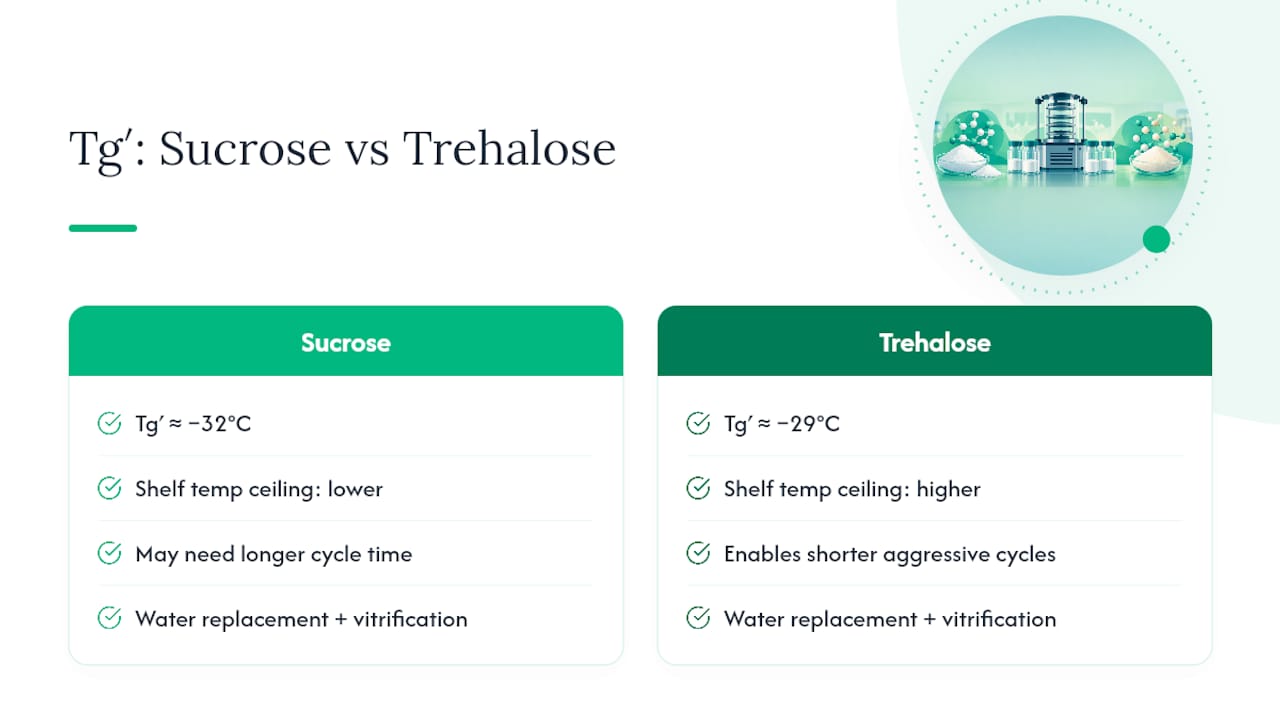
Both mechanisms trace back to the same physical property: the glass transition temperature of the maximally freeze-concentrated solution, or Tg′. Below Tg′, the frozen matrix behaves as a rigid glass. Above it, the matrix softens, mobility increases, and your cake risks collapse during primary drying. Tg′ for sucrose sits around -32°C, while trehalose runs closer to -29°C, a difference of a few degrees that matters more than it looks. That gap can shift your shelf temperature setpoint during primary drying and change cycle time by hours on a production-scale run.
For peptides specifically, water replacement matters more than it does for larger globular proteins. Peptides have less internal structure to lose, but they often have more exposed polar and hydrophobic residues relative to their size, making the hydrogen-bonding network between excipient and peptide surface a bigger share of total stabilization. A review of lyoprotectant effectiveness across protein and peptide systems found disaccharides consistently outperform other sugar classes, and that combining a disaccharide with a second excipient, an amino acid, a polymer, or a polyol, frequently improves outcomes beyond what either excipient achieves alone.
Mechanism should drive excipient selection in a concrete way. If your priority is a short, aggressive drying cycle, a higher Tg′ excipient buys you more headroom before the shelf temperature risks collapse. If your priority is multi-year storage stability at ambient temperature, you want the lowest achievable residual moisture paired with an excipient whose Tg sits well above your storage temperature, not just above zero. Sucrose and trehalose satisfy both goals reasonably well, which is why they dominate commercial peptide formulations, but neither is automatically correct for every sequence. A peptide with unusual hydrophobic patches or an isoelectric point close to formulation pH may behave differently than the disaccharide literature predicts, which is exactly why empirical screening, covered later in this guide, stays non-negotiable.
Which Lyoprotectants and Co-Excipients Work Best for Peptides?
Every lyophilized peptide formulation is built from a small set of functional roles: a molecular stabilizer, often a bulking agent for cake integrity, sometimes a surfactant, and occasionally a pH buffer that doubles as a stabilizer. Matching the right material to each role is the practical core of stabilization of peptides during freeze-drying.
- Sucrose (Tg′ ≈ -32°C): the most widely used disaccharide lyoprotectant, non-reducing so it will not participate in Maillard-type browning with primary amines on the peptide, strong water-replacement capacity, but it stays fully amorphous and contributes no cake rigidity on its own.
- Trehalose (Tg′ ≈ -29°C): comparable stabilization to sucrose with a marginally higher Tg′, useful when you need slightly more thermal headroom during drying or storage, though it is more expensive at bulk scale and can be harder to source in parenteral grade in some regions.
- Mannitol: a crystalline bulking agent that produces an elegant, mechanically robust cake and supports aggressive drying cycles, but it crystallizes during freezing and offers little direct molecular protection. Using it alone with a sensitive peptide risks excluding the peptide from the protective sugar matrix during crystallization, an effect sometimes called cryoconcentration exclusion.
- Glycine: another crystalline bulking agent, generally milder in pH effect than mannitol, often chosen when mannitol’s crystallization behavior proves inconsistent across batches.
- Polyols, lactose, and maltitol: useful in specific niches, but lactose is a reducing sugar and carries Maillard reaction risk with peptides that expose free amines, which rules it out for many sequences despite its low cost. Maltitol and other polyols see occasional use but lack the extensive parenteral safety record of sucrose and trehalose, so regulatory strategy should factor into any decision to use them.
- Polysorbate 20 or 80: added at very low concentrations, typically well under 0.05% w/v, to reduce peptide loss at the ice/liquid or air/liquid interface during freezing and reconstitution. Both surfactants are prone to oxidative degradation over long-term storage, and their degradation products can interfere with HPLC-based purity assays, so use the lowest concentration that solves the interface problem rather than a round default number.
- Histidine: an amino acid that functions as a mild buffer near physiological pH while also contributing modest lyoprotection through its own hydrogen-bonding capacity.
- Arginine: used in select formulations as an aggregation suppressor, particularly for peptides prone to self-association through charge or hydrophobic interactions, though it does not substitute for a proper disaccharide-based stabilization strategy.
- Short peptides and antiplasticizers: an emerging excipient class exemplified by FK906, which shows a Tg′ near -19°C, notably higher than either sucrose or trehalose. The data set behind these excipients remains thin, so treat them as experimental options worth screening rather than default choices for a formulation you plan to lock down soon.
Combination strategies consistently beat single-excipient systems. Nanoparticle and peptide-polymer studies back this up directly: co-lyophilizing with a disaccharide such as lactosucrose measurably preserved particle morphology and post-reconstitution bioactivity compared to formulations lacking a protective excipient. The practical takeaway holds for straight peptide formulations too, not just nanoparticle carriers: pairing an amorphous sugar with a second functional excipient tends to outperform relying on any single material.
How Should You Select and Screen Lyoprotectants for a New Peptide?
Selecting a lyoprotectant is not a lookup exercise. It is a short, structured experiment, and skipping steps here is the single most common reason formulations fail late in development rather than early, when fixing them is cheap.
- Profile the peptide first. Determine its isoelectric point, map hydrophobic patches, and flag chemical liabilities such as free cysteines, methionine, or asparagine residues prone to deamidation. Note your formulation constraints too: intended route, any excipients your institution or downstream partner restricts, and target concentration.
- Shortlist candidates by Tg′, crystallization tendency, and chemical compatibility. Start with sucrose and trehalose as your amorphous stabilizers. Add mannitol or glycine to the shortlist only if you specifically need cake rigidity or are running an aggressive, high-temperature drying cycle.
- Build a minimalist screening matrix. Test sugar concentrations in the 1 to 10% w/v range as a starting band, and use binary mixes (sugar plus bulking agent, sugar plus surfactant) rather than single-variable runs whenever your resources allow it. Stress the leading candidates with an accelerated thermal cycle and at least one freeze-thaw cycle before committing to a full lyophilization run.
- Apply analytical criteria for downselection. Residual moisture, aggregation limits by HPLC or SEC, and activity retention against a pre-lyophilization control should each have a pass threshold defined before you run the experiment, not after you see the data.
Pro Tip: Run your Tg′ comparisons before you run anything else. A three-degree difference between candidate excipients sounds trivial on paper, but it can shift your primary drying shelf temperature enough to change cycle time by several hours at scale, and that gap is far cheaper to discover on a differential scanning calorimetry (DSC) trace than on a failed production batch.
The freeze-drying cycle development and QC protocol that formulation labs commonly follow builds directly on this same four-step logic, and it is worth reviewing before you finalize your screening matrix design.
What Are Practical Starting Formulations for Peptide Lyophilization?
Concrete starting points save time. None of the following recipes are meant as final formulations, but each represents a defensible, literature-supported base you can adapt to your specific peptide within a day or two of bench work.
The table below lays out five starting compositions along with the rationale behind each one.
| Formulation | Composition | Rationale |
|---|---|---|
| A: Basic amorphous | 4% sucrose, 20 mM histidine | Minimal system for early screening; tests core disaccharide protection without confounding variables |
| B: Sugar plus bulking agent | 3% trehalose, 2% mannitol, 20 mM histidine | Combines molecular stabilization with cake structure; good default for peptides needing visual cake integrity |
| C: Interface-sensitive peptide | 4% sucrose, 2% mannitol, 0.01% polysorbate 20 | Adds low-level surfactant for peptides prone to interfacial loss during freeze-thaw or agitation |
| D: Aggregation-prone peptide | 5% trehalose, 20 mM arginine, 10 mM histidine | Arginine targets self-association; higher sugar load compensates for reduced bulking contribution |
| E: High-solids robust cake | 3% sucrose, 3% glycine, 20 mM histidine | Glycine substitutes for mannitol when crystallization behavior proves inconsistent across lots |
- Use an amorphous-only matrix (Formulation A or D) when your peptide is chemically fragile and you can tolerate a cosmetically softer cake.
- Use a crystalline bulking agent (Formulation B, C, or E) when you need a mechanically robust cake for shipping, handling, or a fast reconstitution profile.
- Watch hygroscopicity closely with any amorphous-heavy system: a fully amorphous sucrose or trehalose cake absorbs atmospheric moisture faster than a crystalline-bulked one, which affects both storage stability and the container closure you choose.
Two failure modes show up repeatedly in early screening. Phase separation between the amorphous sugar phase and a crystallizing bulking agent produces a cake with visibly uneven texture, usually traceable to a bulking agent concentration that is too low to crystallize fully or a freezing rate that is inconsistent across vials. Partial crystallization of mannitol, where some vials crystallize and others do not, is the more common problem, and it is almost always solved by adding an annealing step, which the next section covers in detail.
How Do Freezing, Drying, and Reconstitution Interact With Your Excipient Choice?
Every excipient decision has a downstream consequence in the freeze-dryer, and treating formulation and process as separate problems is a mistake that shows up as failed batches months later.
Freezing rate determines pore structure. A fast freeze produces small ice crystals and a fine, dense pore network that slows vapor transport during primary drying, while a slow freeze produces larger crystals and a more open cake structure that dries faster but can look less elegant. Neither is universally correct; the choice depends on whether drying speed or cake appearance matters more for your application.
Annealing, holding the frozen product at a temperature above its initial freezing point for a defined period before primary drying, matters most in mannitol-containing systems. The hold allows ice crystals to undergo Ostwald ripening and gives mannitol time to complete crystallization, typically at temperatures in the range of -15°C to -20°C for mannitol-based systems. Skip annealing on a mannitol formulation and you risk a partially amorphous cake that collapses partway through drying, a failure mode that looks random from batch to batch until you realize the annealing step was missing all along.
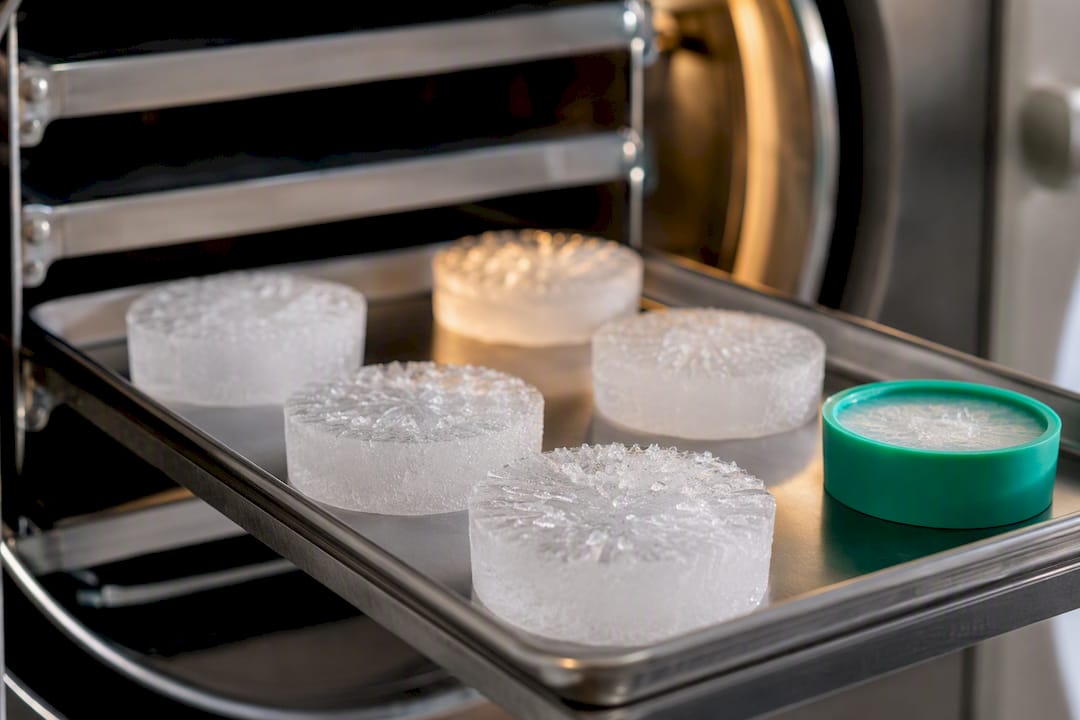
Tg′ sets your primary drying ceiling. Shelf temperature and chamber pressure need to keep the product temperature below Tg′ throughout primary drying to avoid collapse, which is why the few degrees of difference between sucrose and trehalose translate directly into cycle design decisions. Secondary drying then targets residual moisture low enough to preserve a meaningful margin between your storage temperature and the dried cake’s glass transition. Keeping storage temperature roughly 50°C below the dry-state Tg is a reasonable design target, and it is one reason many labs aim for residual moisture in the 1 to 2% range rather than treating any single number as an absolute ceiling.
Pro Tip: If a mannitol-based cake collapses unpredictably across a batch, check your annealing step before you change anything else in the formulation. Inconsistent crystallization, not a bad excipient choice, is the more common culprit.
Reconstitution deserves the same attention as drying. A trace of surfactant, the same low-level polysorbate used during lyophilization, often speeds reconstitution and reduces visible foaming or particulate formation on rehydration, particularly for peptides that showed interfacial sensitivity during initial freezing. Our lyophilized peptide storage and handling guide covers reconstitution practice in more depth for researchers working with finished lyophilized lots.
Which Analytical Methods Confirm Peptide Stability After Lyophilization?
A formulation is only as good as the data proving it works, and four assays cover the core of what any competent QC program for lyophilized peptides should run.
- Karl Fischer titration measures residual moisture directly and remains the industry-standard method, with many programs targeting the 1 to 2% range for long-term stability and using a broader threshold, often cited near 5% w/w, as a marker that primary drying has reached completion.
- Differential scanning calorimetry (DSC) measures both Tg′ in the frozen concentrate and Tg in the final dried cake, letting you confirm your process stayed below the collapse threshold and that your storage temperature leaves adequate margin below the dry-state glass transition.
- HPLC and size-exclusion chromatography (SEC) detect aggregation and chemical degradation products, the two failure modes lyoprotectants are specifically designed to prevent, and they are the assays most likely to reveal a subtle formulation problem that visual inspection misses entirely.
- Potency or activity assays confirm that whatever biological or biochemical function the peptide is meant to have survived the freeze-drying process intact, which is the ultimate test any of the above methods are proxies for.
- Cake appearance and reconstitution time round out the panel as fast, low-cost checks: a collapsed, shrunken, or unevenly textured cake, or an unexpectedly slow reconstitution, is often the first visible sign that something in the formulation or cycle needs revisiting before you invest in the more expensive assays. Bench stability studies, holding samples at accelerated and real-time conditions and pulling these same assays on a schedule, close the loop on whether your excipient choice actually delivers the shelf life you designed for.
Researchers designing a formal, regulatory-facing stability program should also consult ICH Q5C, which lays out expectations for stability data on proteins and polypeptides and is the reference most reviewers will expect your study design to reflect.
How Neolabpeptides Supports Excipient Screening for Peptide Formulation Work
Screening lyoprotectants only works if you trust the purity and identity of the peptide you start with. A formulation failure caused by a contaminated or misidentified starting material looks identical, on the bench, to a genuine excipient incompatibility, and untangling the two after the fact wastes weeks.
That documentation matters most exactly at the screening stage, when you need confidence that any instability you observe traces back to your excipient system rather than to the input material.
Two resources are worth reviewing before you start a screening matrix. Our guide on peptide third-party testing explains what independent verification actually covers and how to read the resulting reports. Our companion piece on how to read a peptide Certificate of Analysis walks through interpreting the HPLC and mass spec data lot by lot, which is useful groundwork before you build any screening matrix on top of it. For labs running their own freeze-drying cycles, the peptide lyophilization protocol guide covers cycle development in more practical detail than fits in this section.
The practical next step for most labs is ordering a small sample lot, requesting the lot-specific COA, and running your excipient screening matrix against a peptide whose starting purity you can already verify rather than assume.
A Practical Perspective on Peptide Lyophilization Surprises
Three things trip up labs that are otherwise doing everything right. Annealing is the first: it gets treated as optional because it adds time to the cycle, and skipping it on a mannitol-based formulation is the single most common reason batches show inconsistent, unexplained collapse from run to run. Residual moisture is the second: teams hit a passing Karl Fischer number and stop looking, without checking whether that number leaves enough margin below the dried cake’s Tg for the storage temperature they actually plan to use. Surfactant oxidation is the third, and the quietest: polysorbate 20 or 80 sitting in a formulation for months can degrade in ways that show up as an unexplained peak on an HPLC trace, and it gets misread as a peptide degradation product when it is really an excipient breaking down.
A one-week cadence handles initial screening reasonably well: profile and shortlist candidates on day one, prepare a binary screening matrix by day two or three, run the lyophilization cycle and stress conditions through the middle of the week, and pull Karl Fischer, DSC, and HPLC data by week’s end. Document every COA and batch record alongside your screening data from day one. The formulation that looks unremarkable in week one is often the one you will need to defend with a full data trail eighteen months later, and reconstructing that trail after the fact is far harder than logging it as you go.
— Stephan
Where to Find Lab-Ready Peptides for Your Formulation Work
Every formulation strategy in this guide depends on starting with a peptide you can trust, and that is where sourcing decisions matter as much as excipient choices. Neolabpeptides supplies research-grade, lyophilized peptides verified above 98% purity through independent HPLC and mass spectrometry testing, with a lot-specific Certificate of Analysis included on every order and shipped from US facilities.

When you order a sample lot for excipient screening, request the COA, the lot-specific test report, and the recommended storage conditions before you start your matrix. That documentation gives you a verified baseline, so any instability you observe during screening can be traced to your formulation rather than to an unknown starting material. Browse the current peptide catalog to source lyophilized peptides for your next screening run, from growth hormone secretagogues to GLP and metabolic peptides, and pair your order with our lyophilization protocol guide to align your cycle development with a verified starting material from day one.
Sources
- Lyoprotective Effects of Mannitol and Lactose Compared to Sucrose and Trehalose: Sildenafil Citrate Liposomes as a Case Study
- Pharmaceutics article on excipients and lyophilization (2025)
FAQ
How Do You Lyophilize a Peptide?
Dissolve the peptide with your chosen lyoprotectant, typically sucrose or trehalose with an optional bulking agent, then freeze, anneal if using mannitol, and dry under vacuum in two stages: primary drying below the formulation’s Tg′ and secondary drying to reach target residual moisture. Confirm the result with Karl Fischer titration, DSC, and an aggregation assay before releasing the batch.
How Long Does Lyophilization Take?
Cycle time varies widely based on fill volume, vial geometry, and the excipient system’s Tg′, ranging from short times for small-volume screening runs to several days for larger batches. A higher Tg′ excipient generally allows a warmer shelf temperature during primary drying, which can shorten the cycle compared to a lower Tg′ system run at the same collapse-safety margin.
What Drugs and Biologics Are Commonly Lyophilized?
Peptide and protein therapeutics, vaccines, and many biologics are lyophilized because they are unstable in aqueous solution over the timeframes required for storage and distribution. Growth hormone secretagogues, GLP-1 analogs, and other research peptides are supplied in lyophilized form for exactly this reason, since the solid state dramatically slows the degradation pathways that liquid formulations are prone to.
Do You Need Oil in a Freeze-Dryer?
Rotary vane vacuum pumps used in most laboratory and pilot-scale freeze-dryers require a specific pump oil to maintain the vacuum seal and lubricate internal components, and using the wrong grade can degrade pump performance over time. This is a pump maintenance requirement rather than a formulation consideration, and it does not affect excipient selection or peptide stability.
What Is the Best Lyoprotectant for Peptides?
Sucrose and trehalose are the most reliable starting excipients for peptide lyophilization, backed by extensive use across protein and peptide formulations. The right choice still depends on your specific peptide’s chemistry, so empirical screening against Tg′, residual moisture, and aggregation criteria remains necessary before finalizing a formulation.
Recommended
This article summarizes published research for informational purposes. Products sold by Neo Lab Peptides are for laboratory research use only and are not intended for human or animal use.