Prevent False Synergy: 5 Lab Protocol Priorities for Ipamorelin and CJC-1295
September 17, 2026 · STEPHAN ZOHAR

Yes: Ipamorelin and CJC-1295 activate distinct pituitary receptors and produce supra-additive GH responses in controlled laboratory models. The complementary mechanism is well documented at the receptor level, but no large trials have validated this exact combination as a product. What follows covers the receptor biology, assay selection, variant differences, and procurement standards researchers need before designing a synergy study.
TL;DR:
- Combining CJC-1295 and Ipamorelin can produce supra-additive growth hormone responses, but this synergy depends on receptor density, timing, and feedback mechanisms.
- Using the long-acting CJC-1295 with DAC can obscure pulsatile GH effects, so pairing it with Ipamorelin for pulse studies is not ideal; no-DAC variants suit pulsatility better.
- DMR assays detect broader receptor activity and inverse agonism at GHSR, unlike calcium mobilization tests, making them more reliable for pharmacological profiling.
- Dose-response pilots for each peptide alone are essential before combining them to confirm true synergy and avoid artifacts caused by dosing imbalances.
- Peptide integrity and lot-to-lot consistency are common confounds, requiring thorough verification of certificates of analysis and proper storage to ensure replicable results.
Table of Contents
- What Causes Ipamorelin CJC-1295 Synergy at the Receptor Level?
- Which CJC-1295 Variant and Protocol Design Fit Your Study?
- Should You Run DMR or Calcium Mobilization Assays?
- What Signaling Pathways Change With Combined Treatment?
- Is It Synergy, or Just an Additive Effect?
- What Confounds Synergy Experiments Most Often?
- Author Perspective: Design Priorities and Evidence Gaps
- Neo Lab Peptides: Research-Grade Supply for GH-Axis Studies
- Sources
- FAQ
What Causes Ipamorelin CJC-1295 Synergy at the Receptor Level?
The synergy hinges on two separate receptors converging on the same cell type. CJC-1295 is a growth hormone releasing hormone (GHRH) analog that binds the GHRH receptor (GHRHR) on pituitary somatotrophs. Ipamorelin, by contrast, is a selective ghrelin receptor (GHSR, also called GHSR-1a) agonist. These are not redundant pathways doing the same job twice. GHRHR activation drives cyclic AMP and protein kinase A signaling, while GHSR activation works largely through phospholipase C and intracellular calcium release.
Because the two receptors sit on the same somatotroph but signal through different second messengers, simultaneous activation can produce a GH pulse larger than either compound generates alone. This is not a new observation dressed up in peptide-industry language. Foundational human infusion studies dating back decades demonstrated that combining a GHRH stimulus with a growth hormone releasing peptide (GHRP) stimulus produces GH release exceeding the simple sum of the two individual responses, a finding that underpins the modern rationale for pairing a GHRH analog with a GHSR-class ligand, as summarized in reviews of growth hormone secretagogue pharmacology.
Several factors shape how that complementarity plays out in a given model system:
- Receptor density on the target tissue. Somatotroph populations vary by species and cell line, which changes the magnitude of any observed synergy.
- Timing of exposure. GHRHR and GHSR signaling kinetics differ, so simultaneous versus staggered dosing can produce different pulse shapes.
- Downstream negative feedback. Somatostatin tone and IGF-1 feedback loops can mask or amplify apparent synergy depending on the experimental window.
The honest caveat belongs here, not buried later: this literature supports the mechanism, not a validated combination-product outcome. No large randomized trials have tested the specific CJC-1295 plus Ipamorelin pairing as a defined regimen. Everything downstream of the receptor biology, meaning actual GH output, IGF-1 changes, or any translational endpoint, still needs to be measured directly in your own model, not assumed from mechanism alone.
Which CJC-1295 Variant and Protocol Design Fit Your Study?
CJC-1295 exists in two forms that behave very differently in a pharmacokinetic sense, and picking the wrong one will quietly undermine an otherwise well-designed synergy study.
CJC-1295 with DAC (Drug Affinity Complex) binds serum albumin, extending its half-life substantially and producing a tonic, sustained elevation in GHRHR stimulation. CJC-1295 without DAC (sometimes called Mod GRF 1-29) clears quickly, closer to native GHRH kinetics, and preserves a pulsatile signaling pattern. Ipamorelin itself has a short half-life and is generally favored in pulse-focused protocols because it does not flatten the GH pulse profile the way a long-acting GHRHR agonist can.
The choice is not cosmetic. If your endpoint is pulsatile GH release, a DAC-bearing variant paired with Ipamorelin can obscure the very pulse dynamics you are trying to characterize. If your endpoint is sustained IGF-1 elevation over a longer window, tonic GHRHR stimulation from a DAC variant may be exactly what the experimental question calls for.
Before running a full protocol, define these variables in writing:
- Dosing pilot range. Establish a dose response curve for each peptide independently before combining them, so any observed synergy can be attributed to the combination rather than to an unrecognized ceiling effect in one compound.
- Sampling schedule relative to pulses. Frequent, tightly timed sampling is non-negotiable for pulsatility work. Sparse sampling will miss the pulse entirely and produce a false negative.
- Control groups. Include vehicle, each peptide alone, and the combination as separate arms.
- Endpoints beyond GH. Track IGF-1 and any secondary hormones relevant to your model (insulin, cortisol, somatostatin where measurable) to distinguish a genuine axis effect from an isolated GH spike.
- Quality documentation per lot. Record lot number, Certificate of Analysis, and storage conditions for every peptide batch used, since inter-lot variability is a common and underreported confound.
Pro Tip: Run your dose-ranging pilot with each peptide in isolation before touching the combination arm. Researchers who skip this step often can’t tell whether an observed “synergy” is real or just an artifact of one compound being underdosed relative to the other.
For background on how Ipamorelin’s receptor selectivity shapes its pulsatile profile, see this breakdown of Ipamorelin’s mechanism and pulsatile GH release.
Should You Run DMR or Calcium Mobilization Assays?
Assay choice determines what you can actually see, and choosing the wrong one can make a real pharmacological signal disappear entirely.
Dynamic mass redistribution (DMR) is a label-free, whole-cell assay that tracks changes in cellular mass distribution following receptor activation. It reliably discriminates full agonists, partial agonists, antagonists, and inverse agonists at GHSR, and it detects pharmacological activity that calcium mobilization assays can miss entirely, according to comparative pharmacological characterization of GHSR ligands. In that study, compounds acting as inverse agonists, including PF-05190457 and H1498, showed clear activity in DMR while appearing inactive in a standard calcium mobilization readout.
Calcium mobilization assays remain useful and cheaper to run at scale, but they have a blind spot: they capture the phospholipase C to calcium arm of GHSR signaling well, yet miss subtler efficacy differences and inverse agonism that DMR picks up.
For a synergy study, the practical recommendation is to triangulate:
- Run DMR to characterize each ligand’s full pharmacological profile, including any inverse agonism.
- Run calcium mobilization in parallel to confirm the canonical signaling arm.
- Layer in a hormone timecourse assay (GH and IGF-1 sampling) to connect in vitro pharmacology to an actual physiological readout.
This is the same logic behind pairing a DMR panel with wild-type control cells and orthogonal pharmacological analysis (Schild-type approaches) when separating a competitive antagonist from an inverse agonist, an approach detailed in the same comparative assay literature. Skipping this triangulation is how a real receptor-level effect gets reported as “no activity” simply because the wrong assay was used to look for it.
What Signaling Pathways Change With Combined Treatment?
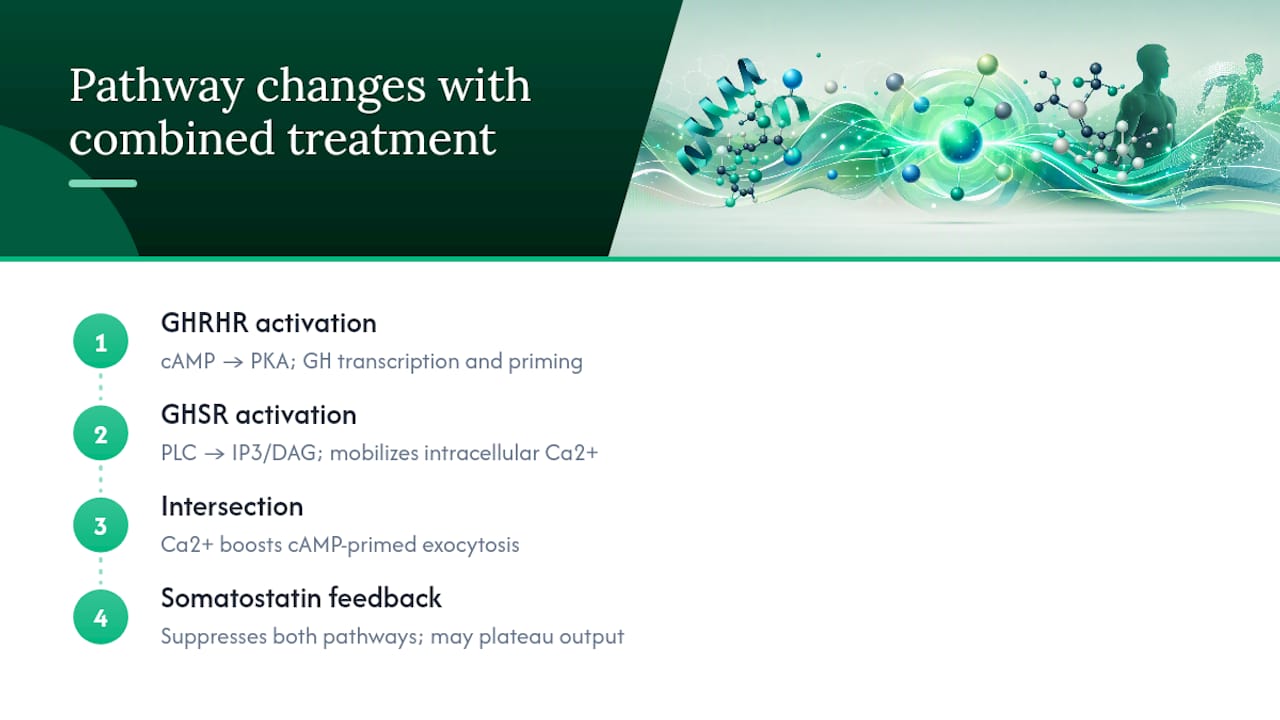
Combining a GHRHR agonist with a GHSR agonist does more than add two independent signals together. GHRHR activation runs primarily through the cAMP and protein kinase A cascade, which promotes GH gene transcription and secretory vesicle release. GHSR activation runs through phospholipase C, generating inositol trisphosphate and diacylglycerol, which mobilizes intracellular calcium stores and activates protein kinase C.
These two cascades intersect inside the somatotroph rather than running in isolated parallel tracks. Calcium influx from the GHSR arm can potentiate the exocytotic machinery already primed by cAMP signaling from the GHRHR arm, which is a plausible mechanistic explanation for why combined stimulation produces a larger pulse than either pathway alone.
Downstream of the immediate secretory event, sustained combined stimulation may also influence somatotroph gene expression patterns over longer exposure windows, though this is an area where in vitro cell line data and in vivo pituitary physiology can diverge meaningfully. Structural work on GHSR, including cryo-EM data showing how ghrelin and nonpeptide agonists occupy the receptor’s binding pocket, helps explain why different GHSR ligands produce different downstream efficacy even when they hit the same receptor, a distinction worth building into any pathway-level interpretation of your data, as shown in structural studies of ghrelin receptor activation.
Somatostatin tone remains the major counter-regulatory pathway to track. Any combined-treatment protocol that ignores somatostatin’s suppressive effect on both GHRHR and GHSR output risks misattributing a feedback-driven plateau to receptor desensitization instead.
Is It Synergy, or Just an Additive Effect?
This distinction is where a lot of otherwise careful synergy claims fall apart, and it deserves more rigor than eyeballing a bar graph.
A truly synergistic effect means the combined response exceeds the sum of the two individual responses measured under identical conditions. An additive effect means the combined response equals that sum, which is still a meaningful finding but a mechanistically different one. An independent effect means the two compounds are acting on separate, non-interacting pathways that happen to both raise the same downstream marker.
Distinguishing between these requires a specific analytical setup, not just a combination arm and a control:
- Measure each peptide alone at the same doses used in the combination arm, in the same experimental run.
- Calculate the predicted additive response mathematically before comparing it to the observed combined response.
- Apply an appropriate statistical model for interaction effects rather than a simple pairwise comparison, since a combination arm that is “higher” than either single arm is not automatically synergistic in a formal sense.
- Repeat across multiple dose ratios where feasible, since true synergy is often ratio-dependent and can disappear or invert outside a specific dose window.
A result that looks synergistic at one dose ratio and merely additive at another is common, and it is informative rather than a failure. It tells you something real about where on the dose response curve the receptor interaction actually matters. Reporting only the dose ratio that produced the most dramatic result, without showing the full curve, is one of the more common ways synergy claims get overstated in secondary literature.
What Confounds Synergy Experiments Most Often?
Peptide degradation is the single most underappreciated confound in this space. Both Ipamorelin and CJC-1295 are susceptible to loss of activity from improper reconstitution, repeated freeze-thaw cycles, or storage at the wrong temperature, and a partially degraded peptide will quietly flatten your dose response curve without producing an obvious error signal.
Cell line variability is the second major issue. Somatotroph-like cell lines can drift in receptor expression across passages, and a “synergy” result that only appears at passage 40 but not passage 15 usually reflects the cells, not the pharmacology.
A shortlist of the confounds worth checking before you trust a result:
- Vehicle effects. Reconstitution solvents and diluents can independently affect baseline signaling, especially in DMR assays sensitive to whole-cell mass changes.
- Timing mismatch. Sampling at a fixed interval that does not align with each compound’s distinct kinetics will underestimate the true peak response.
- Receptor desensitization. Repeated or prolonged GHSR agonist exposure can desensitize the receptor, which looks like declining synergy but is actually a pharmacodynamic artifact of the protocol.
- Batch-to-batch peptide variability. Even at verified purity, different lots can behave differently in sensitive assays; always note lot numbers alongside results.
When a result looks inconsistent between runs, the troubleshooting order should start with peptide integrity and storage records, move to cell line passage number, and only then move to a mechanistic reinterpretation. Most inconsistent synergy results trace back to the first two, not the third.
Author Perspective: Design Priorities and Evidence Gaps
The biggest mistake researchers make with this pairing is treating mechanistic plausibility as if it were experimental proof. Run the dose-response and timing calibration pilots first, always, before committing resources to a full protocol. A biomarker shift in a somatotroph cell line is not the same claim as a translational outcome, and reporting it as one is where credibility gets lost. The field would benefit from more researchers publishing methodological detail and null results, not just the clean supra-additive curves that make it into abstracts.
— Stephan
Neo Lab Peptides: Research-Grade Supply for GH-Axis Studies
Reproducibility starts with the peptide in the vial, and that is where a lot of published inconsistencies actually originate. Neolabpeptides supplies research-grade Ipamorelin and CJC-1295 with third-party HPLC and mass spectrometry verification and a stated purity above 98%, with a Certificate of Analysis issued per lot rather than per product line.

That lot-level documentation matters directly for the confounds covered above: if your synergy result varies between batches, the first thing to check is whether the CoA and lot number actually match what shipped. Neolabpeptides’ Ipamorelin/CJC-1295 blend and broader growth hormone category are labeled research-use-only, consistent with the regulatory posture this article assumes throughout. Before you commit a protocol to a specific lot, verify the CoA against your own HPLC expectations and keep the shipping and lot records on file for your institutional documentation. Browse the growth hormone catalog to compare formats and start building your procurement records.
Sources
- Structural basis for ghrelin receptor activation by ghrelin and ibutamoren
- Review of growth hormone secretagogues and related pharmacology (PMC review excerpt)
FAQ
Does Ipamorelin Plus CJC-1295 Produce Real Synergy?
Receptor-level evidence supports mechanistic complementarity between GHRHR and GHSR pathways, and foundational infusion studies show supra-additive GH release when GHRH and GHRP-class stimuli are combined, but the specific product pairing lacks large clinical validation.
Should I Use CJC-1295 DAC or No-DAC for a Pulsatility Study?
Use no-DAC CJC-1295 for pulsatility-focused endpoints, since the DAC variant’s extended half-life produces sustained rather than pulsatile GHRHR signaling.
Why Does DMR Detect Effects Calcium Assays Miss?
DMR is a label-free, whole-cell readout sensitive to inverse agonism and subtle efficacy differences at GHSR, while calcium mobilization assays only capture the canonical phospholipase C signaling arm.
What Should I Check on a Peptide’s Certificate of Analysis?
Verify the stated purity percentage, HPLC or mass spectrometry identity confirmation, and the lot number against what physically shipped; Neolabpeptides issues a CoA per lot for its research peptides.
Are Ipamorelin and CJC-1295 Approved for Human or Veterinary Use?
No. Both are sold strictly for laboratory research use, not for human or veterinary administration, and any protocol involving them requires appropriate institutional research approval.
Recommended
This article summarizes published research for informational purposes. Products sold by Neo Lab Peptides are for laboratory research use only and are not intended for human or animal use.