

CJC No DAC: Research Guide for Biotech Professionals
CJC-1295 without DAC is defined as a synthetic growth hormone-releasing hormone (GHRH) analog that produces discrete, pulsatile growth hormone secretion through rapid clearance, with a half-life of approximately 30 minutes. This short clearance window is not a limitation. It is the defining pharmacokinetic feature that makes CJC no DAC the preferred tool when research goals require mimicking the natural GH axis. The peptide activates GHRH receptors in the anterior pituitary, triggering GH pulses that resolve within 1–2 hours post-injection. Neolabpeptides supplies this compound in lyophilized form, verified at over 98% purity via HPLC and mass spectrometry, with a Certificate of Analysis included for every batch.
How does CJC-1295 without DAC work biologically?
CJC-1295 without DAC is a 29-amino-acid GHRH analog engineered with four amino acid substitutions at positions D-Ala2, Gln8, Ala15, and Leu27. These substitutions confer resistance to DPP-IV enzymatic cleavage while preserving full GHRH receptor agonism. The result is a peptide that binds the pituitary GHRH receptor with high affinity but clears the bloodstream quickly.
Receptor binding activates the cAMP-PKA signaling cascade inside somatotroph cells. This cascade triggers GH synthesis and release in a burst pattern. The GH pulse typically lasts 1–2 hours before returning to baseline, which closely replicates the endogenous GHRH signaling rhythm.
The 30-minute half-life drives the entire research value of this compound. Because the peptide clears rapidly, each injection produces a discrete GH event rather than a sustained hormonal elevation. Researchers designing studies around physiological GH axis dynamics rely on this property to model natural pulsatile signaling without pharmacological distortion.
- Receptor target: GHRH receptor (GHRHR) on anterior pituitary somatotrophs
- Signaling pathway: cAMP-PKA cascade leading to GH exocytosis
- GH pulse duration: 1–2 hours post-injection
- Clearance: Rapid, with return to baseline hormone levels within hours
- Enzymatic stability: DPP-IV resistance via four modified residues
Pro Tip: Time injections to coincide with somatostatin troughs, typically early morning or pre-sleep, to maximize GH pulse amplitude. Somatostatin is the primary inhibitory brake on GH release, and injecting during its natural low points produces measurably larger pulses.
What are the main differences between CJC-1295 no DAC and DAC forms?
The structural difference between the two variants is a single drug affinity complex (DAC) moiety attached to the 30th amino acid of the DAC form. That one addition changes nearly every pharmacokinetic parameter. The DAC moiety extends half-life from 30 minutes to 6–8 days through albumin binding. This produces sustained GH and IGF-1 elevation rather than discrete pulses.
The clinical evidence base also differs significantly. Phase 1–2 clinical trials document sustained GH and IGF-1 elevation with the DAC form over 4–8 week dosing periods. The no DAC variant lacks independent clinical trial programs, meaning its evidence base comes primarily from preclinical data and mechanistic studies. Researchers should account for this asymmetry when designing protocols and interpreting results.
| Feature | CJC-1295 no DAC | CJC-1295 with DAC |
|---|---|---|
| Amino acid length | 29 aa | 30 aa + DAC moiety |
| Half-life | ~30 minutes | 6–8 days |
| GH release pattern | Pulsatile, discrete | Sustained elevation |
| IGF-1 elevation | Transient | Prolonged |
| Dosing frequency | 2–3 times daily | Once weekly |
| Clinical trial data | Preclinical/mechanistic | Phase 1–2 completed |
| Primary research use | Pulsatile GH modeling | Sustained GH exposure |
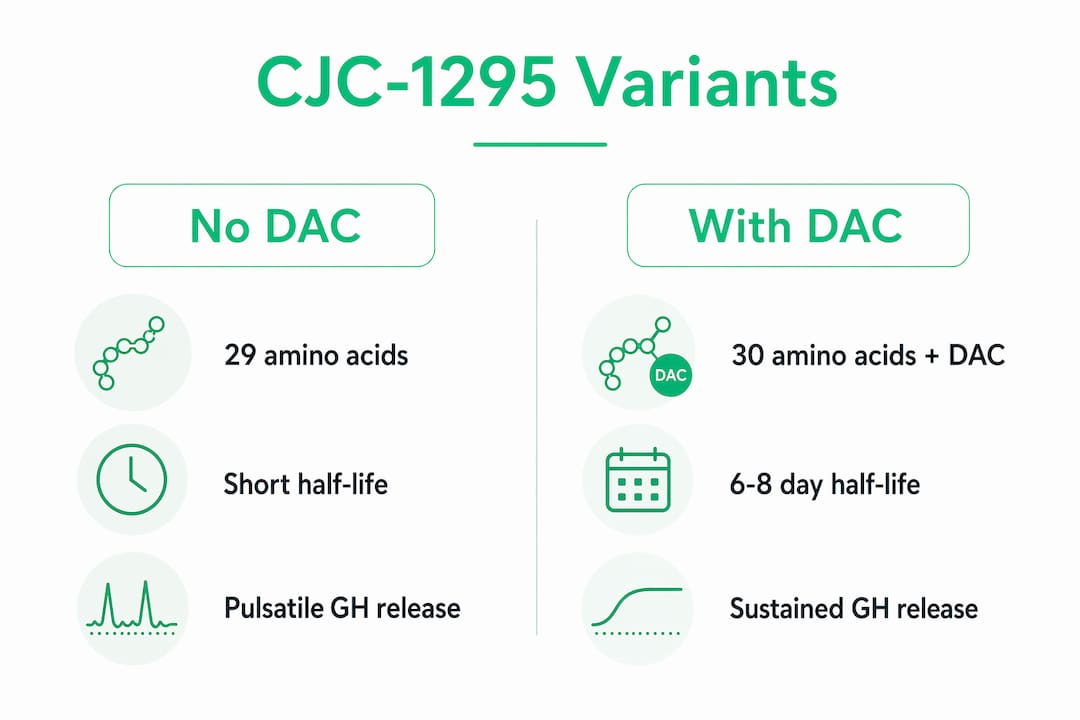
The dosing burden is the most practical difference for laboratory operations. The 6–8 day half-life of the DAC form allows weekly administration, while the no DAC variant requires 2–3 daily subcutaneous injections. For long-duration animal studies or protocols with strict compliance requirements, this distinction directly affects study feasibility.
Researchers prefer the no DAC form when the objective is to replicate physiological pulsatile GH signaling rather than achieve sustained axis stimulation. Misapplying the DAC form in pulsatile GH studies produces non-physiological sustained hormone elevations that invalidate the research model entirely.
What are the primary research applications of CJC-1295 without DAC?
CJC-1295 without DAC is the compound of choice when research requires accurate modeling of the natural GH axis. Its pulsatile release profile makes it irreplaceable for studies examining GH secretion dynamics, somatotroph responsiveness, and downstream IGF-1 regulation under physiologically relevant conditions.
The most well-documented research application is co-administration with growth hormone-releasing peptides (GHRPs). Combining CJC-1295 no DAC with ipamorelin produces synergistic pulsatile GH release that exceeds what either compound achieves alone. Ipamorelin acts on the ghrelin receptor (GHSR-1a), while CJC-1295 no DAC acts on GHRHR. The two pathways converge at the somatotroph, amplifying GH output without activating cortisol or prolactin pathways, which is a key advantage for clean experimental design. Neolabpeptides offers an ipamorelin/CJC-1295 blend for researchers working with this combination protocol.
The four primary research domains for CJC-1295 without DAC are:
- Pulsatile GH axis modeling. Studies examining natural GH secretion rhythms, feedback regulation, and somatotroph sensitivity require a compound that produces discrete, time-limited GH events. The no DAC form is the only GHRH analog that achieves this at the research level.
- Muscle regeneration studies. GH pulses stimulate local IGF-1 production in muscle tissue, which drives satellite cell activation and protein synthesis. Preclinical models use CJC-1295 no DAC to examine these pathways without the confounding effect of chronically elevated IGF-1.
- Fat metabolism research. Pulsatile GH promotes lipolysis in adipose tissue. Researchers use the no DAC form to study GH-driven fat mobilization in controlled time windows, isolating the acute metabolic response from chronic hormonal effects.
- Anti-aging and longevity research. Age-related GH axis decline is a well-characterized phenomenon. CJC-1295 no DAC serves as a tool for studying GH axis restoration in aged animal models, with injection timing designed to replicate the youthful pulsatile pattern.
Pro Tip: When co-administering with ipamorelin, match injection timing precisely. Both compounds should be administered simultaneously to ensure their receptor-level effects converge at the somatotroph during the same secretory window. Offset timing reduces the synergistic effect.
What are key dosing and safety considerations for CJC-1295 no DAC?
Dosing for CJC-1295 without DAC in research settings follows a well-established framework based on its pharmacokinetic profile. Typical dosing ranges from 100–300 mcg per injection, administered 2–3 times daily via subcutaneous injection. Injection timing relative to somatostatin activity is critical. Administering during somatostatin peaks blunts GH release and reduces experimental signal quality.
The safety profile of the no DAC form carries a structural advantage over its longer-acting counterpart. Rapid peptide clearance enables quick return to baseline hormone levels upon discontinuation. Side effects resolve within hours rather than days, and lower sustained IGF-1 exposure reduces theoretical long-term risks associated with chronic GH axis stimulation.
Key handling and storage protocols for laboratory use:
- Reconstitution: Use bacteriostatic water for reconstitution to maintain peptide stability and prevent microbial contamination across multiple draws.
- Storage: Store lyophilized peptide at 2–8°C. Once reconstituted, refrigerate and use within 28 days. Avoid repeated freeze-thaw cycles, which degrade peptide integrity.
- Injection site rotation: Rotate subcutaneous injection sites to minimize local tissue reactions. Common sites include the abdomen and lateral thigh.
- Common local reactions: Transient redness, mild swelling, or discomfort at the injection site are the most frequently observed reactions. These resolve without intervention.
- Documentation: Verify purity via Certificate of Analysis before use. Neolabpeptides provides HPLC and mass spectrometry verification with every batch. Researchers can review how to read a COA to confirm identity, purity, and sequence confirmation before initiating any protocol.
The reversibility advantage of the no DAC form is particularly relevant for studies requiring protocol adjustments mid-experiment. Because the compound clears within hours, researchers can modify dosing schedules, pause administration, or switch compounds without waiting days for hormonal levels to normalize.
Key Takeaways
CJC-1295 without DAC is the definitive GHRH analog for pulsatile GH research, requiring precise injection timing, 2–3 daily doses of 100–300 mcg, and co-administration with ipamorelin for maximum experimental signal.
| Point | Details |
|---|---|
| Pulsatile GH release | The 30-minute half-life produces discrete GH pulses that replicate natural GHRH signaling. |
| DAC vs. no DAC selection | Match the variant to research goals; no DAC for pulsatile modeling, DAC for sustained GH elevation. |
| Ipamorelin synergy | Co-administration with ipamorelin amplifies GH output through dual receptor pathway convergence. |
| Dosing protocol | Administer 100–300 mcg subcutaneously 2–3 times daily, timed to somatostatin troughs. |
| Safety reversibility | Rapid clearance allows hormone levels to normalize within hours of discontinuation. |
Why peptide variant selection is the most underrated research decision
Researchers spend considerable time optimizing assay sensitivity, sample size, and statistical power. The peptide variant selection often receives far less scrutiny, and that is where study validity breaks down.
I have reviewed protocols where the DAC form was substituted for the no DAC variant because of its dosing convenience. The rationale was practical: fewer injections per day simplifies animal handling. The problem is that the resulting sustained IGF-1 elevation fundamentally changes the biological environment being studied. You are no longer modeling pulsatile GH dynamics. You are running a chronic GH elevation study and calling it something else.
The no DAC form demands more from the researcher. The injection frequency is higher, timing precision matters, and the experimental window is narrow. Those constraints are not drawbacks. They are the mechanism. The physiological relevance of the data you generate depends on accepting those constraints rather than engineering around them.
Peptide stability during reconstitution is another area where I see consistent errors. Using non-bacteriostatic diluents, storing reconstituted peptide beyond 28 days, or failing to verify purity via COA before use introduces variability that no statistical method can correct. The compound quality and handling protocol are part of the experimental design, not administrative details.
— Stephan
Research-grade CJC-1295 no DAC from Neolabpeptides
Researchers working with CJC-1295 without DAC need a source that delivers verified purity, complete documentation, and fast domestic shipping. Neolabpeptides meets all three requirements for US-based research operations.

Every CJC-1295 no DAC batch from Neolabpeptides ships with HPLC and mass spectrometry verification, confirming identity and purity above 98%. The catalog also includes the ipamorelin/CJC-1295 blend for researchers running combination protocols, as well as complementary compounds like Sermorelin for comparative GHRH analog studies. All products are supplied in lyophilized form for laboratory research only and are not approved for human or veterinary use.
FAQ
What is CJC-1295 without DAC?
CJC-1295 without DAC is a 29-amino-acid synthetic GHRH analog that stimulates pulsatile growth hormone release through GHRH receptor agonism, with a half-life of approximately 30 minutes.
How does CJC no DAC differ from the DAC form?
The DAC form includes an albumin-binding moiety that extends its half-life to 6–8 days, producing sustained GH and IGF-1 elevation, while the no DAC form clears rapidly and generates discrete GH pulses.
What is the standard dosing protocol for CJC-1295 no DAC?
Research protocols typically use 100–300 mcg per injection, administered 2–3 times daily via subcutaneous injection, with timing aligned to somatostatin troughs for maximum GH pulse amplitude.
Why is ipamorelin commonly combined with CJC-1295 no DAC?
Ipamorelin activates the ghrelin receptor (GHSR-1a) while CJC-1295 no DAC activates GHRHR, and their simultaneous administration produces synergistic GH release that exceeds either compound administered alone.
Is CJC-1295 no DAC safer than the DAC form?
The rapid clearance of the no DAC form allows hormone levels to return to baseline within hours of discontinuation, which reduces sustained IGF-1 exposure and makes protocol adjustments faster and cleaner than with the DAC variant.
Recommended
- BPC-157 Research: Mechanisms and Pre-Clinical Findings | Neo Labs – Neo Lab Peptides
- How to Read a Peptide Certificate of Analysis (COA) | Neo Labs – Neo Lab Peptides
- Ipamorelin/CJC-1295 Blend 10mg | Research Peptide | Neo Lab Peptides
- TB-500 (Thymosin Beta-4) Research Overview | Neo Labs – Neo Lab Peptides