Require Batch COAs: University Peptide Purchasing for U.S. Labs
September 16, 2026 · STEPHAN ZOHAR

Yes, U.S. universities can legally purchase research peptides labeled Research Use Only under current FDA guidance, provided the material is not intended for human or veterinary use. The single most important action procurement can take before issuing a purchase order is requiring a batch-specific Certificate of Analysis with HPLC and mass spectrometry data, plus a clear RUO statement, from any vendor, including Neo Lab Peptides.
TL;DR:
- Most university procurement should prioritize vendors who provide batch-specific Certificates of Analysis with verified HPLC and mass spectrometry data for each shipment.
- Avoid Grey-market importers or vague suppliers that fail to match lot numbers, lack MS data, or offer suspiciously low prices below typical market rates.
- Prior to ordering, request sample COAs and complete vendor documentation, including RUO statements, SDS, W-9, and proof of insurance, to ensure compliance and reproducibility.
- A well-defined workflow involving PI requisitions, vendor pre-qualification, purchase orders, and receipt confirmation helps maintain audit trails and lab safety, especially regarding storage and handling.
- Requiring batch-specific verification for every peptide lot remains critical to reproducibility, audit compliance, and avoiding costly experimental failures.
Table of Contents
- Where to Source Peptides for University Research
- Documentation Procurement Offices Require and How to Verify It Quickly
- How Do You Order Peptides Through University Procurement?
- What Does a Trustworthy Peptide COA Look Like?
- Pricing, Lead Times, and Ordering Strategy for Grant Budgets
- Neo Lab Peptides: Compliance and Documentation Built for Institutional Buyers
- Do IRB and IACUC Rules Apply to Research Peptides?
- How Should Labs Store and Handle Peptides Safely?
- Does Your University Have an Approved Peptide Vendor List?
- What About Restricted or Controlled Peptides?
- How Do You Spot a Counterfeit or Substandard Peptide Supplier?
- What Contract Terms Should Procurement Negotiate?
- Why Batch-Specific Verification Should Be Non-Negotiable
- Request a Vendor Packet or Sample COA From Neo Lab Peptides
- Sources
- FAQ
Where to Source Peptides for University Research
Procurement offices generally choose between three channels, and each carries a different risk profile.
Institutional peptide synthesis cores sit at the top of the trust hierarchy. A facility like the UNC High-Throughput Peptide Synthesis and Array Facility synthesizes custom sequences in house, runs its own HPLC and MALI-TOF/TOF mass spec analysis, and lyophilizes and aliquots the final product. Libraries up to around a hundred peptides typically ship within a few weeks. Cores work best when a lab needs a novel sequence, wants documentation that already matches university audit standards, or wants to avoid vendor qualification paperwork entirely, since the core is already part of the institution.
Compliant U.S. RUO suppliers fill the gap when a lab needs a catalog compound fast, in a specific quantity, with full traceability. A 2026 procurement framework from Peptide Insider recommends a tiered vendor model that treats batch-specific HPLC and MS verification as the non-negotiable baseline, not an upsell. Reputable suppliers issue lot numbers tied to individual COAs and can scale order sizes from milligram research quantities to bulk lab stock.
Grey-market importers and unverified overseas distributors are the channel to flag immediately. Warning signs include generic “product line” COAs that aren’t matched to a specific lot, missing MS data, vague country-of-origin labeling, and reluctance to provide a W-9 or insurance documentation.
Before onboarding any vendor, request:
- A sample batch-specific COA showing HPLC purity and MS identity confirmation
- A written RUO statement
- SDS/MSDS documentation
- Proof of business registration (W-9) and liability insurance
Pro Tip: Ask a prospective vendor for a COA from a lot they shipped last month, not a template. If they can only produce a generic specification sheet, that’s your answer.
Documentation Procurement Offices Require and How to Verify It Quickly
Most procurement rejections trace back to one problem: paperwork that describes the product line instead of the actual shipment. A 2026 sourcing framework flags generic COAs as one of the biggest reproducibility risks in academic peptide purchasing, because a lot-agnostic document tells you nothing about the vial that actually arrives.
When a vendor submits documentation, check these items in order:
- Lot number match. The number on the vial label must match the number on the COA header, exactly.
- HPLC trace with a date. The chromatogram should show a purity percentage and a run date close to the shipment date, not a stock image from a catalog page.
- MS report confirming identity. The mass spectrometry data should show a molecular weight consistent with the labeled sequence.
- RUO statement. Look for explicit language such as “for laboratory research use only, not for human or veterinary use.” Our own Research Use Only regulatory guide walks through acceptable phrasing and why vague labeling creates audit exposure later.
- SDS/MSDS with storage and transport instructions. Temperature requirements and hazard classifications need to be present, not implied.
Batch-specific COAs that pair HPLC with MS data are considered the baseline for publication-grade academic sourcing, and grant auditors increasingly expect them on file.
Vendor-level paperwork rounds out the file: a current W-9, proof of insurance, and any quality-system claims (ISO, GMP-adjacent practices) the vendor makes. Procurement teams that request the full packet up front avoid a second round of emails during onboarding, according to institutional procurement standardization guidance.
How Do You Order Peptides Through University Procurement?
A repeatable workflow protects both grant compliance and lab timelines. The sequence looks like this at most research universities:
- PI requisition. The principal investigator specifies sequence, quantity, and intended use, and flags whether the order supports a grant with specific vendor restrictions.
- Vendor pre-qualification. Procurement confirms the vendor packet (COA sample, SDS, RUO statement, W-9, insurance) before the vendor enters the system, or confirms the vendor already sits on an approved list.
- PO issuance. The purchase order attaches the vendor’s RUO statement and references the specific catalog item or synthesis specification.
- EHS/safety review. Environmental health and safety confirms the SDS is on file and that storage conditions (typically frozen or refrigerated, protected from light) match lab capacity before the order ships.
- Receipt and lot logging. On arrival, lab staff confirm the lot number on the vial matches the COA, log the compound in the inventory system, and file the documentation with the PO.
University vendor portals such as Coupa or Ariba often gate step two automatically. Once a vendor is registered with a complete packet, reordering accelerates significantly because the compliance review doesn’t repeat for every PO. Core facilities skip several of these steps entirely, since the material never leaves the institution’s own compliance umbrella.
At receipt, capture four things every time: lot number, COA match confirmation, storage temperature on arrival, and the date logged into inventory.
Pro Tip: Build a one-page receiving checklist and tape it inside the freezer door. Labs that skip this step are the ones that can’t answer “where did this vial come from” six months later during an audit.
What Does a Trustworthy Peptide COA Look Like?
Reading a Certificate of Analysis takes about two minutes once you know what to check.
HPLC purity tells you how much of the vial is the intended compound versus synthesis byproducts. Most research-grade peptides intended for cell-based or animal studies generally show purity at high levels, though some exploratory work tolerates lower thresholds if the study design accounts for it. A 2026 procurement framework treats batch-specific HPLC verification as a baseline requirement, not a premium feature.
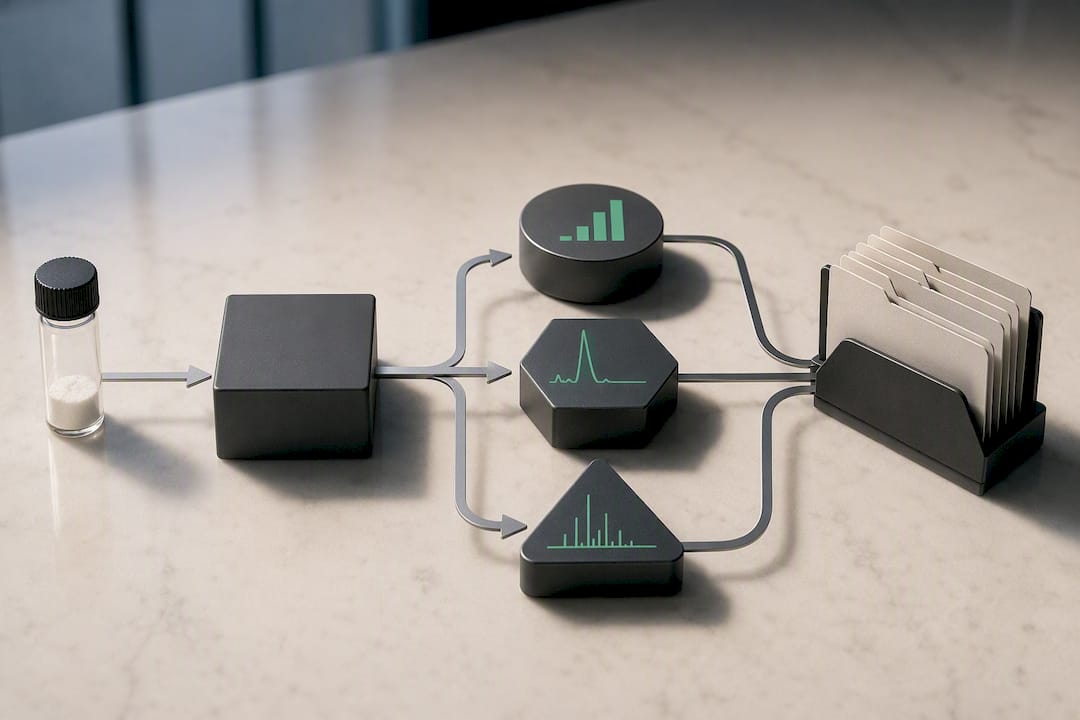
Mass spectrometry confirms the vial contains the right molecule, not just a pure one. The MS report should show a molecular weight matching the theoretical mass of the labeled peptide, typically within a small margin of error.
Verification steps, in order:
- Confirm the lot number on the COA matches the vial label.
- Check the HPLC purity percentage against your study’s minimum threshold.
- Confirm the MS-reported molecular weight matches the expected sequence mass.
- Confirm the COA date is reasonably close to the ship date.
- If anything looks inconsistent, send a reserved sample to an institutional core, such as UNC’s peptide facility, for independent analysis before running experiments on it.
Red flags that should trigger an automatic hold: a COA with no lot number, an HPLC trace that looks recycled from a marketing page, an MS report missing entirely, or a purity claim with no supporting chromatogram.
Pricing, Lead Times, and Ordering Strategy for Grant Budgets
Peptide pricing tracks four variables: sequence length, chemical modifications (like acetylation or amidation), purification level, and whether analytical testing is bundled into the price or billed separately.
Lead times vary by sourcing route. Catalog compounds from a stocked U.S. supplier often ship within days. Custom synthesis for a novel sequence typically takes one to three weeks depending on length and modifications. Peptide libraries scale further out. UNC’s core facility quotes roughly two to three weeks for libraries of 120 peptides or fewer, with larger libraries requiring additional time.
To compare vendors fairly, normalize everything to price per milligram rather than per vial, since vial sizes vary widely between suppliers. Our peptide price comparison guide walks through that math in detail.
For grant-constrained labs, a few habits protect the budget:
- Order in just-in-time increments early in a grant cycle, then shift to bulk purchasing once a protocol stabilizes.
- Lock in pricing with a vendor before a grant’s fiscal year closes, since peptide pricing can shift with raw material costs.
- Reserve a small contingency budget for re-ordering if a COA fails verification and a lot has to be rejected.
Neo Lab Peptides: Compliance and Documentation Built for Institutional Buyers
Neo Lab Peptides supplies research-grade peptides verified above 98% purity through third-party HPLC and mass spectrometry testing, with a Certificate of Analysis issued for every batch. The catalog includes IPAMORELIN, CJC-1295, TB-500, BPC-157, GLP-1 analogs, GHK-Cu, NAD+, and bacteriostatic water, all supplied in lyophilized form and labeled explicitly for research use only, not for human or veterinary use.
For procurement teams building a vendor file, Neo Lab Peptides can provide a sample COA showing lot-specific HPLC and MS data, an SDS, and the RUO statement your compliance office will want on record. Our high-purity peptide supplier guide details exactly how that verification process works, and flexible order quantities accommodate both single-lab studies and larger departmental orders shipped fast within the U.S.
Do IRB and IACUC Rules Apply to Research Peptides?
Whether your peptide purchase triggers Institutional Review Board (IRB) or Institutional Animal Care and Use Committee (IACUC) oversight depends entirely on the study design, not the compound itself.
IRB approval applies when human subjects are involved in any way, including studies where a peptide might eventually be administered to people, even in early feasibility work. Because RUO peptides are explicitly not approved for human use, any protocol that proposes human administration needs a completely different regulatory pathway than a standard RUO purchase, likely involving an Investigational New Drug application through the FDA before any IRB review is even relevant.
IACUC approval applies when animal subjects receive the compound. Most academic peptide research (cell-based assays, in vitro binding studies, animal model work) falls under IACUC’s purview once live animals enter the protocol, and the committee typically wants documentation showing the compound source, purity, and identity confirmation as part of the protocol review, not just the experimental design.
Procurement’s role here is narrower than it might seem: verify the material is properly labeled RUO and documented, then let the PI’s protocol determine whether IRB or IACUC sign-off is separately required. FDA’s guidance on bulk drug substances used in compounding is useful background for understanding why the intended-use distinction matters so much to regulators, and why procurement should never accept a peptide order that implies human administration without a completely separate compliance track.
How Should Labs Store and Handle Peptides Safely?
Most research peptides ship lyophilized (freeze-dried) and require refrigeration or freezing on arrival, typically between 2°C and negative 20°C depending on the specific compound and manufacturer instructions on the SDS. Reconstituted peptides are far less stable and generally need to be used within days to weeks even under refrigeration, so labs should reconstitute only the volume needed for near-term experiments.
Handling protocols should mirror standard lab chemical safety practice: gloves and eye protection during reconstitution, use of a fume hood or biosafety cabinet where the compound’s hazard profile calls for it, and clear labeling of reconstituted vials with the date and preparer’s initials. The SDS a compliant vendor provides should spell out specific hazard classifications, and EHS should keep that document on file, not just the PI’s lab notebook.
Storage logistics matter more than most labs anticipate. A freezer failure that goes unnoticed over a weekend can destroy a semester’s worth of ordered material, so labs working with valuable or hard-to-replace custom peptides should use monitored freezers with alarm systems where the budget allows it. Waste disposal also needs a plan: expired or rejected lots should go through the institution’s chemical waste stream rather than standard trash, since peptides are still active biochemical compounds even in small quantities.
Building these protocols into the receiving checklist mentioned earlier closes the loop between procurement and lab safety.
Does Your University Have an Approved Peptide Vendor List?
Many research universities maintain formal approved or preferred vendor lists specifically to reduce the compliance burden on individual labs. Once a vendor completes the qualification packet (COA samples, SDS, RUO statement, insurance, W-9), that vendor often gets added to the institution’s procurement portal, whether that’s Coupa, Ariba, or a homegrown system, and subsequent orders skip much of the manual review.
If your department orders peptides regularly, ask your procurement office whether a preferred list already exists before starting vendor qualification from scratch. Duplicate qualification work across departments is common at large universities simply because nobody checked first. Where no approved vendor yet supplies a specific compound your lab needs, most procurement offices have an exception process that lets a PI request a new vendor be added, typically requiring the same documentation packet described earlier in this guide.
Core facilities occupy a special status on these lists because they’re part of the institution itself. A lab ordering from UNC’s peptide synthesis core, for instance, isn’t dealing with external vendor qualification at all, since the core operates under the university’s existing research infrastructure and compliance framework.
Preferred vendor status isn’t permanent. Procurement offices periodically re-verify that vendors on the approved list still meet documentation standards, so a supplier that stops providing batch-specific COAs can lose that status even after years of good standing.
What About Restricted or Controlled Peptides?
A small number of peptides and peptide-related compounds fall under additional federal or state restrictions beyond standard RUO labeling, particularly compounds with performance-enhancing applications that have drawn scrutiny from anti-doping and controlled-substance frameworks. Procurement staff don’t need to memorize every restricted compound, but they do need a process for flagging unfamiliar sequences before a PO goes out.
The practical step is straightforward: when a PI requests a compound the department hasn’t ordered before, route it through EHS or the compliance office for a quick regulatory check before purchasing, rather than assuming RUO labeling automatically clears every restriction. Some peptides require additional recordkeeping even when the base purchase itself is unrestricted, particularly for labs receiving federal grant funding with its own reporting obligations.
If a compound does carry additional licensing requirements, that documentation needs to sit alongside the standard vendor packet, not replace it. A restricted-compound license doesn’t substitute for a batch-specific COA. Both are needed, and both should be filed together with the PO for audit purposes. When in doubt, your institution’s research compliance office, not the vendor, is the right party to confirm a compound’s regulatory status before the order is placed.
How Do You Spot a Counterfeit or Substandard Peptide Supplier?
Counterfeit and substandard suppliers share a few consistent tells, and procurement staff who learn to spot them can save a lab from wasted grant money and unusable data.
The most common red flag is a COA that describes a product line rather than a specific shipment. If the document has no lot number, or the lot number doesn’t appear anywhere on the physical vial, treat it as unverified regardless of how professional the document looks. A close second is missing mass spectrometry data. Some suppliers show only an HPLC trace, which confirms purity but says nothing about whether the molecule is actually the labeled sequence.
Pricing that sits dramatically below the market range is worth a second look too, since legitimate suppliers price around the cost of raw materials, synthesis, purification, and testing, and a price far below that range usually means testing got skipped somewhere in the process. Vague country-of-origin labeling, reluctance to produce a W-9 or insurance certificate, and websites with no verifiable business address round out the warning list.
When something feels off, the fastest resolution is independent verification. Send a reserved sample from a questionable lot to an institutional core, like UNC’s facility, for a second HPLC and MS opinion before running it in an experiment. It costs a small amount of time upfront and can save months of unreproducible results downstream.
What Contract Terms Should Procurement Negotiate?
Standard vendor terms and conditions for peptide purchases deserve more scrutiny than a typical lab supply order, mostly because the intended-use language and liability allocation carry real weight if something goes wrong.
The RUO clause itself should be unambiguous in the contract, not just on the product label. Procurement should confirm the purchase agreement states the material is sold exclusively for laboratory research and that the buyer accepts responsibility for ensuring it isn’t used outside that scope. This protects the institution as much as it protects the vendor, since a research lab’s own compliance obligations depend on that boundary being clear on paper.
Liability terms matter most around product identity and purity claims. If a vendor’s COA turns out to be inaccurate, and a lab loses months of work as a result, the contract should specify what recourse exists, whether that’s replacement product, a refund, or something else. Vague liability language that simply disclaims all responsibility is worth pushing back on during vendor qualification, not after a bad lot arrives.
Intellectual property considerations rarely apply to standard catalog peptide purchases, but custom synthesis work changes the calculus. If a university requests a novel sequence synthesized to specification, the contract should clarify who owns the resulting synthesis method or any resulting data, particularly if the peptide relates to patentable research. Procurement and the PI’s tech transfer office should review custom synthesis agreements together rather than treating them like a standard catalog order.
Why Batch-Specific Verification Should Be Non-Negotiable
If there’s one habit procurement offices should refuse to compromise on, it’s requiring a batch-specific COA with both HPLC and mass spec data before a PO clears, every single time, regardless of how long a vendor has been on the approved list. Vendors change synthesis batches constantly, and a supplier’s reputation from six months ago says nothing about the lot arriving next week.
The reproducibility cost of skipping this step is invisible until it isn’t. A lab that runs six months of experiments on a mislabeled or underpurified peptide doesn’t just lose that grant money. It loses the audit trail needed to explain, later, why the results don’t replicate.
— Stephan
Request a Vendor Packet or Sample COA From Neo Lab Peptides
Certain suppliers provide documentation university procurement offices require: batch-specific Certificates of Analysis backed by third-party HPLC and mass spectrometry testing, clear RUO labeling, and fast shipping within the United States. Rather than piecing together compliance paperwork from a distributor that treats documentation as an afterthought, procurement offices can request a vendor packet designed for institutional review from the start.

If your lab is qualifying a new peptide vendor this semester, request a sample COA and full documentation packet before you submit that first purchase order. Browse a representative catalog listing like GHK-Cu research peptide to see the format of the analytical data your procurement office will receive with every batch, then reach out for the specific compound your study needs.
Sources
- FDA — Bulk drug substances used in compounding under section 503A of the FD&C Act
- Sourcing peptides for academic research — A 2026 data-driven framework (Peptide Insider)
- UNC High-Throughput Peptide Synthesis and Array Facility
This article is general information, not a substitute for advice from a qualified doctor. Consult a qualified healthcare professional about your own circumstances before acting on anything here.
FAQ
Can You Legally Buy Research Peptides in the United States?
Yes, provided the peptide is labeled Research Use Only and sold with documentation showing it isn’t intended for human or veterinary use, consistent with FDA guidance on bulk drug substances.
Who Is the Most Trusted Peptide Supplier for University Labs?
Trust comes down to documentation, not brand reputation alone. Look for suppliers that provide batch-specific COAs with third-party HPLC and MS verification for every lot shipped.
Where Can I Buy Research Peptides Online in the USA?
Universities can source from compliant U.S. RUO suppliers with verifiable lot-level documentation, or from institutional cores such as the UNC High-Throughput Peptide Synthesis and Array Facility, which serves external researchers as well as its home institution.
What Makes a Peptide Company Reputable for Institutional Buyers?
A reputable supplier issues batch-specific Certificates of Analysis with HPLC and mass spectrometry data, provides an SDS and clear RUO statement, and supplies a full vendor packet (W-9, insurance) without hesitation during qualification.
Do Universities Need IRB Approval to Purchase Research Peptides?
No, purchasing itself doesn’t trigger IRB or IACUC review. Those approvals depend on the study protocol, specifically whether the peptide will be administered to human or animal subjects.
Recommended
This article summarizes published research for informational purposes. Products sold by Neo Lab Peptides are for laboratory research use only and are not intended for human or animal use.