pH 4.0–5.5: Find Peptide pH Stability with a Four Point Lab Screen
September 20, 2026 · STEPHAN ZOHAR

Most peptides reach peak chemical stability in a slightly acidic window, commonly pH 4.0 to 5.5, though the exact minimum shifts with sequence. For immediate handling: keep lyophilized stock frozen at −20°C or −80°C, reconstitute near that pH optimum rather than at neutral pH, and aliquot before freezing to avoid repeated freeze-thaw cycles. Confirm any pH decision with RP-UPLC, LC-MS, and forced-degradation testing referenced against ICH-style stability guidance.
TL;DR:
- Peptide stability is optimal between pH 4.0 and 5.5, but specific sequences may shift the minimum to slightly higher or lower pH values.
- Deamidation accelerates sharply above pH 6, especially for sequences with Asn-Gly or Asn-Ser motifs, with half-lives as short as 1-2 days at 37°C.
- Acid-labile bonds like Asp-Pro cleave under strongly acidic conditions, while oxidation mainly affects Met and Trp residues in the presence of metal contaminants.
- Empirical pH screening using four buffer conditions at 37°C is the most effective way to identify your peptide’s specific stability minimum.
- Using buffers like acetate or histidine during storage minimizes pH shifts during freeze-thaw cycles compared to phosphate buffers, which can cause pH excursions and accelerate degradation.
Table of Contents
- How pH Drives Peptide Degradation Pathways
- The V-Shaped Stability Curve and How to Find Your Peptide’s Optimal pH
- Choosing Buffers That Protect pH Without Adding New Problems
- Reconstituting Peptides Without Triggering Precipitation
- Storage, Aliquoting, and Freeze-Thaw: A Bench SOP
- Building a Minimal Stability Testing Program
- Formulation Choices That Extend Solution Stability
- How Third-Party Testing Supports Your pH and Storage Decisions
- What Bench Scientists Get Wrong About pH and How to Fix It
- Get Verified, Stable Peptide Stock for Your pH Studies
- Sources
- FAQ
How pH Drives Peptide Degradation Pathways
Every peptide degrades through a handful of predictable chemical routes, and pH decides which one dominates. Get the pH wrong for your sequence, and you’re not preventing degradation, you’re just picking which pathway destroys your sample fastest.
Deamidation is the most common problem at neutral to basic pH. Asparagine and glutamine side chains convert to aspartate or isoaspartate through a cyclic imide intermediate, and the reaction accelerates sharply as pH climbs above 6. Sequence context matters more than most researchers assume. Asn-Gly and Asn-Ser motifs are notorious hotspots because the small, flexible residue following asparagine allows the backbone nitrogen to attack the side chain carbonyl with little steric resistance. Asparagine deaminates considerably faster than glutamine in equivalent contexts. At pH 7.4 and 37°C, Asn-Gly sequences can show half-lives as short as 1 to 2 days, which is why a peptide that looked fine on day one of an experiment can show a shifted charge variant by day three.
Hydrolysis works from the opposite end of the pH scale. Strong acid conditions catalyze backbone cleavage at specific motifs, with Asp-Pro bonds standing out as particularly acid-labile because the proline nitrogen creates a geometry that favors protonation and subsequent cleavage. This is one reason an aggressively low pH, chosen purely to suppress deamidation, can trade one degradation pathway for another. Base-catalyzed hydrolysis exists too, though it’s generally a smaller contributor than deamidation at physiological and higher pH.
Oxidation follows its own pH logic and interacts with metal contamination in ways that surprise a lot of bench scientists. Methionine and tryptophan residues are the primary targets, and while oxidation itself isn’t purely pH-driven, the presence of trace metal ions (iron, copper) accelerates metal-catalyzed oxidation across a range of pH conditions, often worse in near-neutral buffers where metal solubility and peptide susceptibility overlap. A peptide stored in a buffer prepared with tap water or an old chelator stock is far more exposed to this pathway than one in freshly prepared, creator-supplemented buffer.
Analytically, each pathway leaves a signature you can actually see on your instruments:
- Deamidation shows up as a mass shift of approximately +1 Da (from asparagine to aspartate) and typically splits into multiple chromatographic peaks representing aspartate and isoaspartate isomers.
- Oxidation adds roughly +16 Da per oxidized residue, detectable by LC-MS and often visible as an earlier-eluting shoulder on RP-UPLC.
- Hydrolysis produces fragment peaks at lower retention times, with masses corresponding to cleaved N-terminal and C-terminal pieces.
- Aggregation, while not a chemical modification, often co-occurs with these pathways and shows up as high molecular weight species on size-exclusion or as turbidity in the vial.
Understanding which pathway threatens your specific sequence, rather than treating “degradation” as one generic risk, is what separates a useful peptide stability protocol from a guess. If your sequence carries an Asn-Gly motif, you already know deamidation is your primary enemy before you run a single test.
The V-Shaped Stability Curve and How to Find Your Peptide’s Optimal pH
Plot degradation rate against pH for almost any peptide and you get a V shape, or sometimes a broader U. Degradation is high at both extremes and drops to a minimum somewhere in the middle. That minimum is not a universal constant. It’s specific to the sequence sitting in front of you, shaped by which ionizable side chains are present, where the isoelectric point falls, and which degradation pathway dominates at each pH.
Across many peptides studied, that minimum tends to land between pH 4.0 and 5.5, a range low enough to slow deamidation substantially but not so acidic that hydrolysis at labile bonds takes over. This is a population-level tendency, not a rule. A peptide with an unusually acid-labile Asp-Pro bond might have its true minimum closer to pH 5.5 to 6.0. A peptide with no deamidation-prone residues at all might tolerate a broader window without meaningful difference in degradation rate. Treating pH 4 to 5.5 as a starting hypothesis, not a certainty, will save you from mis-formulating a peptide that behaves differently than the average case.
The only reliable way to find your specific peptide’s minimum is to run a small empirical screen. Here’s a bench protocol that works with equipment most research labs already have:
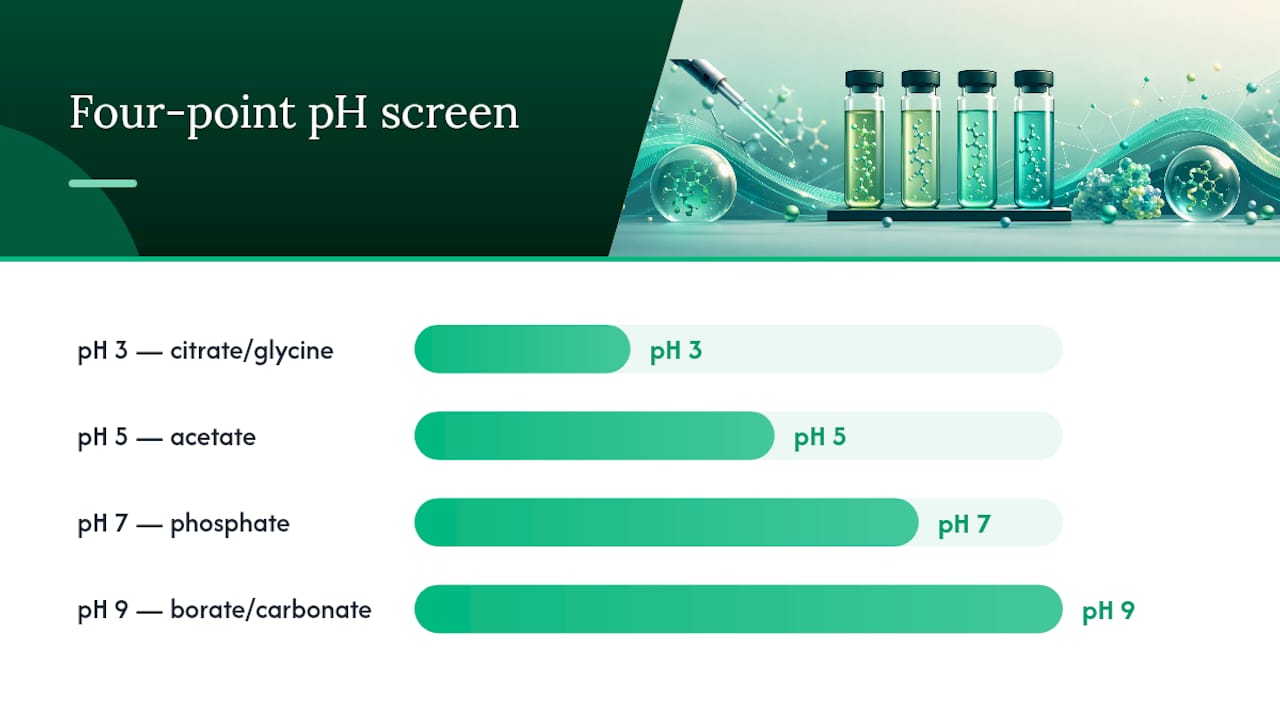
- Prepare four buffer conditions spanning the pH range: pH 3 (citrate or glycine), pH 5 (acetate), pH 7 (phosphate), and pH 9 (borate or carbonate), each at a consistent low buffer strength (around 10 to 20 mM) to avoid buffer-specific artifacts confounding the pH effect itself.
- Spike your peptide into each buffer at a working concentration matching your typical assay use, then incubate all four at 37°C to accelerate degradation into an observable timeframe.
- Sample at defined timepoints, commonly 0, 1, 3, 7, and 14 days, pulling an aliquot from each condition and either freezing it immediately or running it fresh on RP-UPLC/LC-MS.
- Track main peak area (percent of total peak area attributable to intact peptide) at each timepoint and plot the decay curve for all four pH conditions on the same axes.
- Identify the pH with the slowest main peak decline, then confirm with LC-MS which degradation pathway is emerging in the faster-degrading conditions, since that tells you whether you’re seeing deamidation, oxidation, or hydrolysis.
Interpreting the resulting curves takes a bit of judgment. If two adjacent pH points show nearly identical decay curves, your peptide may have a broader plateau of acceptable stability, giving you more flexibility in choosing a working buffer that also suits your downstream assay. Either way, this four-point screen, run once per new peptide, replaces guesswork with a defensible number.
Choosing Buffers That Protect pH Without Adding New Problems
pH control and buffer selection are not the same decision, and conflating them is one of the more common formulation mistakes in peptide-handling labs. The buffer species itself can catalyze degradation or interfere with your analytics even while holding pH exactly where you want it.
Phosphate is the buffer researchers reach for by habit, and it’s often the wrong choice for peptide stocks. Phosphate can actively catalyze certain degradation reactions, and its behavior on freezing is worse: selective crystallization of the disodium and monosodium phosphate salts during freezing can shift solution pH by 0.4 to 0.8 units, meaning your carefully chosen pH 7.0 buffer might sit at pH 6.2 to 6.6 for the duration of the freeze, then swing back on thaw. That excursion happens every single freeze-thaw cycle.
Acetate and histidine perform noticeably better for frozen stocks. Both show smaller pH shifts on freezing and neither is a strong catalyst for the major degradation pathways, which is why a 10 mM acetate buffer at pH 4.5 to 5.0 has become close to a default recommendation for lyophilized peptide reconstitution and frozen aliquot storage. Histidine offers similar freeze-thaw resilience and works well when your target pH sits closer to neutral.
A few other buffer-selection rules worth internalizing:
- Avoid primary-amine-containing buffers like Tris for peptides you plan to analyze by methods sensitive to free amines, since they can interfere with derivatization chemistries or contribute background signal in certain MS workflows.
- Citrate offers good buffering capacity across a useful pH range but chelates divalent metal ions, which is a benefit if you’re trying to suppress metal-catalyzed oxidation and a liability if your assay depends on those same metals.
- Volatile buffers such as ammonium bicarbonate or ammonium acetate are worth considering when lyophilization compatibility matters, since they sublime away during the drying cycle rather than concentrating in the cake.
- Add EDTA (chelator) when oxidation is your dominant concern and metal contamination is plausible; add an antioxidant like methionine as a sacrificial scavenger when Met or Trp oxidation shows up in your forced-degradation data.
Pro Tip: Start with 10 mM buffer strength for most frozen storage applications. It’s usually enough to resist pH drift from minor contamination or CO2 absorption without adding so much ionic strength that it interferes with downstream mass spectrometry or promotes salting-out at high peptide concentrations.
Reconstituting Peptides Without Triggering Precipitation
Reconstitution is where a lot of otherwise careful pH planning falls apart, usually because researchers add solvent too fast or ignore where their peptide’s isoelectric point sits relative to the reconstitution pH. Cross the pI abruptly and net charge collapses toward zero, which is exactly the condition under which electrostatic repulsion between peptide molecules disappears and precipitation becomes likely.
A sequential approach avoids most of this trouble:
- Check the peptide’s isoelectric point before choosing a reconstitution pH. If the target buffer pH sits within roughly 1 unit of the pI, expect solubility problems and plan around them.
- Start with the manufacturer-recommended solvent and pH, adding it slowly along the vial wall rather than as a single fast bolus, then swirl gently rather than vortexing, which can introduce interfacial stress and promote aggregation at air-liquid interfaces.
- For hydrophobic peptides that resist aqueous dissolution, a small percentage of DMSO (commonly under 5%) as a co-solvent can help, but check that concentration against your downstream assay’s DMSO tolerance first, since many cell-based assays lose validity above 0.1 to 1% DMSO.
- For basic peptides (net positive charge, pI above 8), dilute acetic acid is often the most effective solubilizing approach, gradually lowering pH below the pI to restore positive net charge and solubility.
- For acidic peptides (pI below 5), a mild base such as dilute ammonium hydroxide or sodium bicarbonate solution, added dropwise, achieves the equivalent effect from the other direction.
- If cloudiness appears, distinguish precipitation from soluble aggregation before troubleshooting further: a quick spin in a bench top centrifuge that pellets the cloudiness indicates true precipitate, while persistent turbidity that doesn’t pellet under normal centrifugation, or an unexpected high molecular weight peak on dynamic light scattering, points toward soluble aggregates that need a different fix entirely (often ionic strength or excipient adjustment rather than pH).
Physical stability, meaning resistance to aggregation, depends on the interaction between sequence, concentration, net charge, and interfacial exposure, not on pH alone. A peptide that reconstitutes cleanly at low concentration can still aggregate at higher concentration in the exact same buffer, which is worth remembering before assuming a solubility problem is purely a pH issue.
Storage, Aliquoting, and Freeze-Thaw: A Bench SOP
Lyophilized peptide is far more forgiving than reconstituted peptide, and that difference should drive most of your storage decisions. In the dry state, the molecular mobility needed for hydrolysis and many deamidation pathways is drastically restricted, which is why lyophilized stock ships at room temperature reasonably well and tolerates brief handling delays that would be damaging in solution.
Store lyophilized peptide at −20°C or −80°C for long-term holding, protected from light and moisture. Once reconstituted, the clock changes entirely. A peptide in solution at room temperature is exposed to whichever degradation pathway its sequence and buffer favor, continuously, from the moment it dissolves.
Freeze-thaw cycling compounds the pH problem discussed earlier. Every cycle through a phosphate buffer risks another 0.4 to 0.8 unit pH excursion during the frozen phase, and each excursion is an opportunity for accelerated degradation at whatever pH the sample transiently sits at. The fix is procedural, not chemical:
- Aliquot into single-use volumes immediately after reconstitution, sized to exactly one experiment’s worth, so no vial ever sees a second freeze-thaw cycle.
- Choose freeze-thaw-resistant buffers (histidine, acetate) over phosphate whenever the application allows it.
- Overlay headspace with nitrogen or argon for peptides containing methionine or tryptophan, displacing the oxygen that drives metal-catalyzed oxidation during storage.
- Protect light-sensitive residues (tryptophan, tyrosine, and any peptide with photoreactive modifications) with amber vials or foil wrapping, since some side chains undergo photo-oxidation under standard lab lighting.
On unrefrigerated exposure: reconstituted peptide left at room temperature should generally be treated as a short-term, same-day-use situation rather than an overnight one, and any peptide left out longer than a few hours warrants a quick RP-UPLC check before you trust the result of an experiment run on it. This is especially true for peptides known to carry Asn-Gly motifs, where half-lives measured in a single day at physiological pH and 37°C mean a forgotten vial on the bench isn’t a minor inconvenience, it’s a meaningfully degraded sample by the next morning.
Building a Minimal Stability Testing Program
You don’t need a full regulatory-grade stability program to make defensible pH and buffer decisions in a research setting, but you do need a structured accelerated screen and the right analytical toolkit behind it. Regulatory guidance frameworks built for pharmaceutical development recommend evaluating stability across the pH range a compound will actually experience in use, and that logic scales down cleanly to a bench research context: document how your reconstitution and storage choices affect degradation, even for research-only material.
A minimal accelerated screen looks like this:
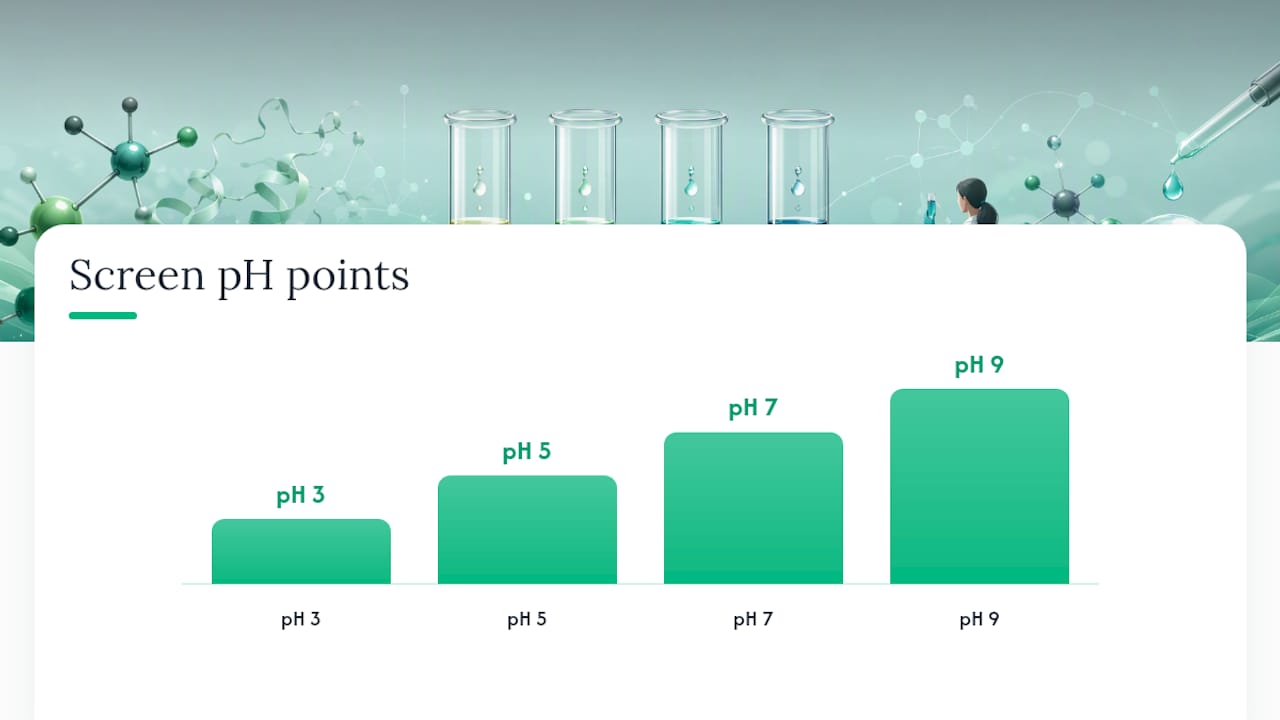
- Set your pH points. Four to five conditions spanning your suspected optimum, typically pH 3, 5, 7, and 9, using low-strength buffers appropriate to each pH.
- Pick an accelerating temperature. 37°C is standard for a quick screen; 40°C or 50°C can compress the timeline further if you need answers faster, understanding that very high temperatures can sometimes shift which pathway dominates.
- Sample on a fixed schedule. Day 0, 1, 3, 7, and 14 gives enough resolution to see both fast pathways (deamidation at high pH) and slower ones (hydrolysis at pH extremes) within a two-week window.
- Run stability-indicating methods on every sample. RP-UPLC for main peak area, LC-MS for degradant mass identification, and where isoAsp/isomer resolution matters, an orthogonal method capable of separating those species, since standard reversed-phase conditions don’t always resolve them.
| Analytical method | What it tells you | When to use it |
|---|---|---|
| RP-UPLC | Main peak area, purity trend over time | Every timepoint, primary go/no-go metric |
| LC-MS | Exact mass shifts identifying deamidation (+1 Da), oxidation (+16 Da), fragments | Flagged timepoints showing purity loss |
| Orthogonal isomer separation | Distinguishes isoAsp from Asp, resolves closely related charge variants | When deamidation is suspected but RP-UPLC peaks co-elute |
Forced-degradation data from this screen also tells you where to invest formulation effort: if oxidation dominates at every pH tested, no buffer adjustment alone will fix it, and you need an antioxidant strategy instead. Standard forced-degradation approaches using RP-UPLC paired with LC-MS identification remain the accepted way to map this landscape efficiently.
Formulation Choices That Extend Solution Stability
When an experiment demands the peptide stay in solution longer than a same-day window, formulation additives become the next lever after pH and buffer selection.
Lyoprotectants like trehalose and mannitol stabilize the peptide during the freeze-drying process itself and in the resulting dry cake, forming a glassy matrix that restricts the molecular motion responsible for solid-state degradation. Trehalose is generally favored over sucrose for research applications because it’s less prone to hydrolysis into reducing sugars that can drive Maillard-type side reactions with free amines on the peptide.
Surfactants, particularly polysorbates (Tween 20 or Tween 80) at low concentration, protect against aggregation driven by interfacial stress, the kind that happens at the air-liquid interface during shaking, pipetting, or shipping vibration. A small amount goes a long way; excess surfactant can introduce its own analytical interference and, in some formulations, its own oxidative degradation products.
Other formulation levers worth having in your toolkit:
- Antioxidants (methionine, acerbate) act as sacrificial reducing agents for Met/Trp-containing peptides, though their effectiveness and appropriate concentration shift with pH, so test rather than assume.
- Chelators (EDTA) suppress metal-catalyzed oxidation across a fairly broad pH range, useful whenever forced-degradation data implicates trace metal contamination.
- Container closure matters more than most labs check. Certain plastics and rubber stoppers adsorb peptide at low concentrations or leach extractables that shift solution pH over extended storage, particularly relevant for dilute, low-abundance peptide stocks.
The right combination isn’t something you can predict from first principles alone. Iterate based on what your forced-degradation screen actually shows: if the dominant pathway is oxidation, prioritize antioxidants and chelators; if it’s aggregation near the pI, prioritize surfactants and pH adjustment away from that point; if it’s deamidation, your primary lever remains pH itself, not an excipient.
How Third-Party Testing Supports Your pH and Storage Decisions
A Certificate of Analysis is more than a purity number. When a lot is verified at over 98% purity through HPLC and mass spectrometry, that documentation gives you a real starting point for your own stability planning, not just a compliance checkbox. Knowing your starting material’s exact purity and confirmed identity means any drift you observe in your own pH screen reflects genuine degradation, not pre-existing impurity you mistook for a new problem.
Research peptides in lyophilized form often come with third-party Certificates of Analysis accompanying every lot, which matters directly for the kind of pH mapping described throughout this article. Starting an accelerated screen with a known-purity, well-characterized lyophilized stock removes one major variable before preparing your first buffer. If your baseline material carries unknown impurities, your day-zero HPLC trace won’t represent your peptide accurately, and every subsequent degradation measurement inherits that error.
Practical storage and reconstitution guidance, including SOP-style recommendations on lyophilized versus solution storage, aliquoting, and freeze-thaw minimization, gives researchers a documented starting point for building their own lab protocols rather than reinventing them from scratch. Pairing a verified Certificate of Analysis with your own bench-level pH screen is how you build a defensible, lab-specific SOP instead of relying on generic assumptions about how “peptides” behave as a category.
What Bench Scientists Get Wrong About pH and How to Fix It
The most common mistake in peptide handling isn’t a lack of knowledge, it’s improvisation. A researcher grabs whatever buffer is already open on the bench, usually phosphate-buffered saline because it’s everywhere, without checking whether that buffer’s freeze-thaw behavior or catalytic tendencies suit the specific peptide in hand. Phosphate is a fine buffer for a great many applications. It is a poor default for frozen peptide stock, and treating it as a universal choice is where a lot of unexplained purity loss originates.
The second mistake is skipping the isoelectric point check entirely. Researchers reconstitute at whatever pH the protocol handout suggests, without confirming that pH sits safely away from the peptide’s own pI, then wonder why the vial turned cloudy. A thirty-second lookup or calculation prevents an afternoon of troubleshooting.
The third is treating refrigeration as a complete solution. A peptide sitting at 4°C in the wrong pH buffer is still degrading, just more slowly. Cold temperature slows chemical kinetics; it does not substitute for choosing the right pH and buffer species in the first place.
The fourth is casual aliquoting, or skipping it altogether. One stock vial, repeatedly thawed over a two-week experiment, accumulates pH excursions and degradation with every cycle, and the researcher has no way to know which timepoint’s data reflects intact peptide versus a compromised sample.
A short checklist covers most of it: confirm the pI before choosing a reconstitution pH, default to acetate or histidine over phosphate for frozen stock, aliquot into single-use volumes on day one, and run a quick RP-UPLC check on any sample that’s had an uncertain storage history before trusting its results.
— Stephan
Get Verified, Stable Peptide Stock for Your pH Studies
Every pH stability protocol in this article assumes you’re starting from a known, well-characterized peptide, and many reliable suppliers provide lots shipped lyophilized with third-party Certificates of Analysis confirming purity and identity, giving you a clean baseline before your first buffer screen even starts.

Instead of guessing whether an unexplained shift in your HPLC trace reflects real degradation or pre-existing impurity, you start with documented purity data and build your own pH mapping on top of it. That combination, verified starting material plus your own accelerated screen, is how a lab builds an SOP it can actually defend. Browse the Healing & Recovery category or check current lot documentation across the full catalog to find the peptide your next stability study needs, with COAs available for every product before you place an order.
Sources
The technical claims throughout this article draw on peer-reviewed literature and regulatory frameworks specific to peptide chemistry. These sources are worth consulting directly if you’re building a formal stability protocol:
- Primary literature on deamidation rates (PMC12801052)
- Peptide stability and pH practical notes (PepSpace)
FAQ
What is the typical pH range for peptide stability?
Most peptides show maximum chemical stability between pH 4.0 and 5.5, a range that slows deamidation without triggering acid-catalyzed hydrolysis. This is a starting point rather than a universal rule, since sequences with unusual liabilities can shift the true optimum higher or lower.
How long can peptides be left unrefrigerated?
Reconstituted peptide left at room temperature should generally be treated as suitable for same-day use only, not overnight storage. Sequences with deamidation-prone motifs like Asn-Gly can show half-lives as short as 1 to 2 days at physiological pH and 37°C, so unrefrigerated exposure of even a few hours can measurably reduce purity.
How long can BPC-157 stay in the fridge once reconstituted?
Specific shelf-life claims for individual peptides depend on the exact buffer, pH, and concentration used, so there’s no single universal number that applies across formulations. As a general lab practice, reconstituted peptides stored at refrigerator temperature in an appropriate low-pH buffer (such as 10 mM acetate around pH 4.5 to 5.0) hold up better than the same peptide in phosphate-buffered saline at neutral pH, but confirming stability empirically with an RP-UPLC check is the only reliable way to know for a specific batch.
What destroys peptides fastest?
Deamidation at neutral to basic pH is typically the fastest-acting degradation pathway, particularly for sequences containing Asn-Gly or Asn-Ser motifs. Freeze-thaw cycling in the wrong buffer compounds this risk, since phosphate buffers can shift pH by 0.4 to 0.8 units during freezing, pushing the sample transiently into a faster-degrading pH zone with every cycle.
Does Neolabpeptides provide documentation to support pH stability testing?
Yes. Every peptide ships lyophilized with a third-party Certificate of Analysis confirming purity and identity, giving researchers a verified baseline before running their own pH and buffer screens. Current product listings and documentation are available across the shop.
Recommended
This article summarizes published research for informational purposes. Products sold by Neo Lab Peptides are for laboratory research use only and are not intended for human or animal use.