Lab Choice: Lyophilized vs Liquid Peptides for 18–36 Month Stability
September 14, 2026 · STEPHAN ZOHAR

For most research labs, lyophilized peptides are the preferred format for long-term storage and inter-lab reproducibility, while liquid peptides serve immediate-use or short-turnover workflows. Freeze-drying removes water and halts hydrolytic degradation, giving lyophilized stock a stability advantage that liquid formulations trade away for convenience. Either format demands a verified Certificate of Analysis and correct storage temperature before it earns a place in your freezer.
TL;DR:
- Lyophilized peptides can remain stable for 18 to 36 months at 2 to 8°C and even longer when frozen at -20°C, whereas liquid peptides typically last only 30 days at 4°C but up to three years at -20°C.
- Moisture content is critical; residual water above 3% in lyophilized peptides accelerates degradation, emphasizing the importance of verified Certificates of Analysis and proper storage conditions.
- Liquid peptides are convenient for immediate use but are more sensitive to temperature fluctuations, pH, and excipient quality, leading to faster degradation and limited shelf life.
- Cold chain integrity is essential for liquid stock, while powders tolerate brief temperature excursions better, making lyophilization more resilient during shipping.
- For quantitative or reference standards where reproducibility is crucial, lyophilized peptides offer more consistent long-term stability compared to liquid formulations.
Table of Contents
- What Are Lyophilized Peptides and Why Does Freeze-Drying Preserve Stability?
- What Are Liquid Peptide Formats and What Do You Trade for Convenience?
- Lyophilized vs Liquid Peptides: Stability, Shipping, and Cost Compared
- How Do You Store, Aliquot, and Reconstitute Peptides Correctly?
- When Does a Liquid Peptide Format Actually Make Sense?
- How Neolabpeptides Applies These Storage Standards
- Choosing a Format for Reproducible Peptide Quantification
- Order Research-Grade Lyophilized Peptides With Verified COAs
- Sources
- FAQ
What Are Lyophilized Peptides and Why Does Freeze-Drying Preserve Stability?
Lyophilized peptides are freeze-dried into a powder or cake, typically sealed in a glass vial under inert gas or vacuum. The process, called lyophilization, sublimates water directly from a frozen sample without passing through a liquid phase. Removing that water arrests the two main degradation pathways for peptides, hydrolysis and oxidation, which is why lyophilized peptides generally outperform liquid formats in stability testing.
Residual moisture is the variable that decides whether that advantage holds. Karl Fischer titration measures water content directly, and moisture above roughly 3% correlates with accelerated breakdown even in a freeze-dried product. Before trusting any lyophilized vial, check for:
- A Certificate of Analysis confirming identity and purity via HPLC and mass spectrometry
- Documented residual moisture by Karl Fischer titration
- An intact vial seal with inert headspace, not just a crimped cap
- Consistent lot-to-lot data rather than a one-time purity claim
Our own lyophilized peptide guide walks through what a compliant COA should include.
What Are Liquid Peptide Formats and What Do You Trade for Convenience?
Liquid or pre-mixed peptides arrive already dissolved, usually in bacteriostatic water, saline, or a buffered solution with a preservative to slow microbial growth. Some formulations add antioxidants or chelators to blunt oxidation, and pH is often adjusted toward the 5 to 6 range, which extends solution life compared to neutral or alkaline mixes.
The appeal is obvious: no reconstitution, no weighing, no solvent selection. That convenience comes at a cost.
- Faster degradation than a sealed lyophilized vial under identical temperatures
- Dependence on an unbroken cold chain from manufacturer to bench
- Sensitivity to excipient choice, where the wrong pH or a missing antioxidant shortens shelf life measurably
- Limited working window, often weeks rather than years, even when refrigerated
Liquid stock is not inferior by design. It is simply built for speed, not longevity.
Lyophilized vs Liquid Peptides: Stability, Shipping, and Cost Compared
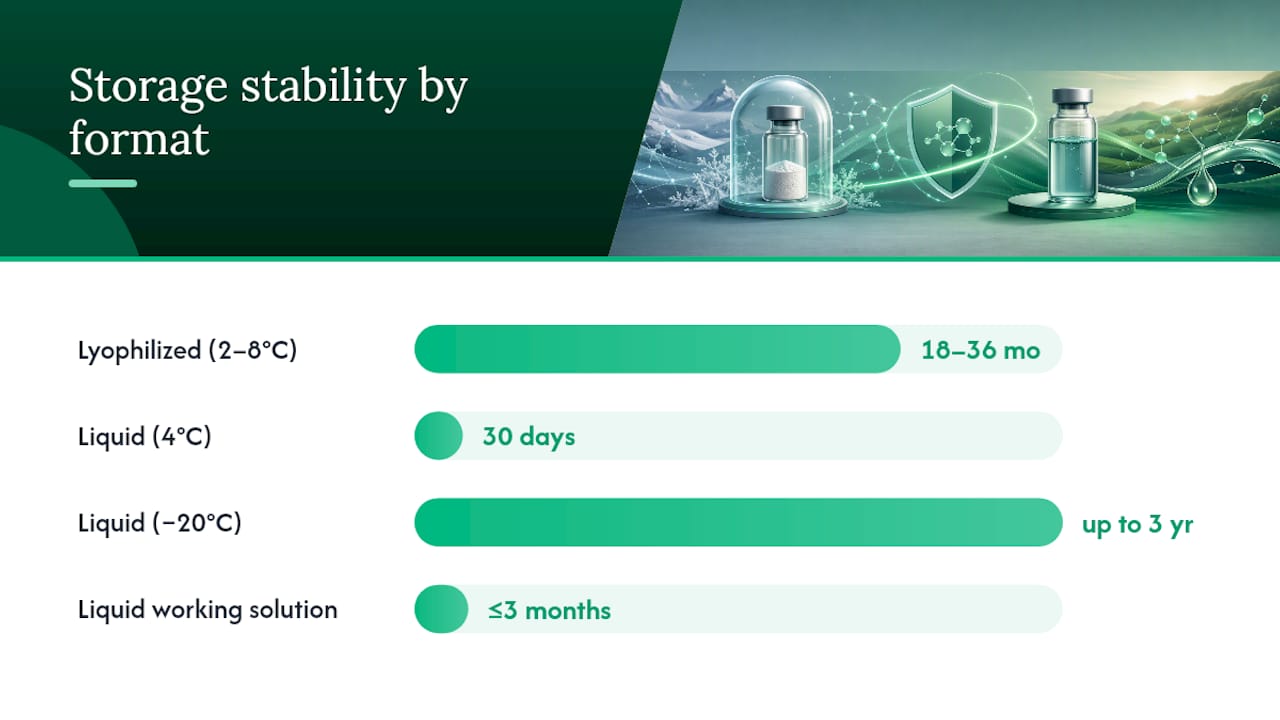
Stability is where the two formats diverge most sharply. Lyophilized peptides held at 2 to 8°C under validated conditions commonly retain potency for 18 to 36 months, and frozen at -20°C the window extends further. Liquid stock, by contrast, is typically rated for 30 days at 4°C and up to three years at -20°C when properly formulated and handled, with working solutions in the 1 to 100 pmol/µL range meant for use within three months. That gap matters most for calibrators and reference standards, where reproducibility across labs depends on the material behaving identically months apart.
Three factors decide which format holds up better in your specific workflow:
- Shipping resilience. Powders tolerate brief temperature excursions far better than solutions. A liquid peptide left at ambient temperature during a customs delay degrades measurably faster than a lyophilized vial exposed to the same lapse, which is why cold-chain packaging matters more for liquid shipments.
- Sterility requirements. A sealed lyophilized vial under inert headspace stays sterile until reconstitution. Preserved liquids rely on the preservative holding up over time, a weaker guarantee for injectable-grade or assay-sensitive work.
- Procurement economics. Lyophilization adds a manufacturing step, which nudges unit cost upward, but the extended shelf life reduces waste and reorder frequency. Liquid stock looks cheaper per vial until spoilage and reorder cycles are factored in.
Container choice compounds all three. Peptides can adsorb to vial surfaces at low concentrations, so high-quality glass or polypropylene matters for both formats, but the effect is more pronounced in dilute liquid stock where there is less peptide mass to offset the loss.
How Do You Store, Aliquot, and Reconstitute Peptides Correctly?
Getting storage and reconstitution right is mostly about discipline, not equipment. Follow this sequence for lyophilized stock arriving at your bench:
- Store immediately at -20°C or -80°C in a static, manual-defrost freezer. Skip frost-free units entirely.
- Keep the vial in a desiccator once opened, and let it equilibrate to room temperature before breaking the seal to prevent moisture condensing on the powder.
- Aliquot on first reconstitution. Divide the dissolved peptide into single-use volumes rather than drawing repeatedly from one vial.
- Choose your solvent by sequence. Start with sterile water, then move to dilute acid or base, and reserve DMSO or DMF for sequences with hydrophobic or aggregation-prone residues. Test a small aliquot before committing the full lot.
- Sonicate briefly if solubility lags, then sterile-filter through a low-protein-binding membrane before use in cell-based or injectable-grade work.
- Freeze aliquots you won’t use within days, and avoid refreezing anything that has already thawed.
Sequence chemistry drives most solubility headaches. Peptides rich in tryptophan, methionine, or cysteine oxidize or aggregate faster once in solution, while asparagine and glutamine residues are prone to deamidation over time, especially at higher pH or warmer storage. Our solubility troubleshooting guide breaks down solvent hierarchy by residue type if you’re working with a difficult sequence.
Pro Tip: Label every aliquot with reconstitution date and solvent, not just peptide name. A frozen aliquot with no history is a variable you can’t control in a reproducibility study.
When Does a Liquid Peptide Format Actually Make Sense?
Liquid stock is not a compromise choice everywhere. Some workflows genuinely favor it.
- Topical or cosmetic-adjacent research, where reconstitution adds a step with no analytical benefit
- Short-term compounding or clinical-adjacent workflows with a validated cold chain and a short, documented beyond-use date
- High-turnover experiments where frozen single-use aliquots get consumed within days, minimizing the window for degradation
The common thread is control. A liquid format is legitimate when the cold chain is documented and the use window is short, not just when it happens to be more convenient to order.
How Neolabpeptides Applies These Storage Standards
That is the same standard the stability literature points to when it recommends checking moisture content before trusting a freeze-dried product.
Beyond the COA itself, we maintain resources built around the exact protocols this article covers:
- A reconstitution calculator for getting solvent volumes and concentrations right on the first attempt
- Detailed guidance on aliquoting strategy to minimize freeze-thaw exposure
- A breakdown of our third-party testing process so researchers can see exactly what HPLC and MS verification confirms
- Storage condition references matched to -20°C and -80°C guidance
None of this replaces good lab technique. It gives you a documented starting point instead of a guess.
Choosing a Format for Reproducible Peptide Quantification
If you’re setting up calibrators or reference standards for quantitative work, lyophilized material is the safer default. Inter-lab comparability depends on a compound behaving the same way six months from now as it does today, and a sealed, moisture-controlled vial gets you closer to that than any solution can.
That doesn’t mean rejecting liquid stock outright. Before accepting a liquid peptide into a calibration workflow, I’d want three things on paper: a COA specific to that lot, documented stability data covering your actual storage window, and a cold-chain record from manufacturer to your freezer. Absent any one of those, treat the liquid format as a convenience item for screening work, not as your quantitative backbone.
— Stephan
Order Research-Grade Lyophilized Peptides With Verified COAs

Our catalog covers commonly requested research compounds including IPAMORELIN, CJC-1295, TB-500, BPC-157, and GLP-1 analogs, alongside bacteriostatic water and peptide blends for labs building out a full research program. We ship across the US, and our lab protocol guides cover reconstitution and aliquoting so your team isn’t guessing at solvent ratios on day one. Visit Neolabpeptides to review current lot COAs and place an order for your next research cycle.
Sources
- Peptide storage and handling guidelines | GenScript
- Peptide storage guidance | NIBSC
- Lyophilized vs Non-Lyophilized Peptides: Which Is More Stable? | FormBlends
FAQ
Can You Inject Lyophilized Peptides Directly?
No. Lyophilized peptides must be reconstituted with an appropriate sterile solvent before any liquid handling, and all Neolabpeptides products are labeled for research use only, not for human or veterinary administration.
Do Liquid Peptides Actually Work as Well as Lyophilized Ones?
Liquid peptides remain effective within their shorter stability window, generally 30 days at 4°C or up to three years at -20°C when properly formulated, but they degrade faster than sealed lyophilized vials once that window closes.
What Shouldn’t You Mix With Reconstituted Peptides?
Avoid solvents or pH levels outside a peptide’s validated range, since the wrong choice can trigger aggregation or accelerated degradation. Follow a solvent hierarchy from water to dilute acid or base to organic solvents based on the specific sequence.
Do You Need to Refrigerate Lyophilized Peptides?
Yes, most lyophilized peptides require storage at -20°C or -80°C for long-term stability, with a static manual-defrost freezer preferred over a frost-free unit to avoid temperature-cycling damage.
Recommended
This article summarizes published research for informational purposes. Products sold by Neo Lab Peptides are for laboratory research use only and are not intended for human or animal use.