
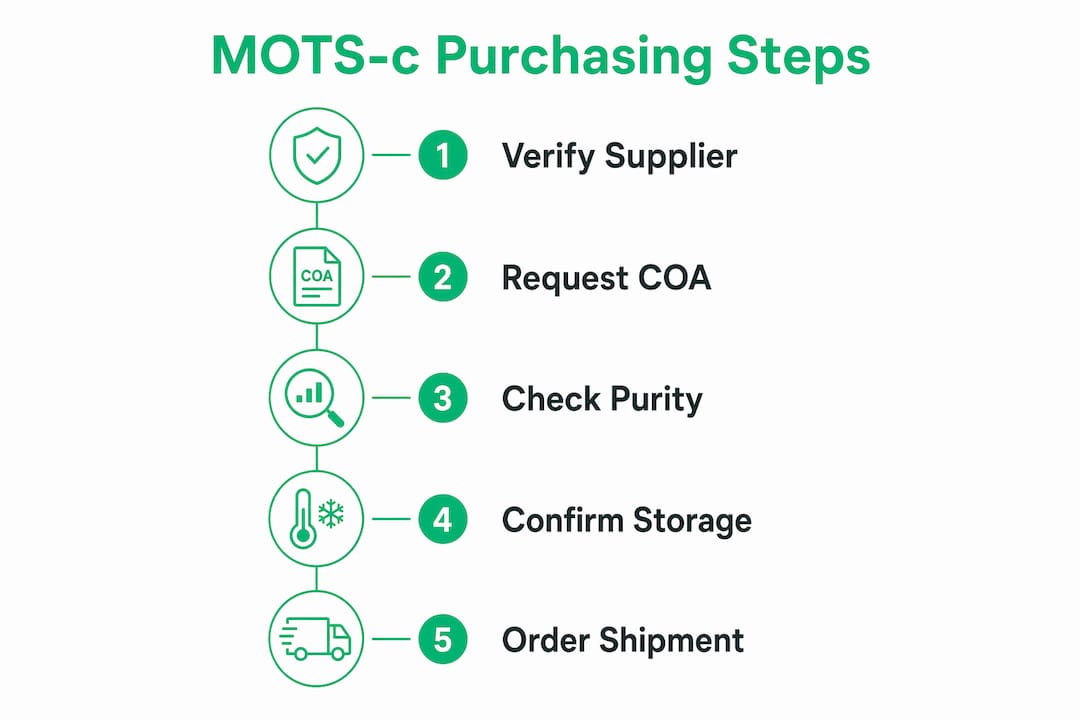
Research-grade MOTS-c is available as a lyophilized vial in standard research quantity with a batch Certificate of Analysis (COA) verified by HPLC and mass spectrometry. Neolabpeptides lists MOTS-c 10 mg in its catalog with COA access included, US-based shipping, and a clear Research Use Only designation. Before placing an order, confirm three things:
- Purity: high purity confirmed by HPLC area% and mass spectrometry
- Lot traceability: a batch/lot number that links to the specific COA for that vial
- Labeling: explicit “Research Use Only — Not for Human or Veterinary Use” language on the product and documentation
Pro Tip: Request the COA before shipment, not after. Labs that receive the COA at the time of procurement approval avoid delays that can set back a preclinical timeline by days.
Table of Contents
- What is MOTS-c and how is it used in research?
- Product specifications you need before purchasing
- How to evaluate a COA and third-party testing
- Handling, reconstitution, and storage protocols
- Ordering, pricing, and US shipping
- Regulatory and institutional compliance
- How to verify a supplier before you buy
- Key Takeaways
- Why COA-backed purchasing protects your research
- Order MOTS-c from Neolabpeptides with COA included
- Useful sources and resources
What is MOTS-c and how is it used in research?
MOTS-c (Mitochondrial Open Reading Frame of the 12S rRNA type-c) is a 16-amino-acid mitochondria-derived peptide encoded within the mitochondrial genome. Its discovery in 2015 established it as a signaling molecule with roles in metabolic regulation, making it a subject of active preclinical investigation. For labs, the peptide is supplied as a lyophilized powder in sealed vials, with 10 mg being the standard research quantity.
Common laboratory applications include:
- Mitochondrial signaling studies: examining how MOTS-c modulates AMPK pathways and nuclear gene expression in cell-based assays
- Metabolic research: in vitro glucose uptake and insulin sensitivity assays in skeletal muscle cell lines
- Preclinical rodent models: systemic administration studies investigating metabolic phenotypes
- Aging and longevity research: PMC studies have positioned MOTS-c as a candidate in age-related metabolic decline models
Researchers sourcing MOTS-c for the first time should consult a US supplier guide to understand purity expectations before committing to a vendor.
Product specifications you need before purchasing
Knowing the exact technical parameters prevents mismatches between what you order and what your assay requires.

| Specification | Detail |
|---|---|
| Peptide sequence | Mrgyalkrewlhqlelisgrk (16 residues; verify against your assay’s reference) |
| Molecular weight | typical for MOTS-c peptide |
| Formulation | Lyophilized powder, stoppered and sealed vial |
| Standard vial size | 10 mg |
| Purity expectation | high purity by HPLC |
| Analytical verification | HPLC (area%) and mass spectrometry (m/z) |
| Recommended storage | –20°C short-term; –80°C for long-term archival |
| Reconstitution solvent | Bacteriostatic water; dilute acetic acid if solubility requires |
Key points to verify with your supplier before purchase:
- Confirm the exact sequence matches your reference (PubChem CID 146675088 is a useful cross-reference)
- Confirm the vial is sealed under inert atmosphere to minimize oxidation during transit
- Ask whether the 10 mg figure is net peptide content or gross weight including counterion salt
How to evaluate a COA and third-party testing
A COA is only as useful as the data it contains. Suppliers who provide batch-specific documentation, rather than a generic template, give you the evidence needed to defend your experimental data.

| COA Element | What to Check |
|---|---|
| Lot/batch number | Must match the vial label exactly |
| HPLC purity (area%) | ≥98% with a clean baseline trace |
| Mass spectrum (m/z) | Matches expected molecular ion for MOTS-c |
| Production and expiration dates | Confirms shelf life remaining at time of receipt |
| Solubility note | Confirms reconstitution solvent compatibility |
| Testing laboratory | Named third-party lab, not in-house only |
When cross-checking a COA, verify both the HPLC area% and the mass-spec m/z for the expected molecular ion. A mismatch in either can indicate synthesis impurities or degradation products that would compromise assay results. Neolabpeptides publishes guidance on reading a peptide COA to help researchers interpret these fields accurately.
Third-party testing adds a layer of independence that in-house QC cannot replicate. Independent HPLC and MS verification confirms the supplier’s own data and is the standard expected by institutional biosafety and procurement offices. When in doubt, request the raw chromatogram and the mass spectrum file, not just the summary table.
Pro Tip: A low-area% shoulder peak on the HPLC trace near the main peak is a common sign of a closely eluting impurity. If the supplier cannot explain it with a mass-spec fragment assignment, treat it as a red flag.
Additional COA checks:
- Baseline drift in the HPLC trace may indicate column contamination or a degraded sample
- Confirm the MS method used (ESI vs. MALDI) matches the expected ionization behavior for a 16-amino-acid peptide
- Ask for the lot-specific COA, not a representative COA from a different batch
Handling, reconstitution, and storage protocols
Lyophilized MOTS-c is stable when stored correctly, but improper reconstitution is the most common source of activity loss in the lab.
Reconstitution steps:
- Allow the sealed vial to equilibrate to room temperature before opening to prevent moisture condensation on the powder
- Calculate your target concentration (e.g., 1 mg/mL = 1,000 µg/mL) and add the corresponding volume of solvent slowly along the vial wall
- Use bacteriostatic water (USP grade) as the primary reconstitution solvent; if solubility is poor, a dilute acetic acid solution (0.1–1%) is a standard alternative
- Gently swirl or roll the vial; avoid vortexing at high speed, which can shear peptide structure
- Allow 5–10 minutes for complete dissolution before drawing the solution
Storage and aliquoting:
- Lyophilized vials: –20°C is acceptable for months; –80°C limits degradation for multi-year archival
- Reconstituted stocks: aliquot into single-use volumes immediately to avoid repeated freeze-thaw cycles, which degrade activity progressively
- Label each aliquot with the lot number, concentration, date, and solvent used
Pro Tip: Prepare a small test aliquot at your working concentration before committing the full vial. This confirms solubility and lets you verify activity in a pilot assay without risking the entire stock.
All handling must occur in a sterile laboratory environment. MOTS-c supplied by Neolabpeptides is for research use only and must not be administered to humans or animals outside of formally approved research protocols.
Ordering, pricing, and US shipping
Pricing for research-grade MOTS-c varies with purity tier, COA documentation, and order quantity. The Peptide Price Tool from Neolabpeptides outlines the key cost drivers for US researchers.
Practical ordering details:
- Standard vial: a lyophilized vial in standard research quantity is the most common research quantity; bulk quantities may be available on request
- Pricing factors: purity level (≥98% with third-party COA commands a premium over unverified material), vial size, and order volume
- Payment options: credit card, institutional purchase order (PO), and standard invoicing in USD
- US shipping: Neolabpeptides ships domestically with fast lead times; same-day or next-day dispatch is typically available for in-stock items
- International orders: available, but confirm import permits and customs requirements for your destination country before ordering
- Returns and refunds: confirm the vendor’s policy before purchase; reputable suppliers will address COA discrepancies or damaged shipments directly through customer service
For institutional procurement, ask the vendor to confirm PO acceptance and whether they can provide W-9 documentation or vendor registration forms required by your institution’s accounts payable process.
Regulatory and institutional compliance
MOTS-c sold for research purposes carries a Research Use Only (RUO) designation. This is not a formality.
- RUO labeling: the product label and all documentation must state “For Research Use Only — Not for Human or Veterinary Use.” This language is a regulatory requirement under US FDA guidelines for research chemicals and is not interchangeable with clinical-grade labeling.
- Institutional approvals: before ordering, confirm whether your institution requires IBC (Institutional Biosafety Committee) review, IACUC approval for animal studies, or biosafety officer sign-off for peptide procurement
- Import permits: international shipments may require import permits or customs declarations; verify with your institution’s research compliance office before placing an order
- Intended use documentation: some institutional procurement systems require a brief statement of intended research use at the time of purchase
This article provides general research-procurement information, not legal or regulatory advice. Confirm current requirements with your institution’s compliance office or the relevant US regulatory authority for your specific situation.
How to verify a supplier before you buy
A supplier checklist prevents costly mistakes. Use these criteria before committing to any vendor for MOTS-c or any research-grade peptide.
- Batch-specific COA: every vial should have its own COA tied to a unique lot number, not a generic document
- Third-party HPLC and MS testing: independent verification, not in-house testing alone; see the GMP quality criteria Neolabpeptides follows
- Traceable lot numbers: lot number on the vial must match the COA exactly
- Clear RUO labeling: no consumer-facing language; no implied clinical or therapeutic use
- Documented storage and handling instructions: supplied with the product or accessible on the product page
- Responsive technical support: can answer questions about sequence, purity method, and reconstitution
- Institutional invoicing and PO acceptance: required for most academic and government lab procurement
Neolabpeptides meets these criteria: high purity verified by HPLC and mass spectrometry, batch COAs included, lot-traceable vials, US-based shipping, and documented GMP manufacturing practices.
Red flags to avoid: missing or undated COAs, purity claims with no named analytical method, no lot number on the vial, and product pages that use consumer wellness language rather than RUO terminology.
Pro Tip: Search the supplier’s site for the phrase “Research Use Only.” If it does not appear prominently on the product page and in the COA, the vendor may not be operating within standard RUO norms for US research procurement.
Key Takeaways
Purchasing research-grade MOTS-c requires a lyophilized vial in standard research quantity with a batch COA showing high purity by HPLC and mass spectrometry, sourced from a US-based supplier with traceable lot numbers and RUO labeling.
| Point | Details |
|---|---|
| Purity and COA standard | Buy a lyophilized vial in standard research quantity with a batch COA confirming ≥98% purity by HPLC and MS. |
| Lot traceability | Verify the lot number on the vial matches the COA before use in any assay. |
| Reconstitution protocol | Use bacteriostatic water; aliquot immediately and store at –80°C for long-term stability. |
| Compliance check | Confirm RUO labeling, institutional approvals, and import permits before ordering. |
| Recommended supplier | Neolabpeptides supplies MOTS-c 10 mg vials with batch COAs, third-party HPLC/MS testing, and US shipping. |
Why COA-backed purchasing protects your research
The reproducibility problem in preclinical peptide research is often traced back to sourcing, not methodology. A lab that receives a vial with no lot-specific COA has no way to confirm whether a failed assay reflects biology or a purity issue in the material itself. COA-backed purchasing is not bureaucratic overhead; it is the first line of experimental control.
US-based shipping and accessible technical support also matter more than researchers typically account for. A delayed shipment on a time-sensitive preclinical project can push a study endpoint by weeks. Suppliers who ship domestically and respond to technical questions quickly reduce that risk in a way that offshore vendors simply cannot match on lead time alone.
Neolabpeptides supplies MOTS-c 10 mg vials with batch COAs and documented third-party testing. For researchers who need to defend their sourcing decisions to an IRB, IACUC, or institutional procurement office, that documentation is the difference between a smooth approval and a procurement hold.
Order MOTS-c from Neolabpeptides with COA included
Neolabpeptides gives US researchers a direct path to verified MOTS-c: a a lyophilized vial in standard research quantity with a batch-specific COA, ≥98% purity confirmed by HPLC and mass spectrometry, and domestic shipping that keeps your project on schedule. Purchase orders are accepted for institutional buyers, and COA documentation is available before or at shipment to support your procurement approval process.

For reconstitution, add bacteriostatic water (USP grade, 10 mL) to your order. It is stocked alongside MOTS-c and ships together, so your lab is ready to begin the moment the vial arrives. Visit Neolabpeptides to place your order, access the current COA, and confirm shipping options for your institution.
Useful sources and resources
- MOTS-c 10 mg product page — Neolabpeptides: product listing, COA access, and ordering details
- How to read a peptide COA — Neolabpeptides: step-by-step field interpretation for lab buyers
- Peptide third-party testing guide — Neolabpeptides: independent HPLC/MS workflows and when to request raw data
- GMP quality criteria for peptides — Neolabpeptides: the ten criteria labs should verify before purchasing
- Peptide testing kit guide — Neolabpeptides: onsite verification planning and sample prep for HPLC/MS
- PubChem: MOTS-c compound record: sequence, molecular weight, and identifier cross-reference
- Original MOTS-c discovery paper (Lee et al., 2015): foundational reference for mitochondrial peptide biology
- PMC review: MOTS-c in metabolic research: broader research context for preclinical applications
Recommended
This article summarizes published research for informational purposes. Products sold by Neo Lab Peptides are for laboratory research use only and are not intended for human or animal use.