Researchers: Demand PRM and Raw Spectra in Mass Spec Peptide COAs
September 21, 2026 · STEPHAN ZOHAR

Mass spectrometry can confirm a peptide’s intact mass and, when MS/MS data is supplied, provide strong sequence evidence for identity. It cannot single-handedly prove sterility, potency, or absolute purity. A trustworthy Certificate of Analysis pairs mass data with a chromatogram, a method summary, and a lot number. Before accepting results, ask the lab which instrument generated them and whether raw spectra are available for review.
TL;DR:
- Intact mass analysis confirms the molecular weight matches the expected peptide, but cannot detect isobaric residues, stereochemistry, or modifications without targeted fragmentation.
- MS/MS peptide mapping provides sequence confirmation but may be complicated by chimeric spectra from co-eluting species or undetected modifications, requiring tailored detection methods.
- PRM and SureQuant offer high sensitivity and quantitative confidence, with SureQuant identifying twice as many low-abundance targets at ultra-low concentrations compared to PRM.
- Sample preparation, especially chromatography and ion suppression factors, significantly influence detection accuracy, making retention time, peak shape, and CV critical to quality.
- Trustworthy COAs include intact mass, detailed HPLC chromatogram, MS/MS spectra, method specifics, and lot traceability; absolute quantification needs stable isotope standards.
Table of Contents
- What Mass Spectrometry Tested Peptides Actually Reveal
- PRM, SRM/MRM, SureQuant, and DIA: What the Acronyms Actually Mean for Your Results
- How Sample Prep and HPLC Coupling Change What You See
- How Do You Read a Peptide Certificate of Analysis?
- How Should You Choose a Peptide Testing Lab?
- What Neolabpeptides’ Verification Practices Look Like in Practice
- Weighing Cost, Speed, and Depth in Peptide QA Planning
- Why Neolabpeptides Fits Researchers Who Need Verified Peptides Fast
- Sources
- FAQ
What Mass Spectrometry Tested Peptides Actually Reveal
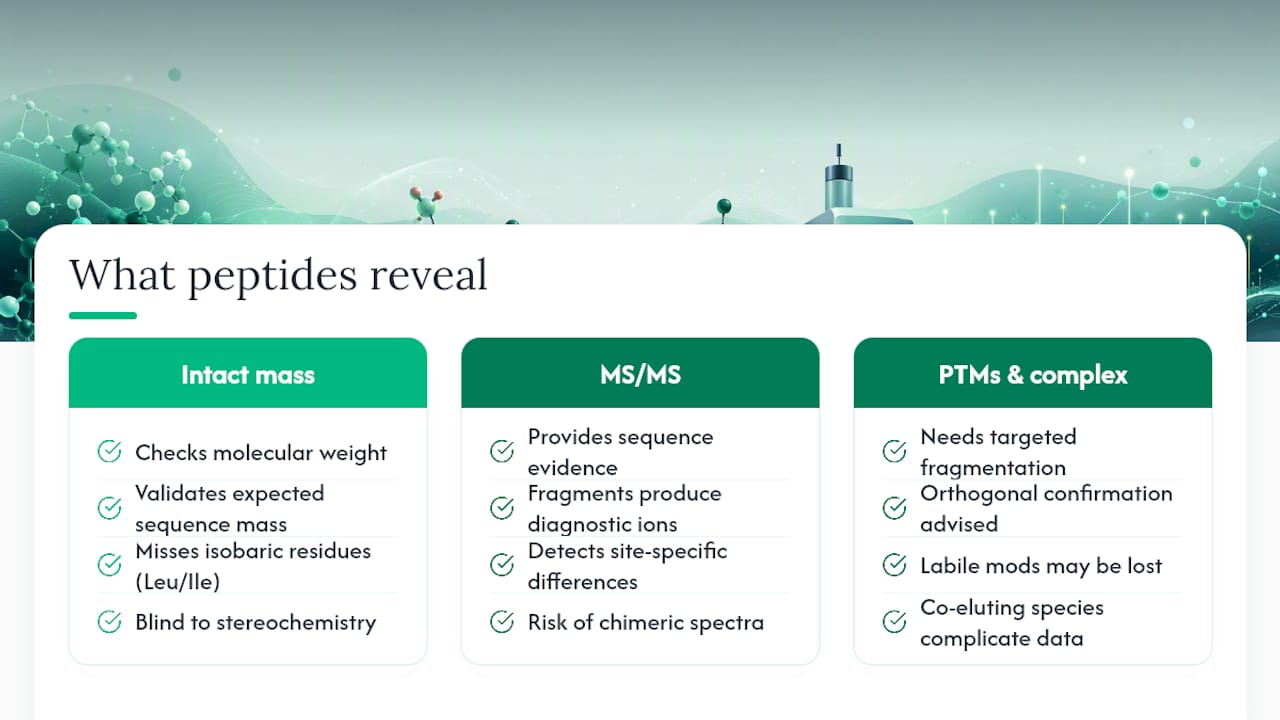
Intact mass analysis tells you the molecular weight matches the expected sequence, which is a solid first checkpoint for verify peptide purity claims. It has a blind spot: isobaric residues like leucine and isoleucine share identical mass, and certain stereochemical differences produce no mass shift at all. A peptide could carry a D-amino acid substitution and still return a perfect intact mass match.
That’s where MS/MS fragmentation, often called peptide mapping, earns its place. Breaking the peptide into fragment ions and matching those masses against a predicted sequence gives you actual sequence evidence rather than a single-number inference. Complex samples introduce their own hazards, though. Co-eluting species can generate chimeric spectra, where fragment ions from two different peptides overlap in a single scan and confuse the interpretation.
Post-translational modifications add another layer of difficulty. Detecting phosphorylation, glycosylation, or disulfide linkages usually requires targeted fragmentation strategies tuned to preserve labile bonds, or orthogonal chemistry to confirm a modification site independently. A standard intact mass scan will often miss a phosphate group that shifted during ionization, or misassign a glycan’s exact position. For any peptide where a modification matters scientifically, ask explicitly whether the reported method was built to detect it.
PRM, SRM/MRM, SureQuant, and DIA: What the Acronyms Actually Mean for Your Results
Service lab reports lean on a handful of acquisition modes, and each one trades sensitivity, specificity, and throughput differently.
SRM/MRM (selected or multiple reaction monitoring) runs on a triple quadrupole instrument. The first quadrupole selects a precursor ion, the second fragments it, and the third monitors a specific fragment. It’s fast and well established, but low resolution means matrix interferences can slip through undetected.
PRM (parallel reaction monitoring) runs on a quadrupole-Orbitrap platform instead. Rather than watching one fragment, PRM captures the full high-resolution fragment spectrum for every precursor, which sharply improves discrimination from background interference compared with traditional SRM. That’s why PRM shows up so often in confidence-critical targeted quantification work.
SureQuant builds on PRM with triggered acquisition: a heavy, stable isotope-labeled standard signals the instrument to switch into a high-resolution scan only when that target is actually present. Comparisons show SureQuant identifying roughly twice as many low-abundance targets as PRM at the lowest concentrations tested, with more than 95% of targets quantified at coefficients of variation under 10%.
DIA/SWATH and DDA sit on the discovery side. DIA fragments broad, systematic mass windows regardless of what’s present, generating comprehensive but computationally heavy data; DDA selects the most intense precursors on the fly, which is efficient for exploratory work but less reproducible run to run.
Choosing between them comes down to your question:
- Need to confirm and quantify a known handful of peptides with maximum confidence? PRM or SureQuant.
- Screening for unknown contaminants or degradation products? DIA or DDA.
- Running a large panel where per-target sensitivity matters more than speed? SureQuant’s triggered logic extends how many low-abundance targets fit into a single run.
How Sample Prep and HPLC Coupling Change What You See
Chromatographic separation isn’t a formality bolted onto mass spectrometry. It’s what keeps co-eluting impurities from contaminating the fragment spectra you’re trying to interpret. HPLC or UPLC separation resolves closely related species before they ever reach the source, which is often the difference between a clean MS/MS spectrum and a chimeric mess.
Sample prep decisions cascade from there. Desalting and concentration steps are close to universal; digestion is added only when peptide mapping requires breaking a larger sequence into analyzable fragments. Skip the wrong step and you either overload the column or under-detect the analyte.
Ion suppression is the quiet variable most researchers underestimate. Salts, detergents, and certain buffers compete with your peptide for ionization, suppressing the signal you actually want to measure.
- Confirm the digestion step (if any) matches what the identity claim requires.
- Ask what mobile-phase additives were used, since additive choice affects both resolution and ionization efficiency.
- Request the reported limit of detection and the assay’s CV, since a wide CV undermines a tight-looking mass match.
Pro Tip: Ask the lab for the retention time and peak shape from the HPLC trace, not just the final purity percentage. A shouldered or split peak often reveals a variant that a summary percentage would hide entirely.
How Do You Read a Peptide Certificate of Analysis?
Two peptides can post identical HPLC percentages while one carries a truncated sequence variant that barely absorbs in the UV wavelength being measured. HPLC purity figures can mislead exactly because ionization and UV response vary by sequence and modification, so a clean chromatogram alone doesn’t rule out issues invisible to UV detection, like residual salts or counterions.
A COA worth trusting includes:
- Intact mass result confirming the molecular weight against the expected sequence.
- HPLC chromatogram showing retention time and peak purity, not just a final percentage.
- MS or MS/MS data, ideally as an extracted spectrum rather than a one-line summary.
- Method summary naming the instrument and acquisition mode used.
- Lot number tying the document to the specific batch you received.
Even a complete COA has a scope. Sterility, endotoxin levels, and absolute potency require separate assays entirely. Absolute quantification, in particular, demands stable isotope-labeled internal standards run alongside the sample; without them, you’re looking at relative signal intensity, not a calibrated amount. If a research application depends on precise dosing rather than relative comparison, SIL-based calibration is the standard researchers should ask for by name.
How Should You Choose a Peptide Testing Lab?
Start with the instrument, not the price. A lab running an Orbitrap-based PRM workflow gives you a fundamentally different confidence level than one running a low-resolution quadrupole screen, even if both hand back a “purity confirmed” summary. MALDI-TOF is fast and useful for a quick intact mass check, but it typically won’t give you the fragmentation depth that peptide mapping requires.
Ask these questions before you commit a sample:
- Which instrument model generated the data, and is the acquisition mode PRM, SRM, or DIA?
- Are raw spectra or extracted MS/MS data available on request, not just a summary table?
- What are the reported limits of detection and quantification, and what CVs back up the quantitative claims?
- Were stable isotope-labeled standards used, or is the result relative rather than absolute?
- What’s the turnaround time, and does the lab retain a physical sample for follow-up testing?
Red flags are usually easy to spot once you’re looking. No MS/MS spectra behind an identity claim, no lot traceability, no method description beyond “tested by mass spec,” or a COA with no retention sample policy at all. Any one of those should slow you down.
Pro Tip: If your work will end up in a publication or regulatory submission, request SIL-calibrated absolute quantification up front. Relative reporting is fine for early screening, but reviewers increasingly expect calibrated numbers.
What Neolabpeptides’ Verification Practices Look Like in Practice
The company publishes third-party HPLC and mass spectrometry results with a Certificate of Analysis for each lot, and its research-grade peptides ship lyophilized under RUO (research use only) labeling. That’s a baseline any serious research supplier should meet, not a differentiator on its own.
Researchers who want to go further should still ask for the extras that separate a good vendor from an exceptional one: raw spectra rather than summary tables, explicit lot traceability, and a documented retention sample policy in case a result needs revisiting months later. Transparency about what was tested, and what wasn’t, is the real signal to look for.
Weighing Cost, Speed, and Depth in Peptide QA Planning
A minimal COA with intact mass and an HPLC trace is fine for early-stage screening, where you’re just confirming you have the right molecule. Once an experiment feeds a publication or regulatory filing, budget for full MS/MS mapping and SIL-calibrated quantification instead. Spend targeted-mode dollars on the peptides your conclusions actually hinge on, and save discovery-mode runs for the unknowns.
Why Neolabpeptides Fits Researchers Who Need Verified Peptides Fast
Ordering research peptides usually means choosing between waiting on an outside lab to verify a vendor’s material yourself or trusting a supplier that’s already done the work. The company sells peptides with third-party HPLC and mass spectrometry verification included with every lot, so the Certificate of Analysis typically ships with the product.

That verification covers the catalog across categories like Growth Hormone, GLP & Metabolic, and NAD+ & Cellular research compounds, all shipped lyophilized and labeled for research use only. If your protocol calls for extra documentation beyond the standard COA, such as raw spectra or lot-specific retention sample details, request it before ordering rather than after. Browse the full catalog to check current lots and place an order for your next research cycle.
— Stephan
FAQ
How Does Mass Spectrometry Analyze Peptides?
Mass spectrometry ionizes a peptide and measures the mass-to-charge ratio of the resulting ions, first confirming intact mass and then, if fragmented via MS/MS, revealing sequence-level detail. Coupling with HPLC separation beforehand keeps overlapping species from contaminating the spectrum.
How Do I Test if My Peptides Are Real?
Request a Certificate of Analysis that includes intact mass results, an HPLC chromatogram, and ideally MS/MS spectra rather than a summary percentage alone. Confirming the instrument and acquisition mode used, such as PRM or SRM, tells you how rigorous that identity claim actually is.
Is 98% Purity Good for Peptides?
HPLC percentages alone can be misleading, which is why pairing that number with mass spectrometry mapping gives a fuller picture. Neolabpeptides pairs HPLC results with third-party mass spectrometry verification on every lot for exactly this reason.
What Is the Most Accurate Lab Test for Peptides?
No single test covers every concern, but PRM on a quadrupole-Orbitrap instrument combined with HPLC separation is currently one of the more reliable combinations for confident targeted identification. For absolute quantification rather than relative comparison, adding stable isotope-labeled internal standards is the accepted reference approach.
Recommended
This article summarizes published research for informational purposes. Products sold by Neo Lab Peptides are for laboratory research use only and are not intended for human or animal use.