35 Day Seizure Window: U.S. Labs' Peptide Shipping Checklist
September 15, 2026 · STEPHAN ZOHAR

Research peptides can be shipped and received legally within the United States when they meet federal labeling and documentation standards, but state laws and carrier policies frequently add extra layers of restriction. Before any shipment moves, four things need to be locked down: a For Research Use Only label, a Certificate of Analysis (COA), an MSDS/SDS, and institutional verification. Skip any one of these, and you increase your odds of a hold, a fine, or a seized package.
TL;DR:
- Shipping peptides legally within the US requires proper labeling, a matching Certificate of Analysis, and institutional verification to avoid delays or seizures.
- Federal restrictions are supplemented by state laws that often impose additional requirements, making it necessary to verify each state’s regulations before shipping.
- FedEx and UPS offer better support for cold chain shipping, while USPS is suitable only for non-temperature-sensitive peptides, with fewer regulatory protections.
- International shipments face increased enforcement, with over 5,000 seizures in recent years due to incomplete documentation or mismanifesting, requiring thorough customs and FDA compliance.
- A supplier’s adherence to high purity standards and proper documentation, like Neolabpeptides, can reduce the risk of shipment holds and streamline regulatory compliance.
Table of Contents
- Peptide Shipping Regulations US: The Federal Baseline
- Why Do State Rules Complicate Peptide Delivery?
- What Labeling and Documentation Do Regulators Expect?
- Which Carrier Is Best for Peptide Deliveries?
- How Do Customs Rules Affect International Peptide Shipments?
- What Happens if a Peptide Shipment Gets Seized?
- A Pre-Shipment and Post-Shipment Checklist
- What Supplier Documentation Actually Reduces Risk?
- A Compliance-First View on Peptide Access
- A Vetted Supplier Option for Institutional Buyers
- Where These Rules Come From
- Sources
- FAQ
Peptide Shipping Regulations US: The Federal Baseline
The Food, Drug, and Cosmetic Act (FD&C Act) gives the FDA jurisdiction over any peptide that could be classified as a drug, and the agency doesn’t rely on labeling alone to make that call. FDA’s intended-use doctrine means marketing language on a website, in an email, or on social media can override an RUO disclaimer on the vial itself. If your promotional copy implies human use, the label stops mattering.
Import alerts complicate things further. Peptides on Import Alert 66-41 face automatic detention without physical examination, meaning CBP holds the shipment before anyone even looks at what’s inside. FDA sets the classification; U.S. Customs and Border Protection handles the physical enforcement, inspection, and release decisions at the port. That division of labor matters because a compliance problem with either agency can stall a shipment independently of the other. Enforcement has tightened noticeably. Recent industry reporting points to more frequent detentions of peptide shipments tied to certain foreign manufacturers, which means the margin for documentation errors has shrunk.
Why Do State Rules Complicate Peptide Delivery?
Federal law sets the floor, not the ceiling. States layer their own requirements on top, and the differences catch a lot of shippers off guard.
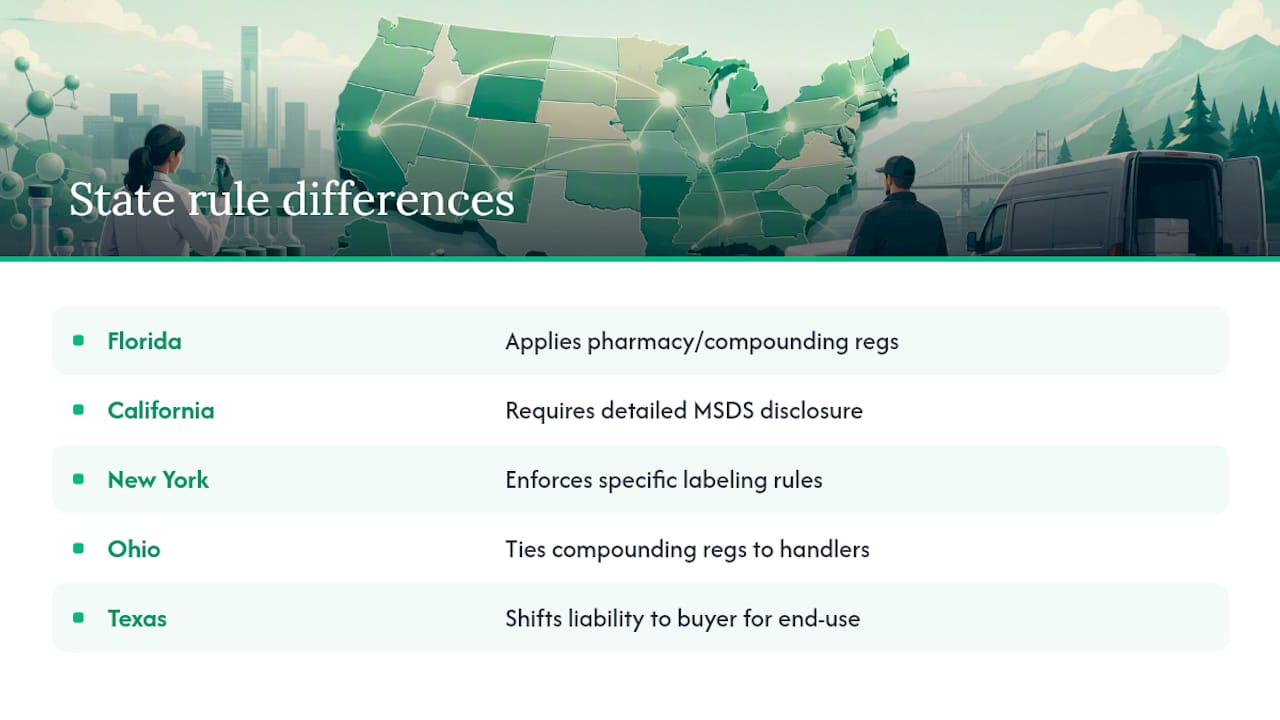
Florida frequently applies pharmacy and compounding registration expectations to entities handling bulk research chemicals, even when the buyer isn’t dispensing anything to patients. California often expects more detailed chemical disclosure on MSDS documentation than federal minimums require. New York has specific labeling conventions that inspectors check against, separate from FDA’s own requirements. Ohio ties certain compounding and registration obligations to research chemical handlers. Texas puts more liability on the buyer to confirm end use before a shipment is accepted.
Noncompliance at the state level doesn’t always trigger a federal case. More often it means a state agency seizes the product, fines the receiving institution, or a carrier simply refuses delivery once a shipment gets flagged. None of that requires FDA involvement.
Before you ship to a new state, check that state’s board of pharmacy or department of health website directly, and keep a record of what you found and when. That research becomes part of your compliance file if anyone ever asks why a shipment went where it did.
What Labeling and Documentation Do Regulators Expect?
Every peptide shipment needs a defined paper trail, and the paperwork has to match the product exactly, not just exist in a folder somewhere.
- The vial and outer packaging need a visible For Research Use Only. Not for human or veterinary use. statement.
- The Certificate of Analysis should show HPLC purity results, mass spectrometry identity confirmation, and a lot number that matches the physical product precisely.
- The MSDS/SDS needs to cover handling, storage, and hazard information consistent with OSHA’s hazard communication format.
- Institutional verification, such as an IRB affiliation or a lab’s institutional credentials, should be on file with the supplier before the order ships.
- Retain all of these records for several years; some institutional review boards require longer retention periods.
Pro Tip: Cross-check the lot number on the COA against the lot number physically printed on the vial before you ship or accept delivery. A mismatched lot number is one of the most common reasons customs agents flag a peptide shipment for secondary review.
Which Carrier Is Best for Peptide Deliveries?
FedEx and UPS both offer dedicated cold-chain services with tracked temperature logging, which puts them ahead of USPS for anything requiring dry ice or refrigeration. USPS handles ambient, non-temperature-sensitive lyophilized peptides reasonably well, but it offers far less regulatory support if a package gets questioned in transit.
- Dry ice shipments over 5.5 pounds require a Class 9 hazmat declaration under DOT and IATA rules, and both FedEx and UPS have separate paperwork for it.
- Residential delivery addresses draw more scrutiny from carriers handling research chemicals, particularly for repeat shipments to the same address.
- Routing to an institutional or laboratory address instead of a home address reduces the odds of a delivery refusal or a compliance inquiry from the carrier itself.
For any shipment moving under IATA or DOT hazardous materials classification, confirm the carrier’s current dry ice and Class 9 packaging requirements before you book the shipment, not after.
How Do Customs Rules Affect International Peptide Shipments?
Importing peptides into the U.S. means clearing both CBP and FDA review, and the paperwork needs to be airtight before the shipment ever leaves the origin country. A complete entry typically includes a commercial invoice, a COA, an MSDS, and, for certain drug-adjacent products, FDA Form 2877.
CBP has been notably aggressive on this front, seizing more than 5,000 peptide shipments in a recent enforcement push, and mis-manifesting is a leading cause. Inconsistent declared values, missing COAs, and shipment structuring designed to obscure origin are all independent grounds for a hold, separate from whatever the FDA thinks about the product itself.
Before importing, check the foreign manufacturer against FDA’s import alert database and confirm their registration status. Incomplete documentation or a flagged manufacturer typically adds seven to fourteen days of clearance delay, sometimes more.
What Happens if a Peptide Shipment Gets Seized?
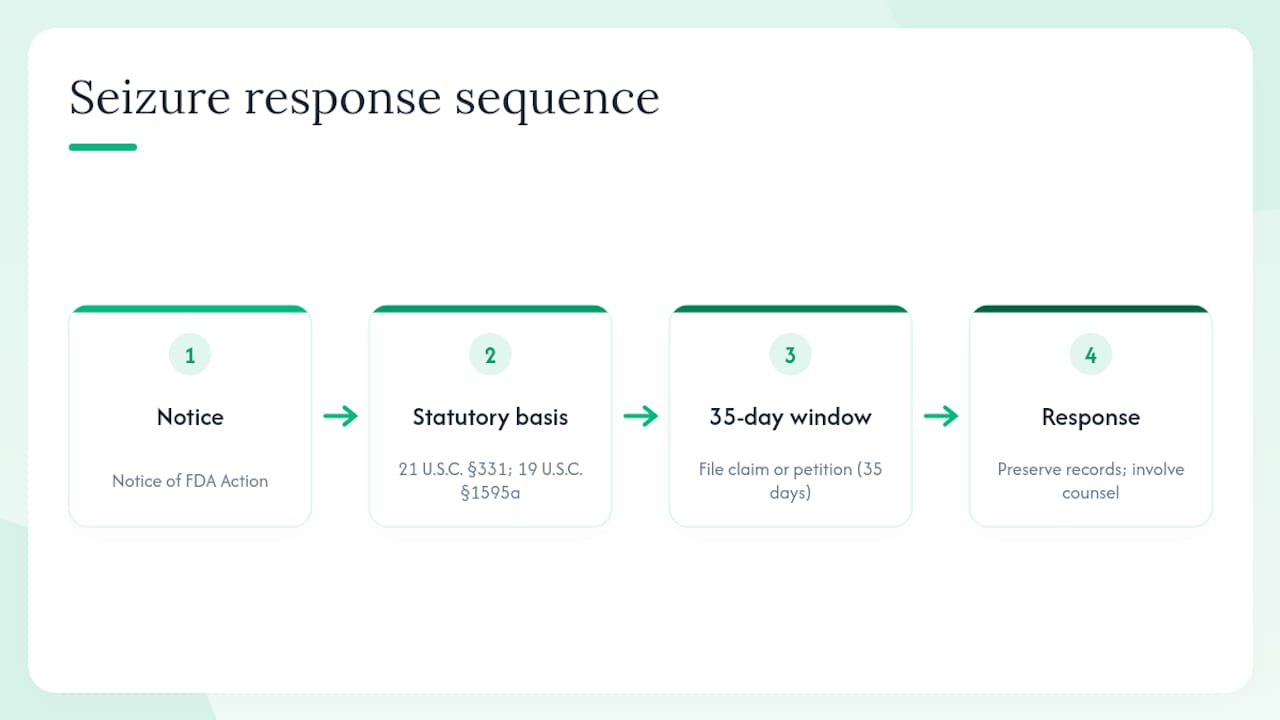
A Notice of FDA Action cites the statutory basis for the hold, usually 21 U.S.C. § 331 for prohibited acts involving unapproved drugs, sometimes paired with 19 U.S.C. § 1595a for customs enforcement authority.
Once a formal seizure notice arrives, CAFRA gives the recipient 35 days to file a claim or petition. Miss that window, and administrative forfeiture usually follows automatically. Personal-use shipments are rarely worth fighting given the value involved, but commercial or institutional shipments often justify the response, especially when the documentation was actually in order. Preserve every email, invoice, and lab record tied to the shipment immediately, and bring in legal counsel before the 35-day clock runs out if the shipment has real institutional value.
A Pre-Shipment and Post-Shipment Checklist
Run this sequence before every peptide shipment leaves or arrives at your facility:
- Confirm the destination state’s specific requirements, including any pharmacy or disclosure rules.
- Verify the receiving institution’s credentials and confirm the shipment ships to an institutional address.
- Match the COA lot number to the physical product lot number.
- Prepare and attach the MSDS/SDS with current hazard information.
- Select a temperature-controlled carrier service if the peptide requires cold chain handling.
- Declare dry ice weight and hazmat classification accurately on carrier paperwork.
- Retain all shipping records, COAs, and verification documents for at least three years.
- Monitor tracking for hold alerts and respond immediately if one appears.
Pro Tip: Build a shipment log that timestamps every document check, not just the final approval. If a shipment is ever questioned months later, a dated audit trail is worth more than your memory of what you meant to verify.
What Supplier Documentation Actually Reduces Risk?
A supplier’s own compliance posture directly affects how smoothly your shipments clear review. Neolabpeptides verifies purity above 98% through third-party HPLC and mass spectrometry testing, and every peptide ships with a matching Certificate of Analysis and cold chain packaging support.
That combination maps directly onto the checklist above: a supplier that already provides accurate COAs, proper cold chain shipping, and documentation aligned with institutional verification standards removes several of the most common failure points before your shipment ever reaches a carrier.
A Compliance-First View on Peptide Access
Institutional purchasing channels exist for a reason: they create a documented, auditable trail that protects both the buyer and the research. Individuals importing peptides for personal use carry disproportionate legal risk with none of that institutional backing, and CAFRA’s 35-day window offers little comfort when there’s no lab, no IRB, and no paper trail behind the shipment.
— Stephan
A Vetted Supplier Option for Institutional Buyers
Institutional procurement teams need a supplier that treats documentation as seriously as purity. Neolabpeptides supplies research-grade peptides, including IPAMORELIN, CJC-1295, TB500, and BPC-157, at verified purity above 98%, with a Certificate of Analysis and cold chain shipping support built into every order. It’s one vetted option among several available to U.S. labs, and it fits naturally into procurement workflows that already require documentation review before purchase. If your lab is evaluating suppliers for high-purity peptides, start by checking Neolabpeptides’s current catalog and confirming which peptides ship with the documentation your institution requires.
Where These Rules Come From
The regulatory claims in this guide rely on primary federal sources: FDA’s personal importation guidance and human drug import guidance, CBP’s biological materials guidance, FDA’s Import Alert 66-41, and the CAFRA statutory text governing seizure response timelines. Check these directly before making a compliance decision that carries real consequences.
This article is general information, not a substitute for advice from a qualified lawyer. Consult a qualified legal professional about your own circumstances before acting on anything here.
Sources
- 18 U.S.C. § 983 — Civil forfeiture procedures | LII / Legal Information Institute
- Import Basics: Personal Importation | FDA
- Importing Biological Materials into the United States | U.S. Customs and Border Protection
FAQ
Are Peptides Legal to Ship Within the United States?
Yes, domestic peptide shipments are legal when they carry proper RUO labeling, a matching COA, and MSDS documentation, though carrier and state rules can still restrict delivery to certain addresses.
Can I Send Research Peptides Through USPS?
USPS can carry non-temperature-sensitive lyophilized peptides, but it offers far less cold-chain infrastructure and regulatory support than FedEx or UPS if a shipment is questioned in transit.
What Changed With Peptide Shipping Regulations in 2026?
Enforcement has intensified rather than the underlying law changing, with more frequent detentions tied to manufacturers on FDA import alert lists and longer clearance delays for incomplete documentation.
Can I Buy Retatrutide for Research Use in the USA?
GLP-1 analogs and similar research peptides can be purchased for laboratory use from suppliers that provide COAs and institutional verification, but they are not approved for human or veterinary use under any circumstance.
What Happens if My Peptide Shipment Is Seized?
You receive a Notice of FDA Action citing the statutory basis for the hold, and CAFRA gives you 35 days to file a claim or petition before administrative forfeiture typically follows.
Recommended
This article summarizes published research for informational purposes. Products sold by Neo Lab Peptides are for laboratory research use only and are not intended for human or animal use.