Protect Your Study: BPC-157 Stability with COA and HPLC Verification
September 22, 2026 · STEPHAN ZOHAR

Lyophilized BPC-157 belongs at negative 20 degrees Celsius, dark and sealed, until you’re ready to work; once reconstituted, it belongs in the refrigerator at 2 to 8 degrees Celsius, used within the window your lot’s Certificate of Analysis specifies. Every decision after that point should trace back to supplier-validated data and HPLC verification, not to forum consensus. Bacteriostatic water typically supports a 28 to 30 day refrigerated in-use window; sterile water without preservative gives you roughly 24 to 48 hours before contamination risk outpaces convenience.
TL;DR:
- Lyophilized BPC-157 stored at negative 20 degrees Celsius remains stable over long periods, while reconstituted solutions degrade faster once exposed to moisture.
- Bacteriostatic water offers a 28 to 30 day refrigerated shelf life, whereas sterile water requires use within 24 to 48 hours due to contamination risks.
- Freezing reconstituted solutions is generally discouraged because ice crystal formation can damage the peptide’s structure, unless aliquots are made to avoid repeated freeze-thaw cycles.
- Proper handling includes logging storage conditions, equilibrating vials to room temperature before opening, and preventing multiple punctures to reduce contamination risk.
- Rely on supplier Certificates of Analysis and third-party testing results, not generic advice, as lot-specific stability data dictate accurate storage and usage timelines.
Table of Contents
- Quick Storage Reference and Bench Checklist
- Why Lyophilized BPC-157 Holds Up Better in the Freezer
- Reconstituted BPC-157: How Long It Actually Lasts
- Aseptic Technique and Aliquoting to Cut Sample Loss
- Analytical QC: Reading HPLC and Mass Spec Results Correctly
- What to Do After a Temperature Excursion
- Building an SOP Around Supplier COAs and Third-Party Testing
- The Gap Between Generic Advice and What the Data Supports
- Where to Source Documented BPC-157 for Your Protocol
- Sources
- FAQ
Quick Storage Reference and Bench Checklist
Before a vial ever reaches the bench, its storage fate should already be decided. Sealed lyophilized powder tolerates freezer storage for extended periods because there’s no water available to drive hydrolysis. Once reconstituted, that protection disappears, and the clock starts running the moment solvent touches peptide.
Use these defaults as your standing operating procedure unless a specific lot’s documentation says otherwise:
- Sealed lyophilized vials: negative 20 degrees Celsius, protected from light, in original packaging with desiccant intact.
- Reconstituted with bacteriostatic water: 2 to 8 degrees Celsius, used within roughly 28 to 30 days.
- Reconstituted with sterile water (no preservative): 2 to 8 degrees Celsius, used within 24 to 48 hours only.
- On receipt: check the lot-specific COA against the shipment, log arrival temperature, and quarantine anything missing documentation before it enters inventory.
Skipping that receiving step is how labs end up chasing inconsistent results three weeks into a study with no way to rule out a storage failure.
Why Lyophilized BPC-157 Holds Up Better in the Freezer
Dried peptide is chemically quiet. Without water present, the hydrolysis and deamidation pathways that break down peptide bonds have almost nothing to work with, which is why lyophilized preparations tolerate long freezer dwell times that would destroy a reconstituted solution in weeks. NIBSC’s peptide-handling guidance makes the same point directly: dry peptides stay stable far longer than solutions, and moisture is the primary accelerant of degradation once it’s reintroduced.
Suppliers typically validate lyophilized BPC-157 for negative 20 degrees Celsius long-term storage, with some product documentation permitting 2 to 8 degrees Celsius for shorter, defined windows. Residual moisture content, how well the vial’s rubber stopper seals, and whether the container blocks light all affect how long that stability holds. This is exactly why a generic internet rule is a poor substitute for the COA that ships with your specific lot.
Handling matters as much as the freezer setting itself:
- Log the vial’s temperature history at receipt and note any deviation from the expected range.
- Let the vial equilibrate to room temperature before opening it. Opening a cold, sealed vial invites condensation directly onto the powder.
- Treat each vial as a single-thaw item. Repeated freeze-thaw cycling on the sealed powder isn’t necessary and adds unneeded risk once moisture has any chance to intrude.
Reconstituted BPC-157: How Long It Actually Lasts
The solvent you choose changes the stability math entirely. Bacteriostatic water contains 0.9% benzyl alcohol as a preservative, which suppresses microbial growth and is why suppliers commonly validate a 28 to 30 day refrigerated in-use window for BAC-reconstituted BPC-157. Sterile water carries no such preservative, so once you break the seal, you’re working against a 24 to 48 hour clock before contamination risk becomes the limiting factor rather than chemical degradation.
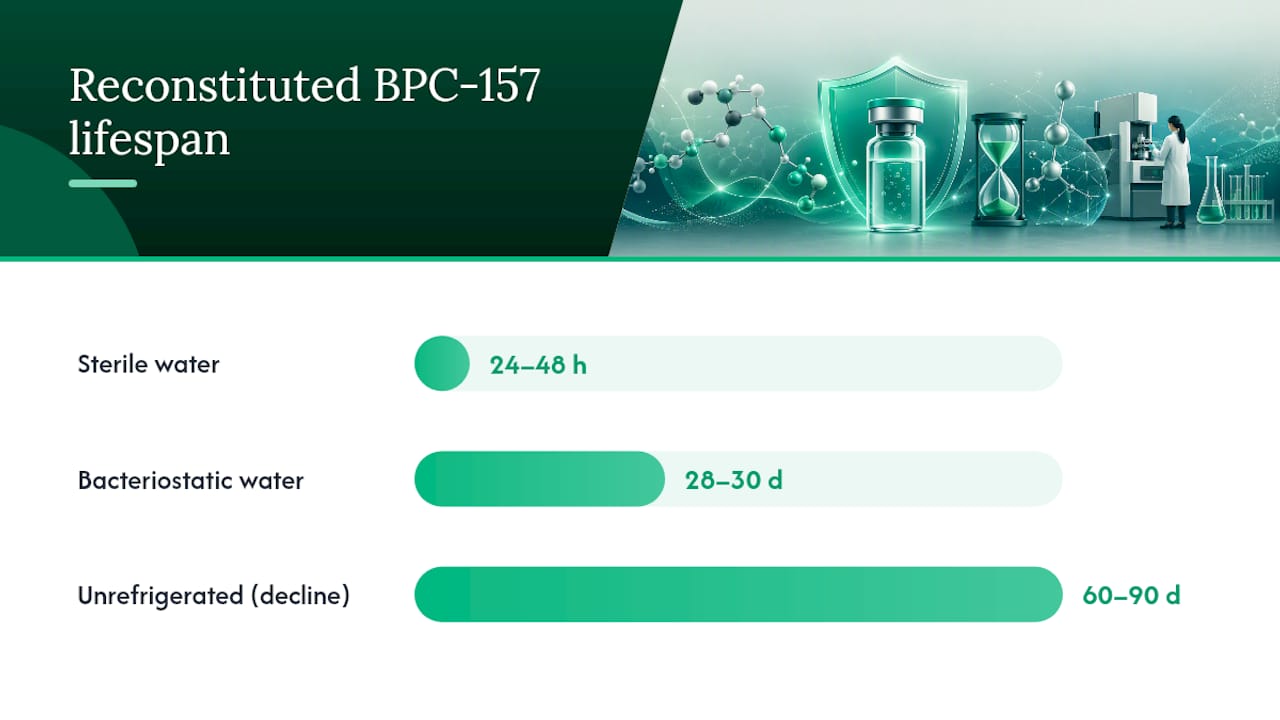
Independent lab stability comparisons tracking BPC-157 across full three-month periods found that refrigeration slows early degradation meaningfully, even though the differences in the first month are modest and appear to be compound and formulation specific. That’s the evidence base behind treating a 28 to 30 day window as a defensible default rather than an arbitrary number pulled from a forum thread. Purity loss compounds past that point, and by 60 to 90 days unrefrigerated or improperly stored samples show measurable decline that undermines dose-response reproducibility in any downstream research.
Freezing a reconstituted solution is usually discouraged. Ice crystal formation can physically disrupt the peptide structure and increase aggregation, which shows up as apparent potency loss even when a chemical assay says the compound itself is intact. If a study genuinely requires long-term storage past the refrigerated window, aliquoting into single-use volumes before any freezing, rather than freezing and repeatedly thawing one working vial, is the only version of that approach worth considering.
- Bacteriostatic water: expect roughly 28 to 30 days refrigerated, per typical supplier validation.
- Sterile water: expect 24 to 48 hours only.
- Frozen aliquots: reserve for cases where the in-use window is not workable, and never refreeze a thawed aliquot.
Pro Tip: Date and initial every reconstituted vial the moment you mix it. A vial without a visible reconstitution date is functionally unusable data, no matter how good the peptide was on day one.
Aseptic Technique and Aliquoting to Cut Sample Loss
Reconstitution errors and clumsy aliquoting cost you more usable peptide than temperature ever will. A tight aseptic protocol protects both sterility and the actual mass of peptide available for your assay.
- Swab the vial septum with alcohol before every needle insertion, and limit total punctures per vial by planning your withdrawal volumes ahead of time.
- Reconstitute by directing the solvent stream gently against the vial wall rather than directly onto the powder, then swirl instead of shaking.
- Size aliquots to match a single experiment or dosing session so you’re not repeatedly re-entering the same vial over its in-use window.
- Store working aliquots in low-protein-binding polypropylene tubes or borosilicate glass; standard polystyrene can adsorb peptide to its surface and quietly reduce your effective concentration.
- Log every access event, including date, volume withdrawn, and technician initials, on the vial label or an accompanying log sheet.
Pro Tip: Vortexing feels efficient, but it introduces shear stress and air interfaces that promote aggregation. A gentle swirl or a brief low-speed vortex pulse gets you the same homogeneity without the risk.
Analytical QC: Reading HPLC and Mass Spec Results Correctly
Stability-indicating HPLC and mass spectrometry are the right tools when a lot’s behavior deviates from its COA, when a storage excursion has occurred, or when you’re extending an in-use window beyond supplier guidance. Peer-reviewed methodology for tracking peptide degradation confirms that HPLC purity trends and mass spec identity checks remain the standard for distinguishing genuine chemical breakdown from other causes of apparent potency loss.
A purity drop on HPLC points to actual chemical degradation, hydrolysis or oxidation breaking down the peptide itself. A content drop with stable purity, on the other hand, often signals physical loss through adsorption to vial or tubing surfaces rather than chemical instability. Confusing the two leads labs to blame the peptide for what’s actually a container problem.
Your SOP should require, at minimum:
- Lot number and COA reference for every sample tested.
- Storage history: temperature range, duration, and any excursions.
- Reconstitution date, solvent type, and volume.
- HPLC purity percentage and any observed shift from the COA baseline.
A broader analytical framework for peptide stability testing reinforces that documentation without a traceable storage history is close to useless for troubleshooting an unexpected result.
What to Do After a Temperature Excursion
A vial left at room temperature overnight or a freezer that drifted above range doesn’t automatically mean discard, but it does mean you stop and document before you use it.
- Record the excursion precisely: duration, peak temperature reached, and whether the vial was sealed lyophilized powder or an opened, reconstituted solution.
- Quarantine the vial immediately, separate from active inventory, until a decision is made.
- Cross-check the event against your supplier’s validated storage instructions and the lot’s COA to see whether the exposure falls inside or outside documented tolerances.
- If it falls outside tolerance, run an HPLC purity check before returning the vial to use, or discard it if visual signs like cloudiness or precipitate are present.
- For high-value or ambiguous lots, request a written assessment from the supplier rather than guessing. A supplier with real third-party testing infrastructure can usually speak to lot-specific risk.
Discard immediately if you see cloudiness, discoloration, or precipitate. Reconstituted solutions left unrefrigerated for more than a few hours after any prior use should also be discarded rather than tested, since contamination risk at that point outweighs the value of the sample.
Building an SOP Around Supplier COAs and Third-Party Testing
A defensible storage SOP starts with the paperwork, not the freezer settings. Every acceptance criterion should reference the lot’s Certificate of Analysis and the third-party HPLC and mass spectrometry data behind it, not a generic figure copied from another lab’s protocol. Neolabpeptides publishes lot-specific COAs alongside its BPC-157, which is the kind of documentation an SOP can actually cite.
Write one clause into every SOP: if a supplier’s written storage instructions diverge from your internal default, the supplier’s lot-specific guidance governs, and that deviation gets logged. That single rule prevents the most common failure mode, treating every lot as identical when purity, moisture content, and packaging can vary batch to batch.
The Gap Between Generic Advice and What the Data Supports
Most of what circulates about BPC-157 storage treats every vial as identical: freeze the powder, refrigerate the mix, done in three sentences. That advice isn’t wrong, exactly, but it’s incomplete in a way that matters for research reproducibility. Purity at day zero varies lot to lot, moisture content varies, and the degradation curve past 30 days is genuinely compound-specific rather than fixed.
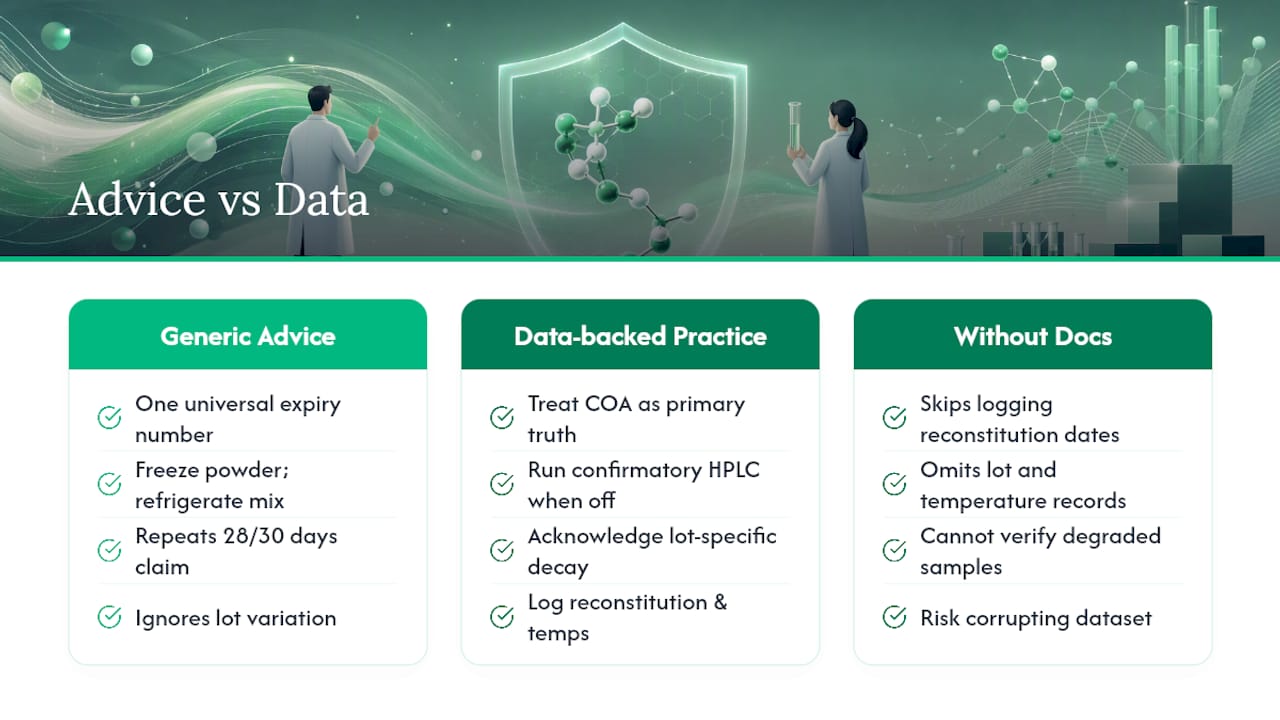
The overrated piece of conventional wisdom is the idea that a single universal number, whether it’s 28 days or 30 days or three months, applies uniformly across every supplier and every batch. It doesn’t. What actually protects a study’s validity is treating the COA as the primary source of truth and running confirmatory HPLC when a result looks off, rather than defaulting to whatever number is most repeated online.
If there’s one priority to take from this, it’s documentation discipline. A lab that logs reconstitution dates, storage temperatures, and lot numbers with the same rigor it applies to its actual assay will catch a degraded sample before it corrupts a dataset. A lab that skips that step is trusting the peptide to behave exactly as advertised, every time, with no way to verify it when something goes wrong.
— Stephan
Where to Source Documented BPC-157 for Your Protocol
Every storage recommendation in this guide only holds if the peptide you started with was accurately characterized in the first place. Some suppliers provide lyophilized, research-grade BPC-157 with lot-specific Certificates of Analysis and third-party HPLC and mass spectrometry verification on batches, which gives you the documentation baseline this article’s SOP recommendations depend on.

That documentation is available on the BPC-157 10mg product page, where you can review lot data before ordering rather than after. Cold-chain shipping practices, detailed on the shipping and returns page, are built to protect the peptide’s stability profile from the moment it leaves the facility. If your lab needs guidance on a specific lot’s validated storage instructions, A technical support team at the supplier can assist with questions regarding validated storage instructions… Start by pulling the COA for your current lot and comparing it against the storage defaults outlined above.
Sources
For deeper technical grounding, consult PubChem’s BPC-157 compound record and FDA guidance on bulk drug substances for compounding and documentation standards.
FAQ
How long can BPC-157 stay unrefrigerated?
Lyophilized powder tolerates brief room-temperature exposure without significant harm, though freezer storage remains the supplier-validated default. Once reconstituted, a solution left unrefrigerated for more than a few hours should be treated as compromised and checked against its COA or discarded.
How long is a vial of BPC-157 good for?
Sealed lyophilized vials stored at negative 20 degrees Celsius can remain stable for extended periods, per supplier documentation. Once reconstituted with bacteriostatic water, most suppliers validate a 28 to 30 day refrigerated window, while sterile water reconstitutions are good for only 24 to 48 hours.
What is the lifespan of BPC-157?
Lifespan depends entirely on form and storage: dry powder in the freezer lasts far longer than any reconstituted solution, since dry peptides resist degradation far better than solutions do. Always confirm the exact window against the lot’s own Certificate of Analysis rather than assuming a universal timeline.
Do peptides really go bad after 30 days?
Reconstituted peptides do degrade progressively past the 30 day mark, with purity loss compounding between 60 and 90 days in unrefrigerated or improperly stored samples. The 28 to 30 day figure isn’t an arbitrary cutoff; it reflects where refrigerated, preservative-containing solutions typically start showing measurable decline, which is why Neolabpeptides and similar suppliers validate that window specifically for bacteriostatic water reconstitutions.
Recommended
This article summarizes published research for informational purposes. Products sold by Neo Lab Peptides are for laboratory research use only and are not intended for human or animal use.